



Summary
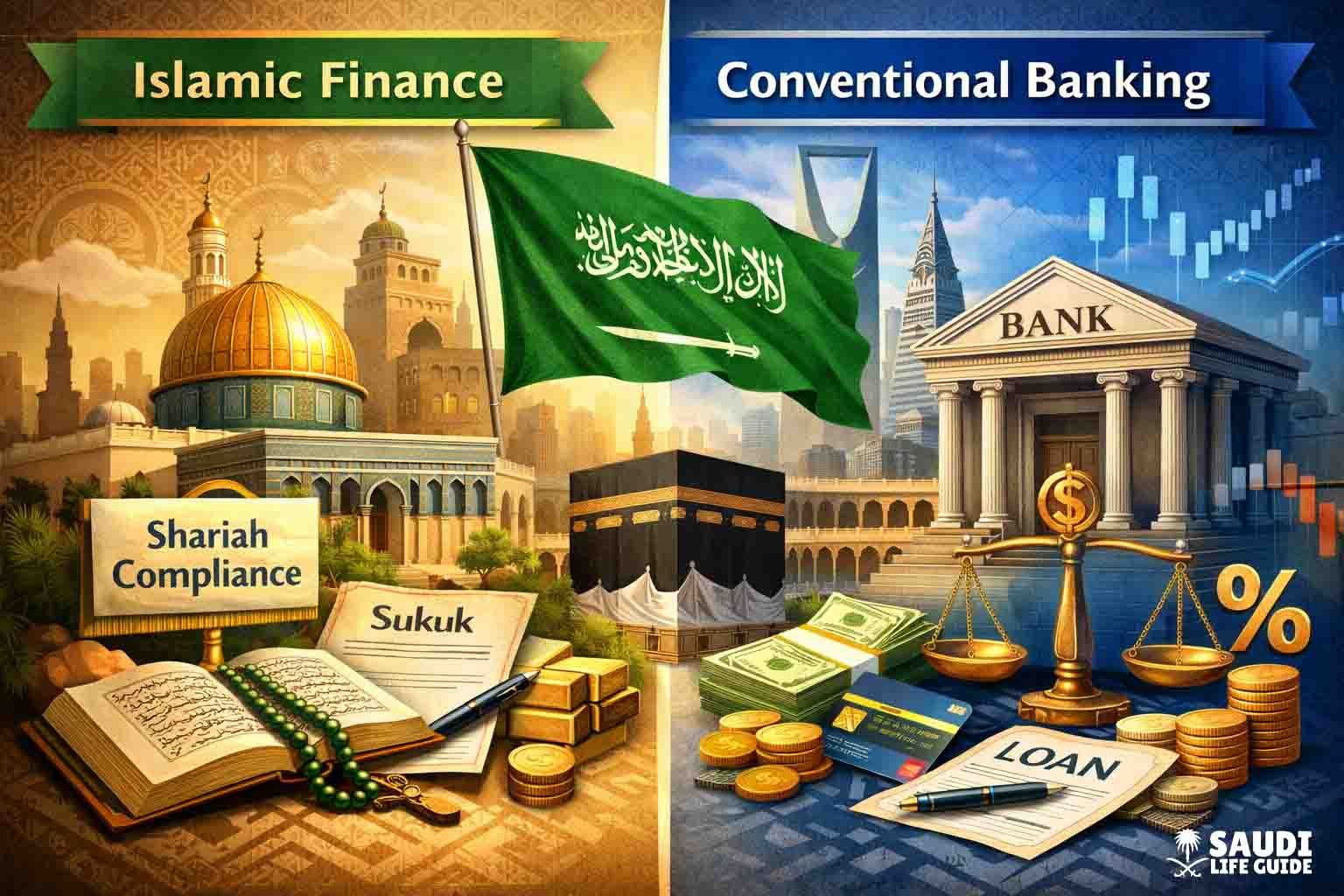
Saudi Arabia is one of the largest Islamic finance markets globally. Unlike conventional banking, Islamic finance bans interest and follows Sharia law. This guide explains how Islamic banking works in Saudi Arabia and what makes it different from traditional financial systems.
Saudi Arabia controls over 25% of global Islamic banking assets. The entire financial ecosystem in the Kingdom runs on principles rooted in Sharia law. Every bank, every loan product, and every investment fund must meet strict religious and ethical standards.
Yet many residents still have questions. Expats arriving in the Kingdom often wonder how Islamic banking actually works. Even some Saudi nationals find it hard to explain the exact differences between Islamic and conventional models.
This guide breaks it all down. You will learn what Islamic finance means, how it operates daily, which products Saudi banks offer, and how regulations keep everything in check. By the end, you will understand exactly how Islamic finance differs from conventional banking and why it matters for your financial life in Saudi Arabia.
What Is Islamic Finance?
Islamic finance is a financial system built on Sharia, which is Islamic law. Its rules come directly from the Quran and the Sunnah, which are the teachings and practices of Prophet Muhammad (peace be upon him).
The central idea is simple. Money should not create more money on its own. Every financial transaction must connect to a real asset, a genuine service, or a productive economic activity.
Islamic finance strictly prohibits four things:
- Riba (interest or usury): Charging or paying interest on loans is forbidden. A lender cannot earn a guaranteed return simply for lending money.
- Gharar (excessive uncertainty): Contracts must be clear. Both parties must understand every term and condition before agreeing.
- Maysir (gambling or speculation): Transactions based on pure chance or excessive speculation are not allowed.
- Haram industries: Funds cannot flow into businesses dealing with alcohol, pork, gambling, or other prohibited activities.
In this system, money is a medium of exchange. It is not a commodity that can be bought and sold for profit.
One important point often missed is that Islamic finance is not exclusive to Muslims. People of all backgrounds use Islamic banking products worldwide. The appeal lies in its emphasis on fairness, transparency, and real economic value.
Core Principles of Islamic Finance
Four foundational principles shape every Islamic financial transaction. Understanding them helps you see why Islamic banking works the way it does.
Prohibition of Riba (Interest)
This is the most well-known rule. Any guaranteed return on a loan is haram (forbidden). Banks cannot charge borrowers a fixed percentage on top of the principal amount.
So how do Islamic banks earn money? They use trade margins, leasing fees, and profit-sharing arrangements. The bank takes on real commercial activity rather than simply lending money at interest.
Profit and Loss Sharing
Both the bank and the customer share the risk. Neither party carries the entire burden alone.
Two main models drive this principle:
- Mudarabah: One party provides the capital. The other manages the project. Profits are split based on a pre-agreed ratio. Losses fall on the capital provider unless the manager was negligent.
- Musharakah: Both parties invest money and effort. Profits and losses are shared according to their contribution.
This structure creates fairness. The bank has a real stake in your success.
Asset-Backed Transactions
Every deal must link to a tangible, real asset. You cannot trade debt for debt. You cannot create financial products based on nothing but paper promises.
This rule prevents speculative bubbles. For example, when you get home financing from an Islamic bank, the actual property is at the center of the contract. The bank either buys it and sells it to you or leases it to you directly.
Ethical and Halal Investment
All investments go through a screening process. A Sharia Supervisory Board reviews every product to confirm it complies with Islamic law.
Stocks, mutual funds, and bonds must all pass strict criteria. Companies with excessive debt, haram revenue sources, or unethical practices get excluded from Islamic investment portfolios.
How Does Conventional Banking Work?
Conventional banking operates on a straightforward model. Banks collect deposits from customers and pay them a small interest rate. They then lend that money to borrowers at a higher interest rate. The difference between what they pay and what they earn is their profit.
In this system, money generates money. A loan does not need to be tied to a physical asset. The borrower takes on most of the risk. If the investment fails, the borrower still owes the full amount plus interest.
Interest rates change based on central bank policies. When rates rise, borrowing becomes more expensive. When they fall, borrowing becomes cheaper.
Conventional banks generally do not screen investments for religious or ethical compliance. Some modern banks offer ESG (Environmental, Social, and Governance) options, but these are voluntary.
This model dominates most Western financial systems. It is efficient and well-established, but it operates on fundamentally different assumptions than Islamic finance.
Islamic Finance vs Conventional Banking — Key Differences
The differences between these two systems go beyond interest. Here is a clear comparison:
| Feature | Islamic Finance | Conventional Banking |
|---|---|---|
| Interest | Prohibited (riba-free) | Core revenue model |
| Risk | Shared between bank and customer | Mostly on the borrower |
| Asset Backing | Required for all transactions | Not always required |
| Ethical Screening | Mandatory (Sharia board) | Optional (ESG in some cases) |
| Late Payment Penalties | Donated to charity, not bank profit | Charged as additional interest |
| Investment Restrictions | No haram industries | No religious restrictions |
| Profit Model | Trade margins, leasing, profit-sharing | Interest spread |
| Regulatory Oversight | SAMA + Sharia Supervisory Board | Central bank only |
A few points deserve extra attention.
In Saudi Arabia, even banks that appear to offer conventional-style products must comply with SAMA’s Sharia guidelines. The entire system leans Islamic by default.
Late payment penalties are a good example of how the two systems differ in practice. In conventional banking, late fees become additional interest income for the bank. In Islamic banking, those penalties go to charitable causes. The bank does not profit from your financial difficulty.
Islamic banks also take legal ownership of assets during financing. When you finance a car through murabaha, the bank buys the car first, then sells it to you at a markup. This changes the legal structure of the deal entirely compared to a conventional car loan.
Common Islamic Finance Products in Saudi Arabia
Saudi banks offer a full range of Sharia-compliant products. Here are the ones you will encounter most often.
Murabaha (Cost-Plus Financing)
Murabaha is the most widely used Islamic finance product in Saudi Arabia. The bank purchases an asset you want, adds a known profit margin, and sells it to you at a higher price. You pay in fixed installments over an agreed period.
The total cost is disclosed upfront. There are no hidden charges or fluctuating rates. You know exactly what you owe from day one.
Al Rajhi Bank, Saudi National Bank (SNB), and Bank Albilad all offer murabaha for car financing, personal financing, and consumer goods.
Ijara (Lease Financing)
In ijara, the bank buys the asset and leases it to you. You pay monthly rent for a fixed term. At the end of the lease, ownership may transfer to you.
This model is common in home financing and equipment leasing. The bank retains ownership during the lease period, which means maintenance responsibilities may differ from conventional loans.
Musharakah (Joint Venture)
Musharakah involves both the bank and the customer investing in a project together. Profits are shared based on pre-agreed ratios. Losses are divided according to each party’s capital contribution.
Saudi banks use musharakah mainly for business financing and real estate development. It is less common in personal banking but plays a significant role in corporate finance.
Sukuk (Islamic Bonds)
Sukuk are the Islamic alternative to conventional bonds. Instead of paying interest, sukuk give investors ownership in an underlying asset. Returns come from the asset’s performance, not from a fixed interest rate.
Saudi Arabia is one of the world’s largest sukuk issuers. The Capital Market Authority (CMA) regulates sukuk offerings in the Kingdom. Both government and corporate sukuk are available to investors.
Takaful (Islamic Insurance)
Takaful replaces conventional insurance with a cooperative model. Policyholders contribute to a shared pool. Claims are paid from this pool. Any surplus at the end of the year is distributed back to members.
In Saudi Arabia, takaful is the standard insurance model. It covers health, auto, property, and life insurance needs.
How Saudi Arabia Regulates Islamic Finance
Saudi Arabia has a strong regulatory framework for Islamic banking. The Saudi Central Bank, known as SAMA, oversees all banks operating in the Kingdom. This includes fully Islamic banks and banks with Islamic windows.
Every Islamic bank must maintain a Sharia Supervisory Board. This board consists of qualified Islamic scholars who review and approve all financial products. No product reaches customers without their clearance.
Saudi Arabia’s legal system is based on Sharia. This creates natural alignment between the country’s laws and its financial system. Courts handle banking disputes using Islamic legal principles.
Vision 2030 includes specific goals to strengthen the Islamic finance sector. The government wants to attract more global investment and position Saudi Arabia as the undisputed leader in Sharia-compliant finance.
The Islamic Development Bank (IsDB), headquartered in Jeddah, supports this mission. It promotes Islamic finance development across member countries and funds large-scale projects worldwide.
As of 2024, Saudi Islamic banking assets exceeded $450 billion. This makes the Kingdom the largest Islamic banking market in the GCC and one of the largest in the world.
Is Islamic Finance Better Than Conventional Banking?
This question does not have a one-size-fits-all answer.
Islamic finance offers clear consumer protections. Risk-sharing means the bank cannot simply walk away when things go wrong. Asset-backing ensures every transaction has real value behind it. Ethical screening keeps your money away from harmful industries.
However, some Islamic products may carry slightly higher total costs. The structural complexity of Sharia-compliant deals sometimes adds administrative overhead. In global markets, conventional banking offers wider product variety.
In Saudi Arabia, this comparison matters less than you might think. Most banks already operate on Islamic principles. You are unlikely to encounter a purely conventional product in the Kingdom.
The best choice depends on your personal values, financial goals, and the specific product you need. Both systems are regulated and safe in Saudi Arabia. What matters most is understanding the terms of any product before you sign.
Practical Tips for Using Islamic Banking in Saudi Arabia
Here are six tips to help you navigate Islamic banking in the Kingdom:
- Choose a fully Sharia-compliant bank. Al Rajhi Bank, Alinma Bank, and Bank Albilad operate as fully Islamic institutions. This guarantees every product meets Sharia standards.
- Ask for the Sharia certificate. Before signing any financing agreement, request proof that the product has been approved by the bank’s Sharia Supervisory Board.
- Compare total cost, not just monthly payments. Murabaha profit margins vary between banks. A lower monthly payment might mean a longer term and higher total cost.
- Understand ijara vs murabaha for home financing. These two products have different ownership structures, maintenance responsibilities, and cost implications. Ask your bank to explain both options.
- Use takaful for all insurance needs. It is the standard model in Saudi Arabia and offers cooperative benefits that conventional insurance does not.
- Visit SAMA’s website for consumer guidance. SAMA publishes consumer protection guidelines, complaint procedures, and comparison tools for banking products.
Conclusion
Islamic finance is more than a religious obligation in Saudi Arabia. It is a complete financial system built on fairness, transparency, and shared responsibility. Every transaction ties to a real asset. Every product passes through scholarly review. Every risk is shared between the bank and the customer.
Saudi Arabia leads the world in Islamic banking. Its regulatory framework, legal system, and institutional infrastructure all support Sharia-compliant finance at the highest level.
Whether you are a Saudi citizen, an expat, or a business owner, understanding these principles helps you make smarter financial decisions. Knowing how your bank earns money, how your loan is structured, and where your investments go gives you real control over your financial future.
Explore more guides on Saudi Life Guide to help you navigate every aspect of life in the Kingdom.
