



Summary
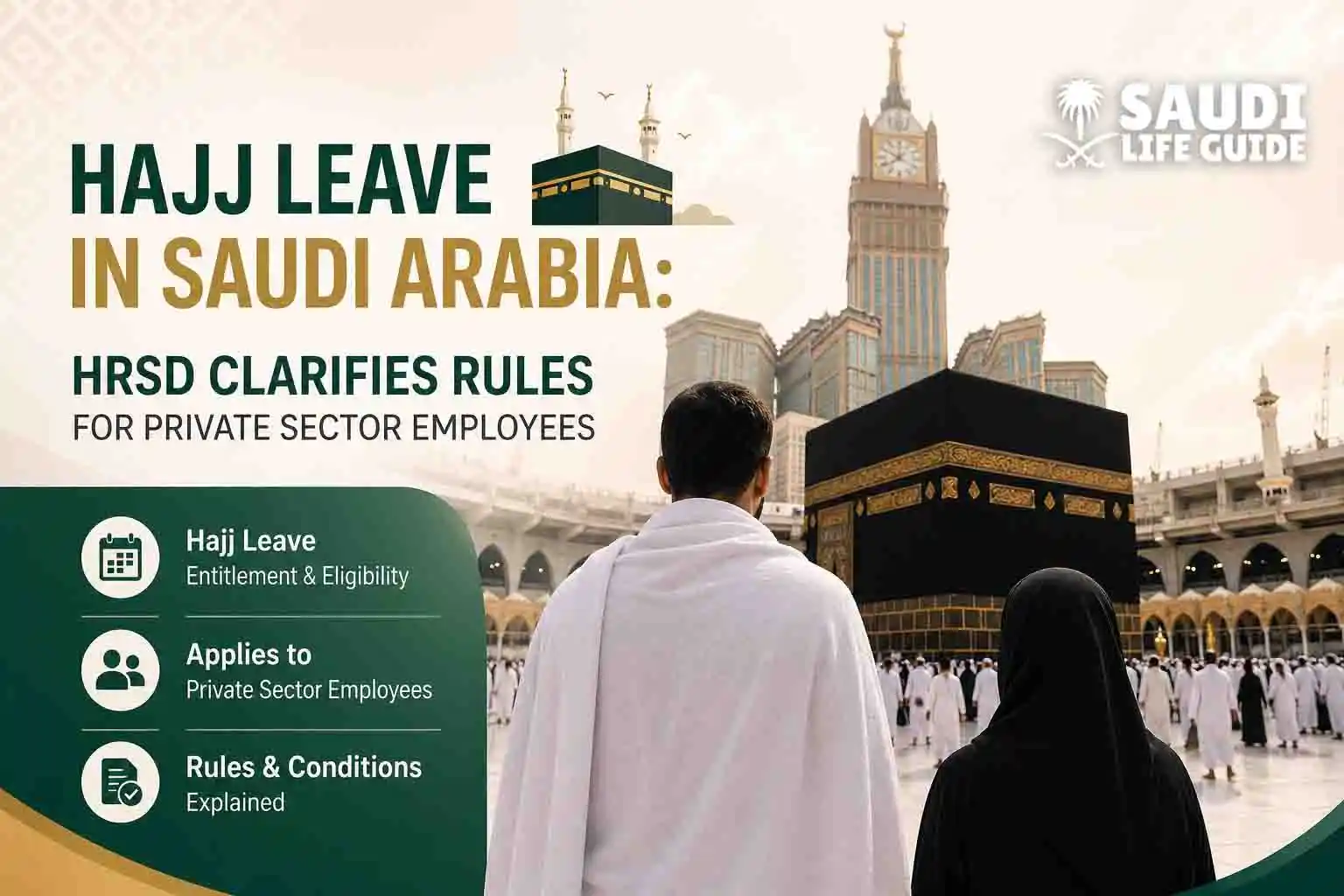
Saudi Arabia’s HRSD has confirmed that private sector employees performing Hajj for the first time are entitled to paid leave of 10 to 15 days. This leave is granted once per career and includes the Eid Al-Adha holiday.
Hajj is one of the five pillars of Islam. For any Muslim who is physically and financially able, performing it at least once in a lifetime is a religious obligation not a choice. But for millions of employees working in Saudi Arabia’s private sector, the fear of losing income or their job while performing Hajj has always been real.
In April 2026, Saudi Arabia’s Ministry of Human Resources and Social Development (HRSD) publicly clarified the rules for paid Hajj leave for private sector employees. The announcement confirmed that eligible workers are entitled to 10 to 15 fully paid days off to perform the pilgrimage including the Eid Al-Adha holiday. This leave is granted once in an employee’s entire career and is protected under Saudi Labor Law.
What Is Hajj Leave?
Hajj leave is a legally protected, fully paid leave granted to Muslim employees in Saudi Arabia so they can perform the annual pilgrimage to Makkah. It is not a company perk it is a statutory right written into Saudi Labor Law.
This means your employer cannot simply refuse it, replace it with annual leave, or dock your pay during this period. If you meet the conditions set by HRSD, you are entitled to take this leave as a matter of law.
Legal Basis: Article 114 of Saudi Labor Law
Hajj leave is governed by Article 114 of the Saudi Labor Law. The article states that an employee is entitled to paid leave of between 10 and 15 days inclusive of the Eid Al-Adha holiday for the purpose of performing the Hajj obligation, provided the employee has not previously performed Hajj and has completed a minimum of two consecutive years of service with the same employer.
The HRSD’s April 2026 clarification did not introduce a new policy it reinforced and publicly communicated rules that already existed under this article. The goal was to ensure both employees and employers understand their rights and responsibilities clearly.
Who Is Eligible for Hajj Leave?
HRSD has defined clear conditions that must all be met for an employee to qualify for paid Hajj leave. Missing even one condition means the entitlement does not apply.
| Eligibility Condition | What It Means |
| Religion | Employee must be Muslim applies to Saudis and expatriates equally |
| First-Time Hajj | Employee must not have performed Hajj before at any point in life |
| Service Duration | Minimum 2 consecutive years with the current employer |
| Employment Type | Applies to private sector employees under Saudi Labor Law |
| Frequency | This leave is granted only once during the entire employment period |
| Employer Discretion | Employer may control how many employees take Hajj leave in a given year |
One point worth noting: the law does not restrict this right to Saudi nationals only. Any Muslim employee regardless of nationality who meets the above conditions is legally entitled to Hajj leave. This is especially important for expatriate workers in Saudi Arabia who plan to perform Hajj for the first time.
How Many Days Is Hajj Leave in Saudi Arabia?
The law sets Hajj leave at a minimum of 10 days and a maximum of 15 days. The exact number within this range is determined by the employer, based on operational needs. Both the minimum and maximum are inclusive of the Eid Al-Adha public holiday.
This is an important detail: Eid Al-Adha days are not separate from your Hajj leave they are counted as part of it. You will not receive additional Eid days on top of the Hajj leave period.
| Leave Component | Days | Paid? | Separate from Annual Leave? |
| Hajj Leave (total) | 10 – 15 days | Yes full salary | Yes completely separate |
| Eid Al-Adha Holiday | Included within 10–15 days | Yes | N/A already counted |
| Annual Leave | 21–30 days per year | Yes full salary | N/A |
| Extra Unpaid Leave | By agreement (Art. 116) | No | Separate employer must agree |
How to Apply for Hajj Leave: Step-by-Step Process
Applying for Hajj leave is straightforward but doing it correctly and early protects your rights if any dispute arises later.
- Submit a formal written leave request to your HR department or direct manager well before the Hajj season begins.
- Include proof that this is your first Hajj. Common documents accepted include a Nusuk platform registration confirmation, passport history showing no prior Hajj stamps, or a signed personal declaration.
- Confirm your service record shows at least two consecutive years with your current employer.
- Request written approval and keep a copy for yourself. A verbal confirmation is not enough.
- If your company uses the Qiwa platform, ensure the approved leave is logged there to maintain compliance with HRSD records.
- Plan your travel dates around the approved leave window remember that your employer has the right to schedule the timing based on business needs.
Tip: Apply as early as possible ideally two to three months before Hajj season. Employers have the right to limit the number of employees taking Hajj leave in a single year, so early requests have a better chance of approval in peak years.
Employer Rights: What Companies Can and Cannot Do
Saudi Labor Law balances employee rights with business needs. Employers are not entirely powerless when it comes to Hajj leave but they operate within defined limits.
What Employers CAN Do
- Set an annual cap on how many employees take Hajj leave in a given year, based on operational requirements.
- Request proof of first-time Hajj status and service duration before approving the leave.
- Determine the exact number of days granted, within the 10 to 15-day legal range.
- Schedule the timing of the leave in coordination with the employee, accounting for business needs.
What Employers CANNOT Do
- Permanently deny a qualified employee from ever taking Hajj leave during their employment.
- Deduct Hajj leave days from the employee’s annual leave balance.
- Reduce or withhold salary during the approved Hajj leave period.
- Require the employee to cancel a registered Hajj plan without a valid, documented reason.
- Discriminate between Saudi and expatriate employees in granting this right.
Hajj Leave vs. Annual Leave: Key Differences
Many employees and even some HR teams confuse Hajj leave with annual leave or try to combine them. They are entirely separate entitlements under Saudi Labor Law.
| Feature | Hajj Leave | Annual Leave |
| Governing Article | Article 114 | Article 109 |
| Duration | 10 – 15 days | 21 – 30 days per year |
| How Often | Once in entire career | Every year |
| Pay | Full salary | Full salary |
| Deducted from Annual? | No fully separate | N/A |
| Min. Service Required | 2 consecutive years | 1 year |
| Who Qualifies | Muslim employees, first-time Hajj only | All employees |
| Includes Public Holidays? | Yes Eid Al-Adha counted within | Depends on scheduling |
What If Your Employer Refuses Hajj Leave?
If you meet all the eligibility conditions and your employer refuses your Hajj leave request without a valid reason, you have clear legal options.
- Document everything: save your written leave request, any responses from HR or management, and your proof of eligibility.
- File a formal labor complaint through the Qiwa platform’s dispute resolution system available to all employees in Saudi Arabia via their mobile device.
- You may also contact HRSD directly to report the violation. Saudi Labor Law explicitly protects this right, and employers who deny it without cause can face penalties.
HRSD has consistently reinforced that performing religious obligations is a protected employee right in Saudi Arabia. Employers are expected to manage operational needs while still honoring this entitlement not use business requirements as a permanent excuse to block it.
Hajj Leave in Saudi Arabia: Complete Rules at a Glance
| Rule | Details |
| Legal Article | Article 114, Saudi Labor Law |
| Who Grants This Leave | Private sector employers mandatory if conditions are met |
| Leave Duration | 10 to 15 days (employer decides within this range) |
| Includes Eid Al-Adha | Yes Eid days are counted within the 10–15 days |
| Pay During Leave | Full salary no deductions |
| Deducted from Annual Leave? | No completely separate |
| Service Requirement | Minimum 2 consecutive years with the same employer |
| Prior Hajj Condition | Must not have performed Hajj before |
| Frequency | Once in entire career per employee |
| Applies to Expats? | Yes all Muslim employees regardless of nationality |
| Employer Quota Right | Yes can limit number of employees per year |
| Dispute Channel | Qiwa platform / HRSD complaint system |
| Governing Authority | Ministry of Human Resources and Social Development (HRSD) |
Final Word
Hajj leave in Saudi Arabia is a clear, enforceable right not a favor from your employer. HRSD’s 2026 clarification makes it even harder for companies to ignore or misapply this rule.
If you are a Muslim employee in Saudi Arabia’s private sector who has never performed Hajj and has at least two years of service with your current employer, you are legally entitled to 10 to 15 fully paid days off to fulfill this religious duty. That leave cannot be taken from your annual leave, and your salary cannot be reduced during this time.
Plan early, document your request, and know that Saudi Labor Law stands behind you. If your employer refuses without a valid reason, you have the Qiwa dispute system and HRSD on your side. For more guides on working and living in Saudi Arabia, visit Saudi Life Guide.
Frequently Asked Questions
Can expatriate workers in Saudi Arabia take Hajj leave?
Yes. The law makes no distinction between Saudi nationals and expatriate employees. Any Muslim worker regardless of nationality who has completed two consecutive years of service with the same employer and has never performed Hajj before is fully entitled to this paid leave.
Do weekends count toward the Hajj leave days?
Yes. Any weekends that fall within the approved Hajj leave period are counted as part of the 10 to 15 days. They are not added on top of the leave balance. This is important to factor in when planning your travel.
Is Eid Al-Adha leave separate from Hajj leave?
No. The Eid Al-Adha public holiday is included within the 10 to 15-day Hajj leave period not in addition to it. So the net extra working days you are absent beyond Eid is the Hajj leave duration minus the official Eid holiday days.
What documents do I need to apply for Hajj leave?
Most employers require: a written leave application, proof of first-time Hajj status (Nusuk platform registration, passport showing no prior Hajj stamps, or a personal declaration), and your employment record confirming at least two consecutive years of service.
What if I already performed Hajj before joining my current employer?
The condition is that you have not performed Hajj before ever. It does not matter which employer you were with at the time. If you have already completed Hajj at any point in your life, you are not entitled to this paid leave, regardless of your years of service.
