



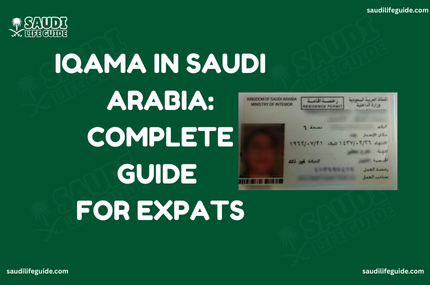
1) What is an Iqama in Saudi Arabia?
An Iqama is your official residence identity in Saudi Arabia (often called Resident Identity). It proves you’re legally residing in the Kingdom and is tied to your employment/residency status.
Think of it as your “main ID” inside Saudi—more important for daily admin than your passport.
2) Why the Iqama matters (real everyday impact)
Once you have your Iqama, life becomes smoother because it typically unlocks:
- Many digital government services (often through Absher and employer platforms)
- Banking and financial services (salary accounts, transfers, credit products)
- Housing rentals (and related verification)
- SIM registration / telecom processes
- Travel workflows (exit/re-entry processes depend on residency compliance)
- Employer-side services like updates to job records and related compliance
If your Iqama is delayed, you can end up in a frustrating loop where multiple services remain “pending” even if you’re already working.
3) Who issues the Iqama (and who is responsible)?
For most employees, the employer/sponsor handles the issuance via government-connected platforms (commonly via systems like Muqeem/Absher flows depending on the context).
The big rule you should know
Saudi Labor Law puts key fee responsibilities on the employer for non-Saudi employees, including residence fees and work permit fees and renewals. HRSD Ministry+1
That means, in normal employment cases, your employer is not “doing you a favor”—it’s part of their obligation.
(Note: special categories like dependents/domestic workers can have different handling. This article is primarily for expats on employment residency.)
4) Requirements checklist for first Iqama (practical version)
Exact requirements can vary by profession and employer category, but in most cases you should expect these to matter:
Core basics
- Passport (valid, and matching details used in visa/work records)
- Border number / entry details (your employer uses this in processing)
- Medical test (done at an approved center)
- Health insurance (active and properly registered)
- Employer’s compliance status (some employer statuses can block issuance until resolved)
- Correct profession setup (and professional registration where required)
Profession-based registration (common examples)
Some roles require registration with a professional body before residency processes complete (examples often include engineering/health/accounting tracks). If your profession falls into a regulated category, assume this can be a major cause of delay.
5) Step-by-step: how a new Iqama is issued (what actually happens)
Here’s the flow that matches real-world experience at most companies:
- Employer initiates the residency issuance process in their portal/workflow
- You complete medical testing (and the result must be recorded/accepted in the system)
- Insurance is activated and shows as valid
- Required professional registrations (if applicable) are completed
- Fees are paid through the required channels (employer-side)
- Your residency record is finalized and your Resident Identity (Iqama) is issued
Key idea: if any one of these dependencies isn’t “green” in the system, issuance can pause silently.
6) Medical test: what to expect (and why it delays people)
Medical testing is one of the first practical bottlenecks.
What the experience is usually like
- You visit an approved medical center
- You complete standard health screening required for residency processing
- Results are submitted electronically and must sync correctly with the relevant system
Top reasons for delays
- The test result is done, but the system status doesn’t update
- Name/passport/border number mismatch
- Employer submits your details with a spelling format that doesn’t match what the clinic used
Pro tip: Take screenshots/photos of your clinic receipt and reference number and send it to your HR/PRO immediately. Don’t assume “it will update.”
7) Health insurance can block everything (quietly)
Even if you’re fully onboarded at work, insurance activation can be the hidden “stop sign.”
Common issues:
- Insurance exists but isn’t correctly mapped to your identity record
- Coverage dates start later than expected
- Dependent insurance (if you arrived with family) complicates eligibility timing
Simple rule: if you feel your Iqama is stuck, ask HR/PRO specifically:
“Is my insurance showing active in the system for Iqama issuance?”
8) Fees: what’s paid, and who should pay
Fees vary by category and situation, and they change over time—so avoid trusting random social posts.
The most important legal principle (employment cases)
Saudi Labor Law states the employer bears fees related to:
- recruitment of the non-Saudi worker
- residence fees and work permit fees (and renewal)
- and related fines caused by employer delays, plus other items like exit/re-entry fees, etc. HRSD Ministry+1
So if you’re asked to pay core residency/work permit fees as a standard employee, you should ask for clarification in writing (politely) and refer to the policy.
9) How long does Iqama issuance take? (realistic timeline)
In many cases, it can be fast once dependencies are complete. In practice, timelines vary based on:
- how quickly medical results update
- insurance activation
- employer processing speed and compliance status
- profession/registration requirements
Realistic expectation for newcomers
- Fast case: about 1–2 weeks after all prerequisites are satisfied
- Normal case: 2–6 weeks depending on HR/PRO workload and system dependencies
- Slow case: longer, usually because one requirement isn’t actually completed in the system
10) How to check your Iqama status (without guessing)
If your employer has PRO/HR support, the fastest path is usually:
- Ask them: “Is my residency issued in the system? If yes, what is my Iqama number?”
- Ask for: status screenshot or confirmation from their portal
- If they say “pending,” ask: “Which dependency is blocking it: medical, insurance, profession registration, or fees?”
This removes the “please wait” loop and forces a concrete blocker.
11) Iqama renewal: rules, timing, best practices
Your Iqama has an expiry date. Renewals matter because an expired Iqama can block services and create legal trouble.
Renewal best practices
- Start checking at least a few weeks before expiry
- Confirm your employer has paid required fees and renewals in time
- Ensure insurance remains valid and continuous
Why renewals fail
- unpaid fees
- insurance lapses
- employer compliance blocks
- data mismatch (name/passport updates not reflected properly)
12) Common mistakes expats make (and how to avoid them)
These mistakes waste the most time:
- Assuming HR will “automatically” handle everything
- Fix: Ask for the blocking reason if delayed more than expected.
- Not checking name spelling consistency (passport vs records vs clinic)
- Fix: Always verify spelling format used in employer submission.
- Waiting too long before escalating
- Fix: If there’s no clear progress after medical/insurance, request a status update with specifics.
- Paying fees personally without documentation
- Fix: If you pay anything, insist on official receipts + written approval.
- Ignoring renewal timing
- Fix: Put an expiry reminder in your calendar as soon as you receive your Iqama.
13) Real-life tips & warnings (expat-to-expat)
- Keep digital copies of passport, visa page, entry stamp, clinic receipt, insurance card/policy.
- If you change phone number, update records carefully—many OTP flows depend on correct details.
- Don’t rely on rumors for fines/penalties. Non-compliance can have serious consequences for both employee and employer, including fines and broader restrictions. middleeastbriefing.com
- If you feel stuck, one smart question to ask HR/PRO is: “Can you confirm which system step is pending and what’s the exact missing requirement?”
14) FAQ (SEO-focused)
1) What is an Iqama in Saudi Arabia?
It’s your official resident identity that proves legal residency and enables most day-to-day services.
2) Can I work in Saudi Arabia without an Iqama?
You may start work operationally depending on employer onboarding, but many essential services remain blocked until your residency is issued. Getting the Iqama is a priority.
3) Who is responsible for issuing the Iqama?
For employees, it’s typically handled by the employer/sponsor through official systems.
4) Who pays for Iqama and work permit fees?
In standard employment cases, Saudi Labor Law places key fee responsibilities on the employer, including residence and work permit fees and renewals. HRSD Ministry+1
5) Why is my Iqama delayed even after medical?
Usually because insurance activation hasn’t synced properly, or there’s a data mismatch in your records (name/passport/border number).
6) How long does it take to get an Iqama?
It varies. Fast cases can be 1–2 weeks after prerequisites are completed, but delays happen if one dependency is not finalized in the system.
7) What happens if my Iqama expires?
An expired Iqama can block services and create legal risk. Renew early and confirm insurance and required payments are active.
8) Do I need professional registration for my Iqama?
Some regulated professions may require professional registration before the process completes. Your HR/PRO should confirm based on your job title and category.
15) Summary / Key takeaways
- Your Iqama is the key that unlocks normal expat life in Saudi Arabia.
- Issuance depends on medical test + insurance + employer processing + correct data + any profession requirements.
- If delayed, don’t guess—ask HR/PRO exactly which dependency is blocking it.
- For employees, Saudi Labor Law places major fee responsibilities on the employer. HRSD Ministry+1
16) Suggested Internal Links (Post Interlink Ideas) SLG
Place these contextually inside the article:
- How to check Iqama expiry date online (Absher guide)
- Iqama renewal process: step-by-step checklist
- How to get Absher account activated for new expats
- Qiwa: how employment records affect expats
- Muqeem explained: what your employer does for you
- Medical test centers for Iqama (city-wise guide)
- Health insurance in Saudi Arabia for expats (what to buy/expect)
- Family Iqama: procedure for dependents (separate pillar article)
- Exit/Re-entry visa guide for expats
- Common Jawazat issues and how to resolve them
17) Suggested External Authority Links (official / high authority) SLG
- Saudi Ministry of Human Resources & Social Development (HRSD) – Labor Law Article 40 explanation HRSD Ministry
- HRSD Labor Law PDF (official text reference) HRSD Ministry
- (Optional context) High-authority explainer on Iqama compliance and risk
