


Last updated: 15 October 2026
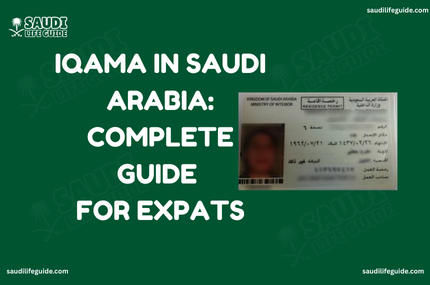
An iqama (إقامة), officially the Resident Identity, is the ID card and residence permit of every foreign national who lives in Saudi Arabia. The General Directorate of Passports (Jawazat) issues it at the request of your employer, or of your family head if you are a dependent. You need it to work, open a bank account, register a SIM card, drive and travel in and out of the Kingdom.
This page is your starting point. Each section gives the essentials and links to our full guide on that topic.
Iqama at a Glance
| Question | Answer |
|---|---|
| Issued by | Jawazat, at the employer’s request through Muqeem or Absher Business |
| Card validity | The physical card is valid for 5 years; the residency is renewed, usually every year |
| Renewal periods | 3, 6, 9 or 12 months |
| Residence permit fee | SAR 650 a year for company workers (paid by the employer) |
| Dependent levy | SAR 400 a month per dependent |
| Late renewal fine | SAR 500 the first time, SAR 1,000 the second |
| Digital version | Digital Resident ID with QR code in the Absher app |
Follow Saudi Life Guide for Iqama, visa and job updates
New rules, fees and news as soon as we publish them. Join 95,500+ followers on Facebook.
Before Your Iqama: The Border Number
When you first enter Saudi Arabia on a work visa, Jawazat records you under a 10-digit border number. You use it for your medical test and Absher until the iqama is issued. Find your border number on Absher with your visa number, no login needed. Still waiting for the visa itself? Do a Saudi visa check by passport number.
How Your First Iqama Is Issued
- You complete the medical examination at an approved centre, and the result is recorded in the system.
- Your employer activates your health insurance.
- Where your job needs it, you complete professional registration (for example for engineers or health workers).
- Your employer pays the fees and issues the iqama through Muqeem or Absher Business.
- Jawazat issues your Resident Identity. You can then register on Absher and link your mobile number.
If your iqama is stuck, ask HR which step is still open: the medical result, the insurance, the professional registration or the fees. For domestic workers, Jawazat says an iqama not issued within 90 days of entry brings a SAR 500 fine for the employer.
Who Pays for the Iqama
Under Article 40 of the Saudi Labour Law, the employer pays the iqama fee, the work permit fee and their renewals, and any fines caused by its delays. The dependent levy of SAR 400 a month per family member is usually paid by the worker. See every fee, with real examples, in our iqama fees guide, and work out your own total with the iqama fees calculator.
Iqama Expiry and Renewal
- Check your expiry date on Absher under My Services, then My Iqama, or without Absher on the HRSD inquiry page: iqama expiry check.
- Your employer renews it through Muqeem or Absher Business after the SADAD bill is paid. Unpaid traffic fines or an expired passport can block the renewal.
- Renew at least a few days before expiry. Late renewal is fined SAR 500 the first time and SAR 1,000 the second.
- Costs and the step-by-step process: iqama renewal fees for 1 year.
Your Employer’s Status Affects Your Iqama
Your employer’s Nitaqat colour decides whether it can renew iqamas and transfer workers. A company in the red band faces restrictions, so check your iqama colour status before your renewal, and check your sponsor name and ID if you are not sure who your sponsor is.
What Your Iqama Is Linked To
| Service | What to know | Full guide |
|---|---|---|
| SIM cards | Up to 2 prepaid SIMs on one iqama | SIM card limit, check SIMs on your iqama |
| National Address | Residents can register up to 2 addresses with SPL | register your National Address |
| Bank account | An expired iqama can freeze your bank card | bank account frozen |
| Driving licence | Your licence is tied to your iqama | driving licence guide |
| Fines and violations | Unpaid traffic fines block renewals | traffic violations |
Travelling on Your Iqama
- Exit re-entry visa: needed every time you leave and come back. A single visa costs SAR 200 for up to 2 months. See the exit re-entry visa guide.
- Final exit visa: ends your residency when you leave for good. It is free and your iqama needs at least 30 days left. See the final exit visa guide.
- GCC trips: iqama holders can apply for a UAE eVisa; see UAE eVisa for Saudi residents.
Changing Jobs, Absence Reports and Family
- Changing employer: transfers run through Qiwa. Track yours with our iqama transfer status guide and read the rules on working for another employer.
- Probation: either side can end the contract during probation; see probation period rules.
- Huroob (absent from work): a worker first gets 60 days to transfer or leave; see the latest huroob rules.
- Family: bring your family on a permanent family visa (each dependent gets an iqama and the SAR 400 monthly levy) or a family visit visa.
Common Iqama Mistakes
- Waiting for HR to remember your renewal. Note your expiry date and remind them in writing a few weeks before.
- Name spellings that differ between your passport, visa and medical records. Ask HR to fix them before the iqama is issued.
- Paying an iqama or work permit fee yourself without a written agreement and an official receipt.
- Letting traffic fines pile up. They block your renewal and exit re-entry visa.
Frequently Asked Questions
What is an iqama in Saudi Arabia?
An iqama is the Resident Identity of a foreign national living in Saudi Arabia. It is issued by the General Directorate of Passports (Jawazat) at the request of your employer, or of the head of your family if you are a dependent, and you need it for work, banking, SIM cards and travel.
Who pays the iqama fee?
For employees, Article 40 of the Saudi Labour Law puts the iqama fee, the work permit fee and their renewals on the employer. The residence permit itself costs SAR 650 a year for company workers. The dependent levy for family members is usually paid by the worker unless the contract says otherwise.
How long is an iqama valid?
The physical Resident ID card is valid for five years, but your residency itself has to be renewed, usually every year, and it can also be renewed for 3, 6 or 9 months. Your expiry date is on Absher under My Services, then My Iqama.
What happens if my iqama expires?
Jawazat fines a late renewal SAR 500 the first time and SAR 1,000 the second time, and repeat cases can lead to deportation. An expired iqama can also freeze your bank card and block exit re-entry visas, so make sure your employer renews it at least a few days before expiry.
Can I use a digital iqama instead of the card?
Yes, in most everyday checks. Jawazat added a digital Resident ID to the Absher app in 2021 with a QR code that officials can scan, and family members can show their dependents’ digital IDs too. Carry the card for airports and banks if they ask for it.
How do I check my iqama status?
Log in to Absher and open My Services, then My Iqama, to see your iqama number and expiry date. Without Absher, the HRSD inquiry page shows the expiry date with your iqama or border number and date of birth. Your employer can also see your status in Muqeem and Qiwa.
Sources: Saudi Labour Law, Article 40 (HRSD); General Directorate of Passports (Jawazat) statements via Ajel (August 2026), Arab News and Gulf News (digital Resident ID); our own guides linked above, each with its official sources.