



Living and working in Saudi Arabia means knowing who is listed as your employer of record and what that relationship legally entitles you to. Whether you are a professional employee, a domestic worker, or somewhere in between, verifying your kafeel information protects your legal status and tells you where you stand.
One thing has changed since most guides on this topic were written, and it changes what this check actually means. If you are new to the residency system generally, our complete iqama guide for expats covers the wider picture.
What Changed: Kafala and Why You Still Check Your Kafeel
In June 2025 Saudi Arabia formally abolished the kafala sponsorship framework for private sector expatriate employees, replacing it with a contract-based employment regime. Employer authority over a worker’s residency status, travel rights and job mobility was removed.
In practice this means:
- Job mobility. Workers may transfer to a new employer once contractual obligations or the applicable notice period are met, without needing the current employer’s permission.
- Exit and re-entry. Applied for directly through Absher or Qiwa, without sponsor approval.
- Passports. Employers are explicitly prohibited from retaining a worker’s passport.
- Legal access. Labour courts can be used to report wage theft, contract violations or workplace misconduct without deportation risk.
- Digital contracts. Employment agreements must be registered on Qiwa.
So why does the kafeel field still exist?
Because the employer of record still exists. Someone still holds your work permit, still processes your iqama, and still appears against your name in Absher, Qiwa and GOSI. What changed is the power attached to that position, not the position itself.
You still need to check it because:
- The name shown must match your actual employer, or your renewal will fail
- A transfer that has not updated in the system is a transfer that has not legally happened
- The record is where a false huroob report appears
- Government services still ask you to confirm the employer against official records
The honest position for 2026 is that the legal framework changed substantially, and enforcement is still catching up with it. Domestic workers and informal labour are not fully covered by the reforms in the same way private sector employees are. In April 2026 UN experts were still urging Saudi Arabia toward effective abolition, citing continued reports of passport retention and wage theft. Knowing your rights on paper and being able to exercise them are two different things, and the first is where you start.
What is Kafeel (Sponsor) in Saudi Arabia?
A kafeel is the Saudi citizen or company registered as the employer of record for an expatriate worker’s visa and residency. Under the old framework the kafeel held broad authority over that worker. Under the contract-based system the role is administrative and the authority sits with the contract.
Key Responsibilities of a Kafeel
| Sponsor Responsibility | Description |
|---|---|
| Iqama processing | Issuing and renewing the residence permit |
| Work permit | Obtaining and maintaining legal work authorisation |
| Contract registration | Registering the employment agreement on Qiwa |
| Wage payment through WPS | Salary paid through the Wage Protection System |
| Legal accountability | Responsible for the worker’s regulatory compliance |
Note what is no longer on this list. Approving your exit and re-entry visa, and approving your departure, are no longer sponsor powers for private sector employees.
Why Should You Check Your Kafeel Sponsor Information?
- Verify employment status. Confirm the registered relationship matches reality.
- Iqama renewal. Sponsor information must match official records or renewal fails.
- Transfer of sponsorship. Required when changing employers, and the record is how you confirm it completed.
- Legal protection. Identify unauthorised or incorrect sponsor registrations.
- Government services access. Many services require sponsor verification.
- Huroob check. Confirm no false absconding report has been filed against you.
If you are mid-transfer, our guide to checking sponsor transfer status in MOL covers what each stage means and how long each typically takes.
Method 1: Check Kafeel Name Using MOL Website (mol.gov.sa)
The Ministry of Labor (MOL) provides the most reliable method to verify sponsor information online.
Step-by-Step Process:
- Step 1: Visit the official MOL website: mol.gov.sa
- Step 2: Navigate to “E-Services” or “الخدمات الإلكترونية”
- Step 3: Select “Labor Query Services”
- Step 4: Click on “Iqama Query” or “Worker Query”
- Step 5: Enter your Iqama Number (10 digits)
- Step 6: Enter the Image Code (Captcha verification)
- Step 7: Click “Search” or “بحث”
Information Displayed:
- Kafeel Name (Arabic)
- Kafeel ID Number
- Profession/Job Title
- Iqama Validity Status
- Work Permit Status
Method 2: Check Sponsor ID Through Absher Platform
Absher is the primary government portal for expatriates and citizens to access various services.
Using Absher Individuals (Absher Afrad):
- Step 1: Go to absher.sa
- Step 2: Log in with your credentials (username and password, or Nafath, plus OTP)
- Step 3: Navigate to “My Services” then “Query Services”
- Step 4: Select “Passport” then “Personal Information”
- Step 5: View complete sponsor details, including: Full kafeel name, Sponsor ID number
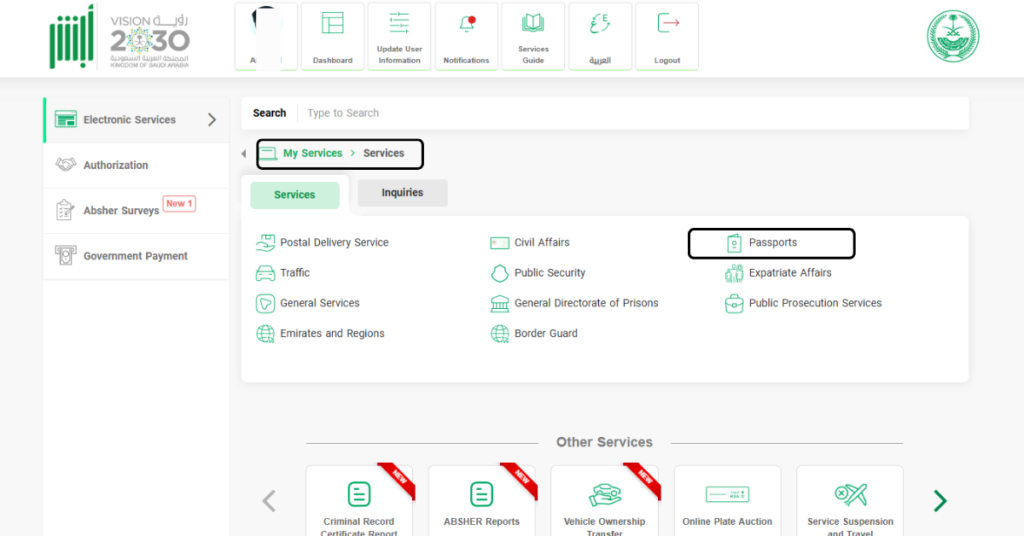
Second Method Through Absher
- Step 1: Go to absher.sa
- Step 2: Log in with your credentials (username, password, or Nafath, OTP)
- Step 3: Navigate to “Dashboard” → “More Details”
- Step 4: Check the Sponsor details in section → “Personal Information“
- Step 5: View complete sponsor details, including:
- Full Kafeel Name
- Sponsor ID Number
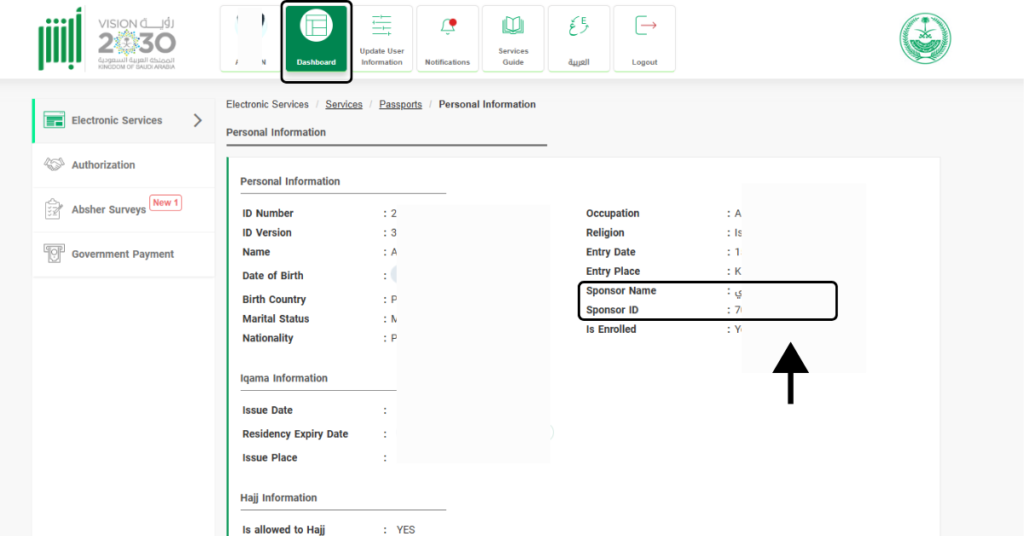
The second route is quicker if you are already logged in, and it survives interface changes better because the dashboard is more stable than the deeper service menus.
Absher Registration Requirements
| Requirement | Details |
|---|---|
| Valid iqama | Must be active and not expired |
| Mobile number | Registered against your record |
| Email address | Valid email for verification |
| Fingerprint | Must be registered in the system |
If your iqama has lapsed you will not get a result here. Check your iqama expiry date first, because an expired iqama blocks most Absher query services rather than returning an error that explains why.
Method 3: GOSI Website Verification
The General Organization for Social Insurance (GOSI) website can also reveal sponsor information for insured workers.
Steps:
- Step 1: Visit gosi.gov.sa
- Step 2: Click “Online Services”
- Step 3: Select “Subscriber Services”
- Step 4: Enter Iqama Number and verification code
- Step 5: View employer (sponsor) details and contribution history
GOSI Information Includes:
- Current Employer/Sponsor Name
- Registration Number
- Salary as per GOSI records
- Insurance subscription status
This is the most useful of the four methods and the most overlooked. The GOSI salary figure is what your end of service benefit is calculated from, and it is what a bank checks when you apply for finance. If it does not match your actual salary, that is worth resolving now rather than on your last day. Our guide to downloading your GOSI salary certificate covers how to get it as a formal document.
Understanding Your Kafeel Information: What Each Field Means
| Field | Arabic | Description |
|---|---|---|
| Kafeel name | اسم الكفيل | Sponsor’s full legal name |
| Kafeel ID | رقم هوية الكفيل | 10-digit national ID number |
| Establishment number | رقم المنشأة | Company registration number |
| Profession | المهنة | Your official job title |
| Iqama status | حالة الإقامة | Valid, expired or cancelled |
| Border number | رقم الحدود | Entry registration number |
The profession field deserves more attention than it usually gets. It is the job title on your permit, not the job title on your business card, and the two are frequently different. It determines what work you are legally authorised to do, affects some transfer routes, and can matter for licensing in regulated fields. If it says something unrelated to what you actually do, that is a discrepancy worth correcting before it blocks something.
Common Issues When Checking Kafeel Information
Problem 1: “No Record Found”
Possible causes:
- Iqama number entered incorrectly
- New iqama not yet registered in the system
- Expired iqama
- System temporarily unavailable
Solution: Confirm the number digit by digit, wait 24 to 48 hours if the iqama is newly issued, and check the iqama has not expired. If all three are fine, contact the relevant authority directly.
Problem 2: Wrong Sponsor Name Displayed
Possible causes:
- A recent transfer has not yet updated in the system
- Data entry error during registration
- The transfer was never actually completed
Solution: Check the transfer status before assuming it is a display error. Our guide to tracking a sponsorship transfer in MOL shows what each stage looks like. If the transfer shows as complete but the name has not updated after several days, visit the nearest Jawazat office with your original documents.
Problem 3: Huroob (Absconding) Status Shown
Possible causes:
- The employer filed a false absconding report
- An unresolved employment dispute
Solution: Act immediately. A huroob report affects your legal status while it stands, and time works against you. Our guide to checking huroob status online covers the three official verification routes, and file a complaint through the HRSD friendly settlement process without delay.
A false huroob is one of the most common forms of retaliation when a worker tries to leave. If you are in a dispute with your employer and considering resigning, understand your position under Article 81 of the Saudi Labour Law before you give notice, not after.
2026 Updates: What Replaced the Kafala System
Saudi Arabia’s sponsorship framework was formally replaced in June 2025 under Vision 2030. The change was structural rather than incremental.
| Reform | Status in 2026 |
|---|---|
| Job mobility | Active. Transfer permitted once contractual obligations or notice period are met |
| Exit and re-entry without sponsor approval | Active for private sector employees, applied for via Absher or Qiwa |
| Final exit | Worker can request directly in most cases |
| Passport retention by employer | Prohibited |
| Digital contract registration | Mandatory on Qiwa |
| Wage Protection System | Enhanced monitoring |
| Labour court access | Available without deportation risk |
| Premium residency | Available as an alternative residency route |
What has not fully changed. Implementation is still unfolding. Domestic workers and informal labour are not covered by the private sector reforms in the same way, and international bodies continue to report cases of passport retention and wage theft in practice. The legal position and the lived experience are not yet the same thing everywhere.
The practical takeaway: your rights are considerably stronger than they were, but you still need to know what the record says about you. That is what these four verification methods are for.
Important Contact Information
| Authority | Contact | Purpose |
|---|---|---|
| HRSD call centre | 19911 | Labour inquiries and complaints |
| Absher support | 920020405 | Portal assistance |
| Jawazat | 920033334 | Passport and iqama issues |
| GOSI | 8001243344 | Insurance and contribution queries |
Tips for Expatriates in Saudi Arabia
- Screenshot every check with the date visible. If a dispute reaches HRSD later, showing what the system said on a specific date carries weight that a verbal account does not.
- Check GOSI, not just Absher. Absher tells you who your employer is. GOSI tells you what salary they registered, which is the number your end of service is calculated from.
- Verify before you resign, not after. Confirm your record is clean and your salary is correctly registered while you still have leverage.
- Compare the Arabic name character by character. Transliteration is inconsistent and near-matches hide real problems.
- Act on a huroob the day you find it. Delay is the single most damaging thing you can do with an absconding report.
- Use official channels only. Third-party verification services want your iqama number and have no legitimate reason to hold it.
If something looks wrong on your record
Conclusion
Checking your kafeel sponsor ID and name takes a few minutes through Absher, Qiwa, SMS or GOSI. What the check means has changed since June 2025, when the kafala framework was replaced with contract-based employment for private sector workers. The sponsor field still exists, and it still needs to be right, but the power attached to it is substantially reduced.
Verify your record when you start a job, when a transfer completes, before you resign, and once a year in between. Check GOSI as well as Absher, because the salary registered there determines what you are eventually paid on departure.
The reforms gave expatriate workers in Saudi Arabia meaningfully stronger rights than they had. Knowing what your own record says is how you make use of them.
Frequently Asked Questions
Has the kafala system been abolished in Saudi Arabia?
Yes, formally. In June 2025 Saudi Arabia replaced the kafala sponsorship framework with contract-based employment for private sector expatriate workers. Employer authority over residency status, travel and job mobility was removed. Implementation is still unfolding, and domestic workers are not covered in the same way.
Why do I still have a kafeel if kafala was abolished?
Because the employer of record still exists. Someone still holds your work permit and processes your iqama, and that entity still appears in Absher, Qiwa and GOSI. What changed is the authority attached to the role, not the existence of the role.
Can I change jobs without my employer’s permission in 2026?
For private sector employees, yes, once contractual obligations or the applicable notice period have been met. This is no longer restricted to a small list of professions as it was under the earlier mobility initiative.
Do I need my sponsor’s approval for an exit re-entry visa?
No. Private sector employees can apply directly through Absher or Qiwa.
What is the fastest way to check my kafeel name?
Absher via the dashboard route, if you are already logged in. GOSI is more useful if you also want to see your registered salary.

Assalamu Alaikum. I would like to know the name, address and city of my coffin.
Metek pass job perablm