


Last updated: 11 October 2026
“Huroob” is the word expats still use, but officially it is now an absent from work report. For private-sector workers it is handled in Qiwa by the Ministry of Human Resources and Social Development (HRSD); for domestic workers it is handled in Musaned. The worker is first marked “disconnected from work” and has 60 days to transfer, leave or sign a new contract before becoming “absent”.
The most important new update: since 18 September 2025, workers who are already marked absent can still move to a new employer through Qiwa if they spent at least 12 continuous months in the Kingdom and the new employer pays the overdue work permit fees (HRSD). Qiwa confirmed this again in September 2026 (Gulf News).
Huroob Updates 2025 and 2026
| Date | What changed |
|---|---|
| 30 July 2025 | Qiwa introduced the 60-day “disconnected from work” stage: the worker can transfer, take a final exit or re-contract with the same employer before becoming absent (Gulf News). |
| 18 September 2025 | Correction initiative: absent workers with 12 continuous months in the Kingdom can transfer through Qiwa; the new employer pays overdue work permit fees. |
| February 2026 | New Musaned service for domestic workers who stop working (HRSD). |
| May 2026 | Qiwa listed who cannot use the transfer: under 12 months in the Kingdom, absent because a final exit visa expired, border numbers or suspended status (Okaz). |
| About May 2026 | The second six-month grace period for absent domestic workers, which started on 11 November 2025, ended. No further extension has been announced (Gulf News). |
| 30 June 2026 | HRSD extended to 31 December 2026 the grace period for workers whose work permit expired more than 12 months ago, or who never got a permit within 6 months of joining (HRSD). |
| 1 July 2026 | Qiwa started automatically removing workers from the employer’s record when their work permit has been expired for more than 3 months (Okaz). |
| September 2026 | Qiwa restated that absent workers with more than 12 months in the Kingdom can transfer to a new employer. |
Get Iqama, visa and job updates on WhatsApp
Follow the Saudi Life Guide channel to get new rules, fees and news as soon as we publish them.
Follow on WhatsAppHow Huroob Works Now (Private Sector)
- Who can file: the employer, in Qiwa, when a worker has been absent without a valid reason for more than 15 days in a row or more than 30 days in one contract year (HRSD guide). Under the 2025 rules, the iqama or work permit must have at least 60 days left and there must be no active contract.
- Notice: both the employer and the worker receive an SMS, and the worker is removed from the employer’s establishment.
- 60 days to act: counted from the date of the report. During this time the worker can transfer to a new employer (more than 12 months in the Kingdom needed), take a final exit from their own Absher account, or sign a new contract with the same employer. The old employer’s approval is not needed.
- After 60 days: if nothing happens, the status becomes “absent from work” and the Ministry of Interior systems are updated. The worker is then in violation, but may still be able to transfer under the September 2025 initiative.
Domestic Workers: Musaned Rules
- Since February 2026, an employer reports a domestic worker who stopped working through Musaned, and the Musaned report must be registered for the Absher report to take effect.
- In the first two years in the Kingdom, the worker must leave on a final exit within 60 days. After two years, the worker can leave or transfer to a new employer within 60 days.
- The report cannot be cancelled during the 90-day probation period. After probation, the employer can cancel it within 15 days of filing.
- The six-month grace periods of 2025 and 2026 for absent domestic workers have ended.
How to Check If You Have a Huroob Report
- Look for the SMS sent when a report is filed, and check your Qiwa individual account and Absher.
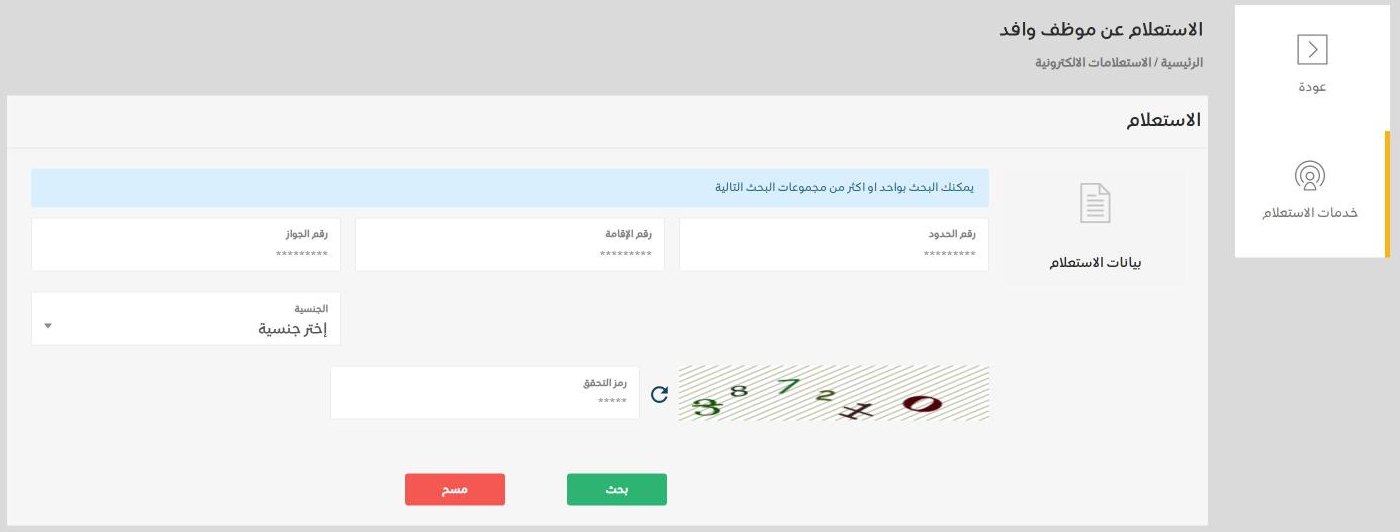
- Use the HRSD expatriate employee inquiry page: enter your border number, iqama number or passport number with your nationality and the captcha code. No login is needed.
- If you are not sure what your status means, call HRSD on 19911.
How to Clear a Huroob Report
Within the 60 days
- Transfer: the new employer requests the transfer in Qiwa, you accept it in your own Qiwa account, and the Ministry approves it. You need more than 12 months in the Kingdom.
- Final exit: issue it from your own Absher account and leave within its validity. Pay any traffic fines first. See our final exit visa guide.
- New contract with the same employer: if the problem is resolved, the employer can offer you a new contract in Qiwa.
After the 60 days
- Under the September 2025 initiative, a new employer can transfer you through Qiwa if you completed at least 12 continuous months in the Kingdom. The new employer pays the overdue work permit fees.
- Excluded: workers with less than 12 months in the Kingdom, workers who became absent because a final exit visa expired, and workers on border numbers or with a suspended status.
- A transfer must be completed within 15 days of approval or it lapses, and only two transfer requests are allowed.
There is no separate “huroob removal fee”. The cost is the overdue work permit fees paid by the new employer, plus the usual iqama fees. See our iqama fees guide.
Expired Work Permit: Removed From the Employer’s Record After 3 Months
This is a separate rule from huroob, but it affects many of the same workers. Since 1 July 2026, Qiwa automatically removes a resident worker from the employer’s record when their work permit has been expired, or missing, for more than 3 months. Qiwa announced the rule on its X account in May and June 2026 (reported by Okaz and Ajel).
- Exception: you are not removed if your work permit and iqama expire on different dates and your iqama still has 180 days or more left, even if the employer cannot renew the permit yet. With less than 180 days left, both should be renewed straight away.
- The employer still pays: the employer remains liable for all work permit fees for the period you had no valid permit, up to the removal date. Removal does not cancel that debt. See our work permit (Maktab Amal) fee guide.
- Older cases have until 31 December 2026: on 30 June 2026 the Ministry of Human Resources extended the grace period for workers whose permit expired more than 12 months ago, and for workers who never got a permit within 6 months of joining. After that date the Ministry says the prescribed penalties apply (HRSD).
What to do if your work permit has expired
- Check your contract and work permit status in your Qiwa individual account, and your iqama expiry on Absher (see our iqama expiry check).
- Ask your employer in writing (email or WhatsApp) to renew the work permit, and keep a copy.
- If the employer refuses to renew your work permit or iqama, the job mobility rules in force since March 2021 let you move to a new employer through Qiwa without the current employer’s consent. Three consecutive months of unpaid salary also gives you that right.
- For any dispute over salary or papers, file a friendly settlement request with the Ministry (see below).
If the Report Is Unfair
- Keep proof that you were working: attendance records, approved leave, emails or messages.
- File a claim through HRSD’s Friendly Settlement for Labor Disputes service. It is free, must be filed within 12 months, and unresolved cases go to the labour court. Domestic workers use a separate route.
- HRSD has treated a report as malicious in cases such as a worker proving attendance on the report date, or a report filed after the worker had already raised a claim against the employer.
- HRSD’s number is 19911.
Penalties and Returning to Saudi Arabia
- There is no officially published ban period for absent workers. Leaving on a final exit within the 60 days is a normal departure.
- Being deported is different and can stop you returning to work in the Kingdom, so act within the 60 days if you can.
- Do not work for anyone without a proper transfer. The Ministry of Interior has warned of fines of up to SAR 100,000 for employing workers illegally, and violations also affect the worker.
Want to check your employer’s details or Nitaqat status first? See how to check your sponsor name and ID and how to check your company’s Nitaqat colour.
Frequently Asked Questions
Does huroob cancel my iqama straight away?
No. When an employer reports a private-sector worker, the worker is first marked “disconnected from work” and has 60 days to transfer to a new employer, leave on a final exit or sign a new contract with the same employer. Only if nothing happens in those 60 days does the status become “absent from work”.
Can I transfer to a new employer after huroob?
Yes, in most cases. Within the 60 days, a new employer can request your transfer in Qiwa without your old employer’s approval if you have been in Saudi Arabia for more than 12 months. Since September 2025, workers already marked absent can also transfer if they spent at least 12 continuous months in the Kingdom and the new employer pays the overdue work permit fees.
Who cannot use the absent worker transfer?
According to Qiwa, as reported in May 2026, the transfer is not available to workers with less than 12 months in the Kingdom, workers who became absent because a final exit visa expired, and workers on border numbers or with a suspended status.
How do I check if I have a huroob report?
Watch for the SMS that Qiwa sends to both parties when a report is filed, check your Qiwa and Absher accounts, or use the HRSD expatriate employee inquiry page with your iqama, border or passport number. If you are unsure, call HRSD on 19911.
What can I do if the huroob report is false?
Collect proof that you were working, such as attendance records or approved leave, and file a claim through HRSD’s Friendly Settlement service within 12 months. A report filed after you had already raised a claim against the employer can be treated as malicious.
Sources: HRSD procedural guide on ending the contractual relationship (2022), HRSD news on the absent workers correction initiative (September 2025) and the Musaned service (February 2026), HRSD Friendly Settlement service, Qiwa updates reported by Okaz and Gulf News (2025 and 2026), HRSD expatriate employee inquiry page, HRSD news on the work permit correction deadline (30 June 2026), Qiwa’s work permit removal rule reported by Okaz and Ajel (May and June 2026), HRSD job mobility rules reported by Arab News (November 2020).
Chek hurrub aqama number 2466586431 4year 6 month ready
Hurrub check sir because I want come back saudi Arabia my aqama number 2466586431
Aw6827941 par saudi arabia huroob ban hai ya khatam hova hai