



Last updated: 9 November 2026
Salary delay in Saudi Arabia is illegal from the first day your pay is late. After 2 months unpaid, the Ministry of Human Resources (MHRSD) suspends most of your employer’s services. After 3 months, all services stop and you can transfer to a new employer on Qiwa without their approval. You can also claim your wages for free through the ministry’s Friendly Settlement service, or resign under Article 81 and keep your end-of-service benefit.
Many expats in Saudi Arabia wait too long because they are afraid of losing the job or the iqama. The rules are on your side, but they work best when you act early and keep proof. This guide explains what happens at each month of delay, what you can do, and how to file a claim step by step.
Salary Delay in Saudi Arabia: 1, 2 and 3 Months at a Glance
| How late | What happens to the employer | What you can do |
|---|---|---|
| Due date passed | Mudad, the wage protection system, reminds the employer to pay and upload the wage file | Ask in writing (email or WhatsApp to HR) and keep a copy |
| About 10 to 20 days | Second notice at day 10, final warning at day 15, inspection request at day 20 (as reported by the ministry) | Answer any request to accept or reject the employer’s excuse within 3 days |
| 1 month | The delay can lead to an inspection visit and referral | File a free Friendly Settlement claim if HR gives no date |
| 2 months | All ministry services suspended except issuing and renewing work permits | Claim the wages; consider resigning under Article 81 |
| 3 months | All services suspended, work permits included | Transfer to a new employer on Qiwa without approval, claim wages and end-of-service |
Source: MHRSD Wage Protection System page; day 10, 15 and 20 steps from the ministry’s Mudad statement reported in 2025.
Follow Saudi Life Guide for Iqama, visa and job updates
New rules, fees and news as soon as we publish them. Join 95,500+ followers on Facebook.
Is It Legal to Delay Salary in Saudi Arabia?
No. Article 90 of the Saudi Labour Law says monthly-paid workers must be paid once a month, on the due date, into their bank account. There is no legal grace period. A shortage of cash or a late client payment is not a lawful excuse in practice; only the labour court can decide whether an employer had a valid reason.
Article 94 gives you a direct route to the labour court when wages are late or wrongly deducted. The court can order payment and fine the employer up to double the delayed wages. Article 93 also limits deductions to half of your wage, so an employer cannot cut most of your salary and call it paid.
The amended Labour Law that took effect on 19 February 2025 kept these wage rules. If your salary is lower than agreed, also compare it with the minimum salary rules and your contract on Qiwa.
How Many Days Can a Salary Be Delayed in Saudi Arabia?
There is no legal grace period. Under Article 90 your salary is due on the agreed monthly date and is already late from the next day, so even a one-day delay is a breach on paper. Mudad starts reminding your employer on the due date, sends a final warning around day 15, and can request an inspection at about day 20. In practice, act once a full pay cycle is missed and you have written proof: send HR a dated request, keep your bank statement, and file a free Friendly Settlement claim if no clear payment date is given.
How Mudad Flags Late Salaries
Every private company must upload its monthly wage file to Mudad, the wage protection system linked to MHRSD. Because salaries are paid through banks, the system can see when a salary is missing or late. According to the ministry’s 2025 statement:
- on the due date the employer gets a reminder to pay and upload the file;
- at day 10 a second notice, and at day 15 a final warning;
- at day 20 Mudad automatically requests an inspection visit;
- the employer then has 10 days to justify the delay, and you have 3 days to accept or reject the explanation. If you do not answer, the employer’s excuse is accepted automatically.
Mudad also flags a basic wage that looks unreasonably high or low, deductions above half the wage, and a basic wage not recorded for 90 days or more. Keep your notifications switched on in your Qiwa and bank apps so you do not miss the 3-day window. Your GOSI salary certificate also shows the wage your employer registered, which helps if there is a dispute.
The Mudad justification notice: your accept or reject right
When Mudad flags a month, the employer files a justification and you receive it as a notice in the app. It names the exact problem the system found, for example a deduction of more than half your gross pay, and it shows the salary paid into your account next to the salary registered for you in GOSI, so you can see any gap. You then get a short response period, usually three days, to accept or reject the explanation. If the justification is wrong, reject it inside that window: a rejection is recorded and supports your case in a Friendly Settlement or at the labour court. If you do not answer, the explanation is accepted for you, so open every notice and respond.
What Happens After 1 Month of Salary Delay
One month late is already a violation, and the delay can trigger an inspection. At this stage most problems are solved by pressure and paperwork:
- Send HR a short written request with the month, the amount and your employee number. Email or WhatsApp is fine; keep screenshots.
- Save your contract, payslips, bank statements showing the missing deposit and any messages that promise a date.
- Watch for the Mudad request to accept or reject the employer’s excuse and answer within 3 days.
- If HR gives no clear payment date, file a Friendly Settlement claim (steps below). Filing is free and does not end your job.
What Happens After 2 Months of Salary Delay
After 2 months of unpaid salary, MHRSD suspends all of the employer’s services except issuing and renewing work permits. In practice the company cannot get new visas or most ministry services, which pushes many employers to pay.
For you, this is the time to file the Friendly Settlement claim if you have not already. You can also resign under Article 81 (explained below) if the employer keeps failing to pay. You cannot yet transfer without approval, unless another legal case applies, such as an expired iqama the employer refuses to renew.
What Happens After 3 Months of Salary Delay
After 3 months, MHRSD stops all of the employer’s services, work permits included. Most importantly for expats, you can transfer to another employer without your current employer’s approval, even if your work permit has not expired. This is one of the cases created by the Labour Relations Improvement Initiative that started on 14 March 2021, which replaced the old NOC (no-objection) system.
How to transfer to a new employer on Qiwa
- Find a new employer and ask them to send you a job offer through Qiwa.
- Log in to your Qiwa individual account and accept the offer.
- Your current employer is notified and the system checks the conditions, including the unpaid salary months.
- A new work permit is issued under the new employer. The transfer itself is free.
You can follow the request with our guide to checking your sponsor transfer status. The transfer moves your job, but it does not cancel your claim: keep the Friendly Settlement case open for the unpaid wages.
Resigning Under Article 81 and Keeping Your End-of-Service
Under Article 81 a worker can leave without notice and keep all legal rights, including the end-of-service benefit, when the employer fails its essential obligations. Not paying wages is the clearest example. The law does not set a number of months, so the stronger your record of missed salaries and written requests, the safer your position. Read our full guide to Article 81 and resigning without notice and estimate what you are owed with our end-of-service calculator.
If you resign the normal way instead, the notice rules in the Saudi resignation rules apply. Do not stop going to work without filing first, because an absence report (huroob) can be filed against you; see our huroob guide.
How to File a Salary Complaint in Saudi Arabia (Friendly Settlement)
The official first step for any salary claim in the private sector is the MHRSD e-service Friendly Settlement for Labor Disputes, also called Wedi. It is free and fully online.
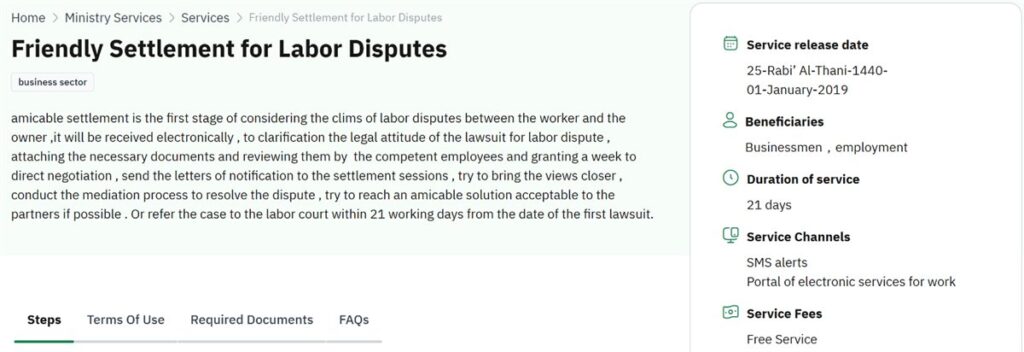
- Prepare evidence: contract (from Qiwa), payslips, bank statements showing the missing salaries, and your written requests to HR.
- Log in to the e-services portal at hrsd.gov.sa and open Friendly Settlement for Labor Disputes.
- File with the right office: choose the settlement office of the city where you last worked, list the months and amounts you claim, and attach the documents.
- Negotiation: you and the employer get one week to settle directly, then settlement sessions with a ministry mediator. Attend every session; missing one can close the case.
- Labour court: if there is no agreement within about 21 working days, the case is referred to the labour court, which is followed on Najiz. The Ministry of Justice says most labour cases close in about two hearings.
Deadline: claims must be filed within 12 months of the end of the job (Article 234). An agent with a power of attorney that covers settlement can attend for you. For help call the ministry on 19911.
Penalties for Employers Who Do Not Pay Salaries
- Fines per worker: the ministry’s wage protection page lists SAR 3,000 for each worker not paid on time.
- Service suspension: all services except work permits after 2 months, and all services after 3 months.
- Court fine: up to double the delayed wages under Article 94.
- Labour Law maximum: under Article 229, violations can be fined up to SAR 100,000 each, multiplied by the number of workers affected, and doubled on repeat.
Domestic Workers and Unpaid Salaries (Musaned)
Domestic workers follow separate rules. Since 1 January 2026, all employers must pay domestic workers electronically through banks or wallets approved on Musaned; cash salaries are no longer accepted as proof. See our guide to domestic worker salary transfer.
If 3 wages go unpaid without a reason, consecutive or not, the ministry can transfer the domestic worker to a new employer without the current employer’s approval. Domestic workers cannot use Friendly Settlement; since 3 October 2024 they file through the ministry’s Filing a Domestic Labor Lawsuit service, which tries settlement first and then goes to the labour courts.
Mistakes That Weaken a Salary Claim
- Waiting too long: after 12 months from the end of the job, the claim lapses.
- Leaving work without filing: it can lead to an absence report. File first, then decide.
- Ignoring the 3-day Mudad request: silence means the employer’s excuse is accepted.
- Signing a full settlement or clearance: do not sign that you received all dues if you did not.
- Leaving the Kingdom first: try to file before final exit; if you have already left, you can still use an agent with a power of attorney within the 12 months. Embassies can advise and help, but only MHRSD and the labour court can order your employer to pay.
- Working elsewhere informally: taking a side job while you wait is illegal; see the fine for working for another employer.
While you wait for back pay, our Saudi salary guide helps you judge a fair offer from a new employer, and our overtime calculator shows any overtime you can add to the claim.
Frequently Asked Questions
What happens after 3 months salary delay in Saudi Arabia?
After 3 months of unpaid salary, the Ministry of Human Resources stops all of the employer’s services, including work permits, and you can move to a new employer without your current employer’s approval, even if your work permit is still valid. The new employer sends you a job offer on Qiwa and you accept it there. You can also claim the unpaid wages through the free Friendly Settlement service.
What happens after 2 months salary delay in Saudi Arabia?
After 2 months of unpaid salary, the ministry suspends all of the employer’s services except issuing and renewing work permits. You cannot transfer without approval yet, but you can file a free Friendly Settlement claim for the unpaid wages on hrsd.gov.sa, and you may resign under Article 81 if the employer keeps failing to pay, keeping your end-of-service benefit.
Where can I complain if my company is not giving my salary?
Use the Ministry of Human Resources e-service Friendly Settlement for Labor Disputes on hrsd.gov.sa. It is free, filed online with the settlement office of the city where you last worked, and you attach your contract or other proof of employment. If there is no settlement within about 21 working days, the case goes to the labour court. The ministry helpline is 19911.
Can I resign if my salary is delayed in Saudi Arabia?
Yes. Article 81 of the Saudi Labour Law lets a worker leave without notice and keep all legal rights, including the end-of-service benefit, when the employer fails its essential obligations, and paying wages is the most basic one. The law does not set a number of months, so keep proof of every missed salary and your written requests before you rely on Article 81.
What is the fine for late salary in Saudi Arabia?
Fines are charged for each affected worker. The ministry’s wage protection page lists SAR 3,000 per worker. On top of that, the labour court can fine the employer up to double the delayed wages under Article 94, and the employer’s ministry services are suspended after 2 months.
What if my domestic worker or I as a domestic worker am not paid?
Since 1 January 2026 every employer must pay domestic workers electronically through Musaned. If 3 wages go unpaid without a reason, the ministry can transfer the domestic worker to a new employer without the current employer’s approval. Domestic workers cannot use Friendly Settlement; they file through the ministry’s Filing a Domestic Labor Lawsuit service, which then goes to the labour courts.
Sources: MHRSD Wage Protection System page, Friendly Settlement for Labor Disputes service, Saudi Labour Law Articles 81, 90 to 94, 229 and 234, MHRSD Musaned announcements (2024 to 2026); Mudad day 10, 15 and 20 steps and 2026 fine amounts from ministry statements reported by Okaz, Gulf News and MRRORS.
I need help. Problem of my salary. My employer want to hold my salary for 3-4months.