



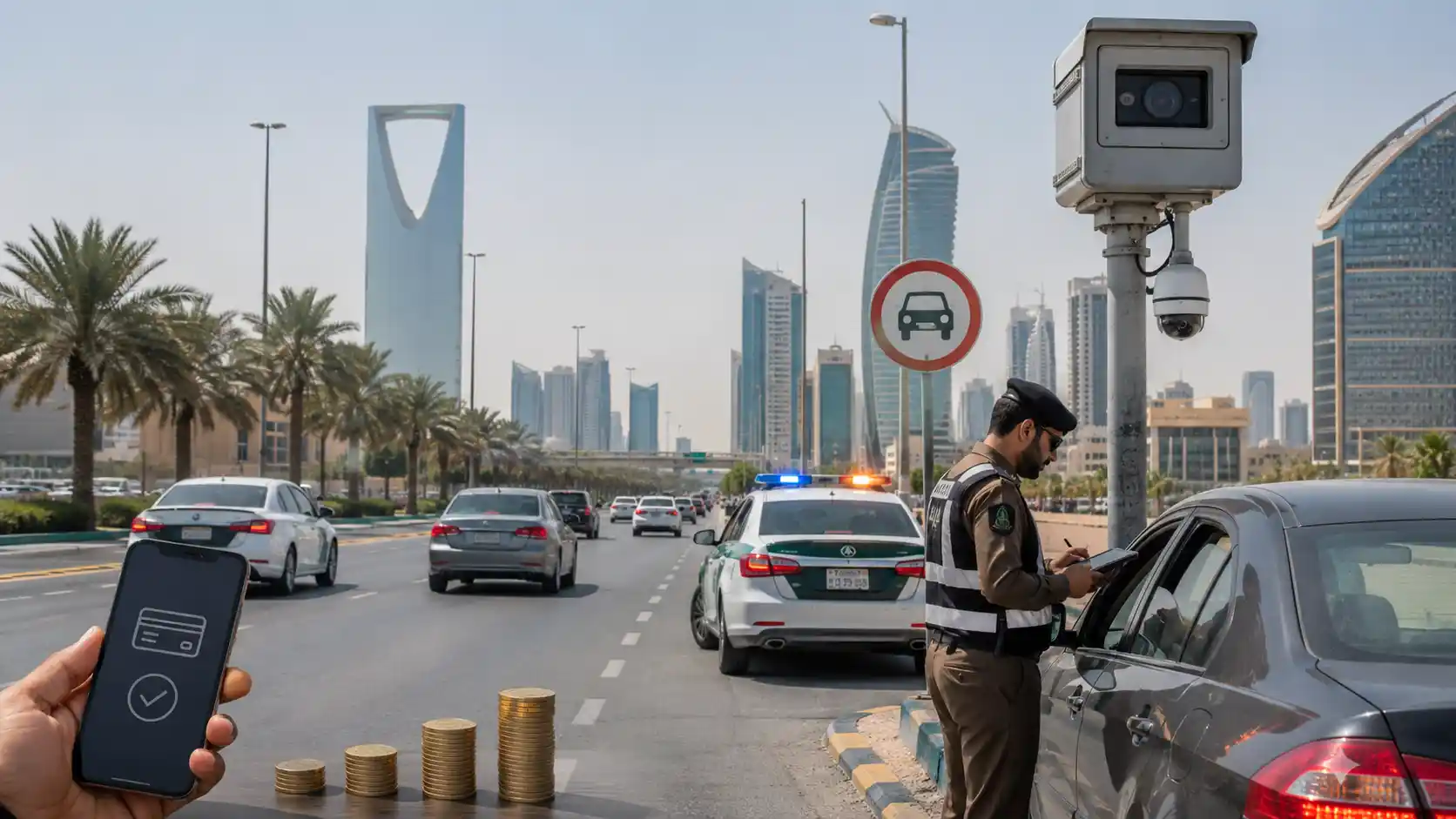
Summary:
“From red light fines of SAR 3,000 to seatbelt penalties of SAR 150, every Saudi traffic violation falls into one of eight official categories. This guide breaks down each one, plus the license point system, the Saher camera network, and the full Absher payment process.”
Traffic fines in Saudi Arabia range from SAR 100 for minor parking mistakes to SAR 10,000 for reckless driving. The General Department of Traffic, known locally as Muroor, divides all violations into eight categories based on severity. Every fine is linked to your Iqama or vehicle registration, which means unpaid violations can block your exit visa, vehicle renewal, and other government services.
Most Common Traffic Fines in KSA
Here are the fines drivers in Saudi Arabia ask about most often:
| Violation | Fine (SAR) | Points Deducted |
|---|---|---|
| Running a red light | 3,000 – 6,000 | 6 |
| Using a mobile phone while driving | 500 – 900 | 4 |
| Not wearing a seatbelt | 150 – 300 | 2 |
| Driving without a valid license | 1,000 – 2,000 | None |
| Speeding (up to 25 km/h over limit) | 300 – 500 | Varies |
| Speeding (more than 25 km/h over limit) | 500 – 900 | Varies |
Each of these falls into a specific category in the official Muroor fine structure, which we explain below.
How the Saudi Traffic Fine System Works
The Ministry of Interior (MOI) sets traffic penalties in Saudi Arabia, and Muroor enforces them. Instead of assigning one fixed amount per violation, the system uses eight categories with a fine range inside each one. The exact amount you pay depends on the circumstances, your driving history, and whether you are a repeat offender. First-time violators usually receive the lower end of the range.
Enforcement is largely automated. The Saher camera network monitors roads across the Kingdom 24 hours a day and issues violations directly to your Absher account. You receive an SMS notification, and the fine appears in your record within minutes. Because every fine is tied to your national ID, Iqama, or vehicle plate, there is no way to ignore a violation and hope it disappears.
Complete Saudi Traffic Violations List by Category
Below is the full breakdown of all eight categories with the most common violations in each.
Category 1: SAR 100 to 150
These are the lightest penalties in the system:
| Violation | Fine (SAR) |
|---|---|
| Parking in non-designated areas | 100 – 150 |
| Driving in areas where driving is not allowed | 100 – 150 |
| No valid vehicle insurance | 100 – 150 |
| Leaving a vehicle unattended with engine running | 100 – 150 |
| Pedestrians crossing from non-allocated places | 100 – 150 |
Category 2: SAR 150 to 300
This tier covers everyday mistakes that many drivers commit without realizing:
| Violation | Fine (SAR) |
|---|---|
| Not wearing a seatbelt | 150 – 300 |
| Not using turn signals when turning or changing lanes | 150 – 300 |
| Failure to submit vehicle for periodic inspection | 150 – 300 |
| Not leaving a safe distance between vehicles | 150 – 300 |
| Obstructing driver vision with objects inside or outside the vehicle | 150 – 300 |
Category 3: SAR 300 to 500
| Violation | Fine (SAR) |
|---|---|
| Driving with an expired license | 300 – 500 |
| Improper use of child safety seats | 300 – 500 |
| Speeding up to 25 km/h over the limit | 300 – 500 |
| Gathering at an accident scene | 300 – 500 |
Category 4: SAR 500 to 900
| Violation | Fine (SAR) |
|---|---|
| Using a mobile phone while driving | 500 – 900 |
| Driving an unregistered vehicle | 500 – 900 |
| Speeding more than 25 km/h over the limit | 500 – 900 |
| Improperly following an ambulance or emergency vehicle | 500 – 900 |
Category 5: SAR 1,000 to 2,000
| Violation | Fine (SAR) |
|---|---|
| Driving without ever obtaining a license | 1,000 – 2,000 |
| Riding a motorcycle without a helmet | 1,000 – 2,000 |
| Entering roads with unauthorized vehicle types | 1,000 – 2,000 |
Category 6: SAR 3,000 to 6,000
This is where penalties become severe. These violations cause the majority of serious accidents at intersections:
| Violation | Fine (SAR) |
|---|---|
| Running a red light | 3,000 – 6,000 |
| Driving against the flow of traffic | 3,000 – 6,000 |
| Dangerous overtaking | 3,000 – 6,000 |
| Failing to stop for school buses | 3,000 – 6,000 |
Categories 7 and 8: SAR 5,000 to 10,000
The highest tier is reserved for offenses that put lives at direct risk:
| Violation | Fine (SAR) |
|---|---|
| Reckless driving and drifting (tafheet) | 5,000 – 10,000 |
| Exceeding 160 km/h | Up to 10,000 |
| Driving under the influence of alcohol or drugs | Up to 10,000 plus legal action |
| Racing on public roads | 5,000 – 10,000 |
Drifting and driving under the influence can also lead to vehicle impoundment, license suspension, and imprisonment depending on the case.
Traffic Point System and License Suspension
Alongside financial penalties, Saudi Arabia operates a point deduction system. Each serious violation removes points from your record, and accumulating 24 points results in license suspension.
| Violation | Points Deducted |
|---|---|
| Running a red light | 6 |
| Using a mobile phone while driving | 4 |
| Dangerous overtaking | 6 |
| Not wearing a seatbelt | 2 |
| Driving against traffic flow | 8 |
The first suspension lasts a defined period set by Muroor, and repeated suspensions carry longer durations. Points reset over time if you maintain a clean record, so a single violation does not haunt you forever. Drivers who repeatedly reach the 24-point threshold may face permanent license revocation.
How the Saher System Detects Violations
Saher is one of the most extensive automated traffic enforcement networks in the world. It uses fixed cameras, mobile units, and radar systems installed across highways, intersections, and city roads. The system primarily captures two violation types: speeding and red light running. At intersections, Saher cameras can record both violations in a single incident, which means running a red light at speed can generate two separate fines.
Once a camera records a violation, the system matches your plate number to your Absher account and sends an SMS notification. You can view the violation photo through the Absher web dashboard, which is useful if you plan to dispute the fine.
How to Check Your Traffic Fines
You have several official channels to check outstanding violations:
- Absher platform: Log in at absher.sa, go to Services, then Traffic, then Traffic Violations. You will see all fines linked to your ID or Iqama with dates, amounts, and violation types.
- Absher app: The mobile app shows the same list, though high-resolution violation photos are usually only available on the desktop version.
- Kulluna Amn app: The Ministry of Interior security app also displays traffic violations.
- Phone: Call 993, the official traffic helpline, for violation inquiries.
Checking your record monthly is a good habit, especially before renewing your Istimara (vehicle registration) or applying for an exit re-entry visa.
How to Pay Traffic Fines in Saudi Arabia
Payment is straightforward and fully digital:
- Absher: Select the violation and pay directly through the platform using SADAD.
- Bank app: Open your banking app, go to SADAD payments, select Traffic Violations (Biller code 007), enter your ID number, and pay.
- ATM: Most Saudi bank ATMs support traffic fine payments through the government payments menu.
Early payment discount: Under Article 75 of the traffic law, you receive a 25 percent discount if you pay within 30 days of the violation date. On a SAR 6,000 red light fine, that discount saves you SAR 1,500, so paying early is always worth it unless you plan to object.
How to Object to a Traffic Violation
If you believe a fine was issued in error, you have 30 days from the violation date to file an objection:
- Log in to Absher and open the Traffic Violations section.
- Select the violation and choose the objection option.
- Provide your reason and attach any supporting evidence, such as proof the vehicle was sold or that you were not driving.
- Track the objection status through your Absher dashboard.
Review the Saher photo on the Absher web dashboard before objecting. If the image clearly shows your vehicle committing the violation, paying within the discount window is usually the smarter choice.
Unpaid Fines: Impact on Exit Visas and Iqama Services
This is the part many expats learn the hard way. Unpaid traffic fines block several essential services:
- Final exit visa: All violations must be cleared before a final exit is approved.
- Istimara renewal: You cannot renew vehicle registration with outstanding fines.
- Vehicle ownership transfer: Selling your car requires a clean violation record.
- License renewal: Pending fines can hold up your driving license renewal.
For a temporary exit re-entry visa, minor unpaid fines do not usually cause problems, but clearing them before any travel is the safest approach. Fines do not expire, and amounts can escalate if ignored.
Final Thoughts
Traffic fines in Saudi Arabia are designed to be unavoidable through automation and unforgiving through escalation, but they are also easy to manage if you stay informed. Know the eight categories, check your Absher account regularly, and always pay within the 30-day discount window. For expats, keeping a clean violation record protects far more than your wallet, since it directly affects your Iqama services, vehicle registration, and ability to exit the Kingdom smoothly.
FAQs
How do I get the 25 percent discount on traffic fines?
Pay within 30 days of the violation date through Absher or SADAD. The discount applies automatically under Article 75 of the traffic law.
How many points lead to license suspension in KSA?
Accumulating 24 points results in license suspension. Serious violations like driving against traffic deduct 8 points, while a red light violation deducts 6.
How long do I have to object to a traffic violation?
You have 30 days from the violation date to file an objection through Absher, the Muroor app, or by visiting a traffic department office.
Can I leave Saudi Arabia with unpaid traffic fines?
You can usually travel on a temporary exit re-entry visa with minor unpaid fines. However, a final exit visa requires all violations to be cleared first.
What is the highest traffic fine in Saudi Arabia?
The maximum fine is SAR 10,000, applied to reckless driving, drifting, exceeding 160 km/h, and driving under the influence. These offenses can also lead to vehicle impoundment and imprisonment.
