


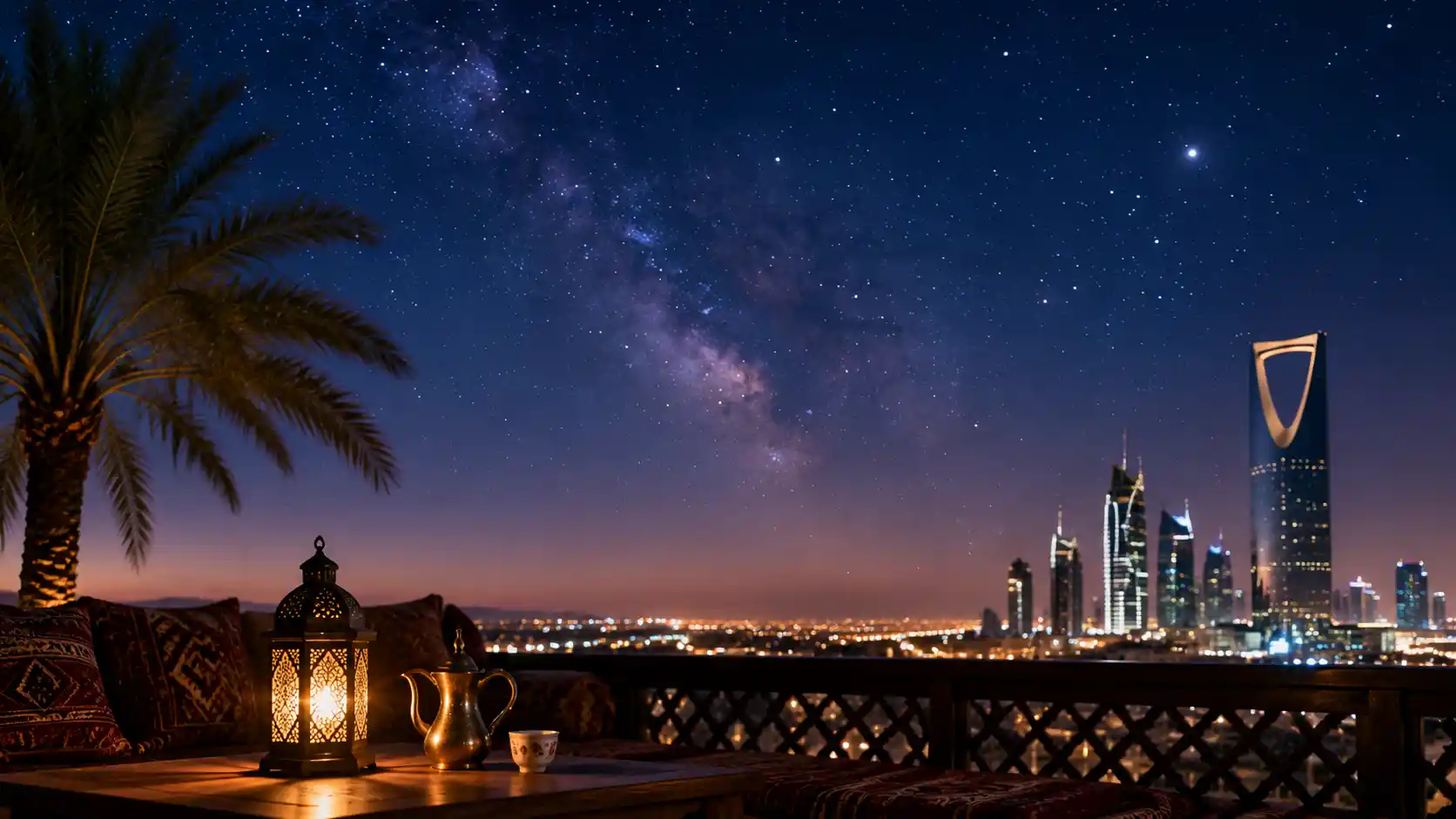
Suhail season began on Thursday, 20 August 2026, according to Saudi astronomer Dr. Khalid Al-Zaaq. It runs 52 days and marks the traditional break in extreme summer heat. Nights ease first. Daytime stays hot until roughly mid-September, and the midday outdoor work ban still runs to 15 September.
If you have been through a couple of Saudi summers, you already know the mood shift. People start saying the word in lifts and on WhatsApp groups. Nobody is promising sweater weather. What they mean is that the worst of it is now behind you, and that the calendar has finally agreed.
What changed on 20 August
| Item | Detail |
|---|---|
| Season start, per Al-Zaaq | 20 August, the same date every year |
| Season start, per Al-Hussaini | 24 August 2026 |
| Length | 52 days |
| Structure | Four manzila of 13 days each: Al-Tarfa, Al-Jabha, Al-Zubra, Al-Sarfa |
| First 26 days | Change felt at night only |
| Second 26 days | Change felt during the day |
| Season ends | Around 10 October, rolling into the Al-Wasm rain season |
The star itself is Canopus, the second brightest in the night sky after Sirius, sitting roughly 310 light years away. Arabs have used its return as a calendar entry for centuries, long before anyone had a forecast app.
Follow Saudi Life Guide for Iqama, visa and job updates
New rules, fees and news as soon as we publish them. Join 60,000+ followers on Facebook.
Two astronomers, two dates, and both are defensible
Reporting on the start date genuinely differs, so it is worth being straight about it.
Dr. Khalid Al-Zaaq works from the traditional Najdi seasonal calendar, in which Suhail season opens on 20 August regardless of the year. Saudi press coverage of his statements has carried that same fixed date across multiple years, and he frames it as the dividing line between the scorching heat of Al-Qaid and a milder autumn.
Sabq reported in July 2026 that the astronomer Al-Hussaini places the start on 24 August, which fell on 11 Rabi al-Awwal 1448 in the Islamic calendar. Al-Hussaini describes Suhail as marking “the beginning of a gradual break in the heat” after the peak of summer. That date lines up with when the star is first reliably visible to the naked eye in central Saudi Arabia.
Neither is wrong. One is a calendar entry, the other is a sighting. If you are converting dates between systems, our Hijri to Gregorian date converter handles the crossover.
When you can actually see Suhail where you live
Suhail rises in the pre-dawn dark, low on the southern horizon, and the sighting date shifts with latitude. The further north you are, the later you see it.
| Where you are | Naked-eye sighting |
|---|---|
| Jazan and the far south | Around 7 August |
| Central Saudi Arabia, including Riyadh | Around 24 August |
| Northern Borders region (Arar) | Star rises 26 August, visible in the first third of September |
| Northern Saudi Arabia generally | Around 8 September |
In the Northern Borders the star clears the horizon at roughly 5:51 am, about a minute before sunrise, which is why nobody up there sees anything until it starts rising earlier in September.
There is a traditional check for it too. Al-Zaaq notes that seeing the star Al-Mirzam clearly is taken as proof that Suhail has risen. Get away from street lighting, face south, and look close to the ground in the last half hour before dawn.
The 52 days, split down the middle
This is the part that matters practically, and it is the part most people get wrong.
The first 26 days change the night only. Late evening and the hours before dawn lose their edge, the humidity drops back, and sitting outside stops being unpleasant. The afternoon does not care. Midday in Riyadh in late August is still midday in Riyadh in late August.
The second 26 days are when daytime temperatures start moving. By the end of the season the heat has genuinely broken, and it hands over to Al-Wasm, which most Saudis will tell you is the best stretch of weather in the year.
What the Suhail season means for expats in Saudi Arabia
The midday work ban has not ended. This is the one to get right. The Ministry of Human Resources and Social Development ban on outdoor work under direct sunlight runs from 15 June to 15 September 2026, from 12:00 to 3:00 pm, across all private sector establishments. Suhail season starting on 20 August changes nothing about it. If your employer pushes you to work through that window, you can report it to MHRSD on 19911, and you can raise it in person at your nearest Maktab Amal labour office. Violations carry penalties under the Labour Law.
Plan evenings, not afternoons. For the next three to four weeks the payoff is after Isha, not at 4 pm. Corniche walks, parks, desert trips and outdoor football all become viable well before the daytime figures move.
Do not expect your SEC bill to drop yet. Air conditioning load follows daytime temperature, and daytime temperature is the thing that changes last. Budget for one more heavy month.
The calendar markers stack up quickly from here. Meteorological summer ends on 31 August, autumn begins astronomically on 23 September, and the Saudi National Day holiday on 23 September lands in the same week. In the traditional Arab reckoning autumn starts on 6 September.
Umrah gets easier from here. Cooler mornings change the calculation on Haram crowding, and it is worth reading the best times to perform Umrah by crowd density before booking leave.
Frequently asked questions
What is Suhail season in Saudi Arabia?
Suhail season is the traditional Arabian seasonal marker tied to the rising of Canopus, the star Arabs call Suhail. Saudi astronomer Khalid Al-Zaaq places its start on 20 August every year. It runs 52 days, divided into four 13 day manzila, and ends in early October.
Does the weather actually change when Suhail rises?
Not because of the star. Astronomers who cover the season are clear that Suhail is a time marker, not a cause. The real driver is the Earth’s orbit and the shortening day. What you notice first is cooler air in the last third of the night.
Can I see Suhail from Riyadh, and when?
Yes, but you need to be up early. In central Saudi Arabia the star is reported visible to the naked eye from around 24 August, low on the southern horizon in the last half hour before sunrise. Get away from streetlights and look south, close to the ground.
Does Suhail season mean the midday work ban is over?
No. The ban on outdoor work under direct sunlight runs from 15 June to 15 September 2026, between 12:00 and 3:00 pm, across all private sector establishments. Suhail season starting on 20 August does not shorten it. Violations can be reported to MHRSD on 19911.
When does the heat really break in Saudi Arabia?
In practice, in two stages. The first 26 days of Suhail season change the nights while afternoons stay punishing. The second 26 days bring the daytime drop. Meteorological autumn starts on 1 September and astronomical autumn on 23 September, so late September is when most people feel it.