



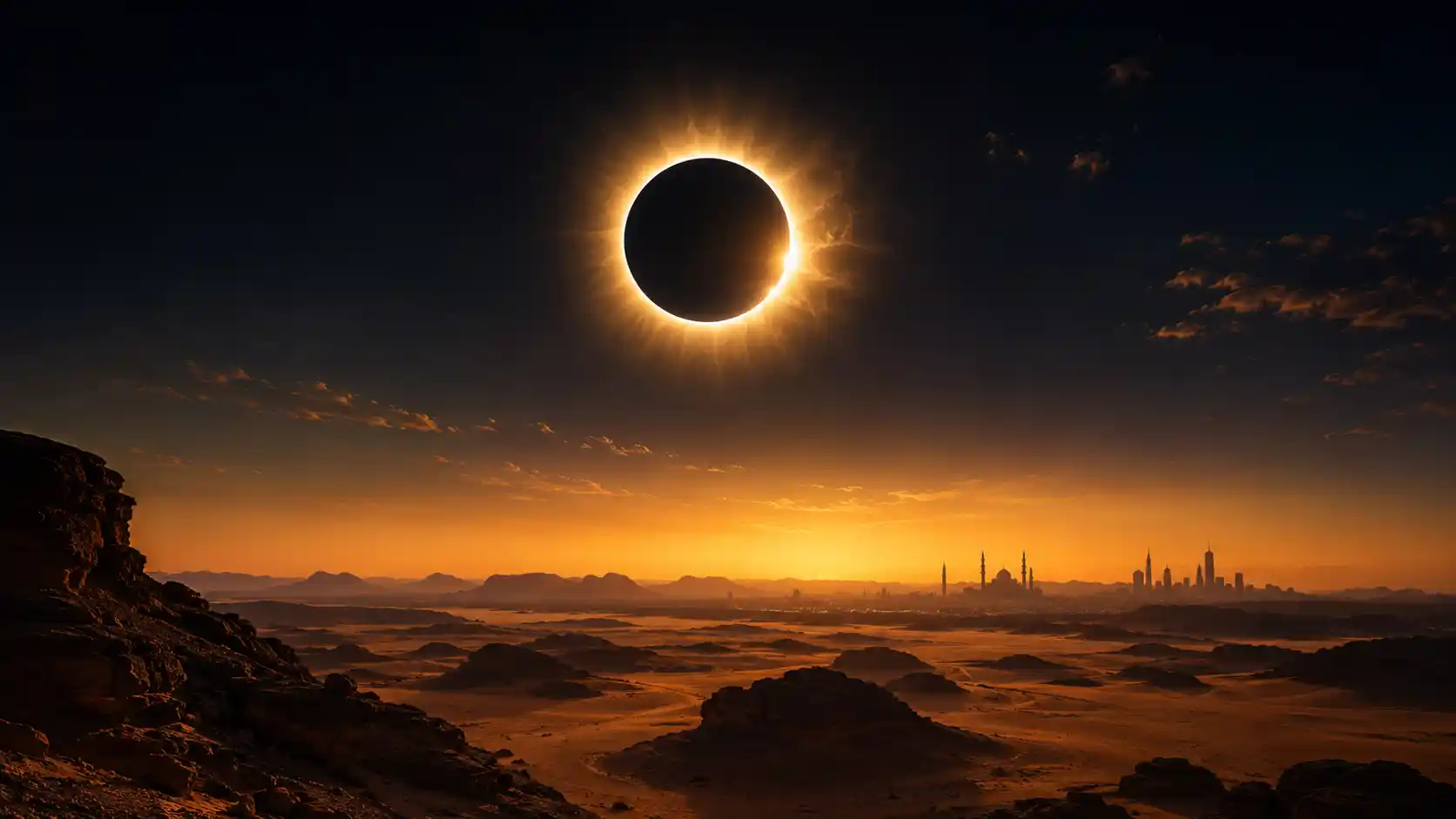
On the afternoon of August 2, 2027, the sky over western Saudi Arabia will go dark in the middle of the day. For up to six minutes, the moon will completely cover the sun, the temperature will drop, stars will appear, and the sun’s corona will blaze around a black disc where the sun used to be.
This is not a partial eclipse or a passing dimming. Along a corridor running through Jeddah and out toward the southwest, this is a total solar eclipse, and it is the first one visible from Saudi Arabia in more than 75 years. The next comparable event will not arrive for decades. If you are living in the Kingdom in 2027, this is genuinely a once-in-a-lifetime opportunity sitting on your doorstep.
This guide covers exactly what will happen, where to be, when it starts, and how to watch it without damaging your eyes.
Quick Facts: The 2027 Saudi Arabia Eclipse
- Date: Sunday, August 2, 2027
- Type: Total solar eclipse
- Maximum totality (in Egypt): 6 minutes 23 seconds, one of the longest of the 21st century
- Totality in Jeddah: around 6 minutes
- Partial eclipse elsewhere in the Kingdom: up to around 80% coverage
- Last total eclipse visible from Saudi Arabia: more than 75 years ago
- Cost to watch: free, but you must have certified eye protection
How a Total Solar Eclipse Actually Works
A total solar eclipse happens when the moon passes directly between the sun and the earth, and lines up so precisely that it blocks the sun completely.
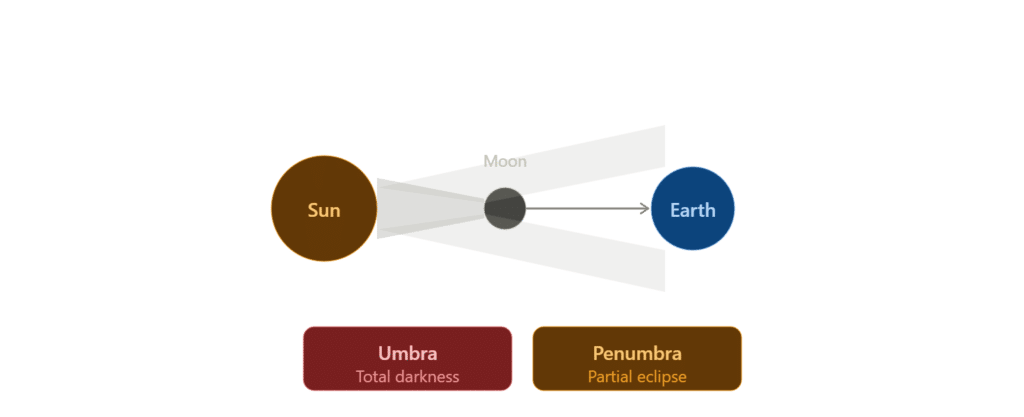
The moon casts two shadows. The umbra is the dark inner cone, and anywhere inside it sees the sun fully covered: this is totality, the few minutes of true darkness. The penumbra is the lighter outer shadow, and anywhere inside it sees only part of the sun covered: a partial eclipse.
The reason totality is so rare in any one place is that the umbra is narrow. It traces a thin path across the earth’s surface, called the path of totality, often only a couple of hundred kilometres wide. Stand inside that path and you get the full spectacle. Stand outside it, even a short drive away, and you get a partial eclipse only, which is a completely different and far less dramatic experience.
That distinction is the single most important thing to understand about this event, and it determines everything about where you choose to be.
The Path of Totality Through Saudi Arabia
The moon’s shadow will sweep in from Egypt across the Red Sea and make landfall on the western coast of Saudi Arabia, cutting a corridor through the west and southwest of the Kingdom before continuing on toward Yemen.
Cities inside or very close to the path of totality will experience the full eclipse. Cities well outside it will see a partial eclipse only.
A note on Makkah. Makkah sits inside the path, and Masjid al-Haram will fall into daytime darkness during totality, which is a remarkable thing to consider. Access to Makkah is restricted to Muslim visitors, so factor that into any travel plan.
A note on Madinah. Madinah lies just north of the path, so it gets a very deep partial eclipse rather than totality. Close, but the difference between 99% and 100% here is the difference between an interesting afternoon and an unforgettable one.
Why Totality Is Completely Different From a Partial Eclipse
People who have not seen a total eclipse often assume a 90% partial is “almost the same.” It is not, and this is worth being blunt about, because it will decide whether you travel.
During a partial eclipse, even at 95%, the remaining sliver of sun keeps the sky bright. You need eye protection the entire time, the corona stays invisible, and if you were not told it was happening you might not notice. It is interesting. It is not moving.
Totality is a different category of experience. In the final seconds before the sun disappears, the light goes strange and silvery, the temperature drops noticeably, birds fall quiet, and then the sun vanishes behind the moon and the corona explodes into view. For those few minutes, and only during those minutes, it is safe to look directly at it. Then the first sliver of sun returns and normal daylight floods back.
The takeaway: if you can reach the path of totality, do. A partial eclipse from your balcony in Riyadh is not a substitute for standing in the shadow in Jeddah.
When Will It Happen? Timing
The eclipse unfolds in stages over a couple of hours, but totality itself is the brief window in the middle. In Jeddah, maximum eclipse falls in the early afternoon, with the sun high in the sky.
Exact clock times vary by city, sometimes by several minutes over a short distance. As August 2027 approaches, confirm the precise local times for your exact viewing spot using a dedicated eclipse timing tool such as timeanddate.com or Xavier Jubier’s interactive eclipse maps, which give times down to the second for any point you click.
How to Watch Safely: This Part Is Not Optional
During every part of the eclipse except totality itself, looking at the sun will damage your eyes, and it can do so permanently and without pain. Solar retinal burns have no warning sensation. This is the one section of this guide you cannot skip. <div style=”border-left:4px solid #c0392b;background:#fdf6f5;padding:16px 18px;margin:24px 0;border-radius:4px;”> <p style=”margin:0 0 8px;font-weight:700;”>The rule in one line</p> <p style=”margin:0;”>Certified eclipse glasses on at all times during the partial phases. They come off only during totality, and only if you are inside the path of totality. The moment the sun’s edge reappears, protection goes back on.</p> </div>
What works:
- Certified solar eclipse glasses that meet the ISO 12312-2 standard. These are hundreds of thousands of times darker than sunglasses. Ordinary sunglasses, however dark, are not remotely sufficient.
- Solar viewers and eclipse handheld filters to the same ISO standard.
- Pinhole projection, the safest method for children and groups. Project the sun’s image through a small hole onto a surface and watch the crescent there rather than looking up at all.
- A certified solar filter fixed over the front of a telescope, binoculars or camera lens. Never look through any of these without one, and never with eclipse glasses alone, since the magnified sunlight destroys the filter and your eye instantly.
What does not work, and will hurt you: ordinary sunglasses, stacked sunglasses, smoked glass, exposed photographic film, CDs, or looking through a phone camera “to be safe.” None of these protect your eyes.
Buy your glasses early and from a reputable source. Before the 2024 eclipse in North America, counterfeit glasses flooded the market. Order from an established astronomy supplier well ahead of time, and check them for scratches or pinholes before the day.
Where to Watch in Saudi Arabia
For anyone able to reach it, the western corridor around Jeddah is the prime location: firmly inside the path, long totality, and the practical infrastructure of a major city. Jeddah is also expected to draw large numbers of eclipse tourists from around the world, so plan for crowds.
If you are already in the west or southwest, you are well placed. Jeddah, Makkah for those able to enter, and the Abha region all sit in the path with long totality.
If you are in Riyadh, Dammam or the north, you have a choice. Stay and watch a partial eclipse of around 80%, which is a genuine event but not totality, or travel west to stand in the path. If you have never seen a total eclipse, the journey is worth making.
Practical viewing considerations:
- Get out of the city if you can. An open horizon away from tall buildings and light gives the best experience, and lets you see the strange twilight spread across the sky during totality.
- Early August is hot. Temperatures in western Saudi Arabia at that time of year are severe, and you will be outdoors around midday. Bring far more water than you think you need, sun cover for the partial phases, and shade.
- Arrive early. Popular viewing sites and the roads to them will be busy. Treat it like a major outdoor event, because it will be one.
- Check the weather in the days before. August is generally clear in the west, but a single cloud across the sun at the wrong moment ends the show. Have a backup location in mind that you can reach quickly.
Planning to Travel for the Eclipse
If you are travelling within Saudi Arabia to reach the path, or flying in from abroad, a few things are worth sorting early.
Domestic travel to the west will be heavy around the date. Book flights and hotels in Jeddah well ahead, since eclipse tourism is already driving demand and prices upward. If you are driving, make sure your paperwork is in order before a long trip: confirm your iqama is valid, and if you are travelling from outside the Kingdom, check the current exit and re-entry visa rules.
For visitors from abroad, Saudi Arabia’s tourist visa framework has expanded considerably, and the eclipse falls squarely within the Kingdom’s push to grow tourism. Expect eclipse-specific packages and events to be announced as the date nears.
Why This Eclipse Matters Beyond the Spectacle
This is more than a beautiful afternoon. A total eclipse is one of the few moments when the sun’s corona, its faint outer atmosphere, becomes visible from the ground, and the long duration of this particular eclipse makes it scientifically valuable for studying it.
For Saudi Arabia, the event also lands at a moment when the Kingdom is investing heavily in astronomy, space science and tourism. Having both Jeddah and Makkah inside the path of a six-minute totality is the kind of alignment that does not repeat in a lifetime, and it places the country on the global map for one of the great natural events of the century.
For you, living here, it is simply a chance to stand under a darkened midday sky and watch something almost no one gets to see from their own home. Mark the date now.
Planning your eclipse trip
When is the solar eclipse in Saudi Arabia in 2027?
Sunday, August 2, 2027. The partial phase runs for around two hours, with totality, the period of full darkness, lasting up to about six minutes in the path, which crosses western and southwestern Saudi Arabia in the early afternoon.
Will the eclipse be total in Riyadh?
No. Riyadh is outside the path of totality and will see a partial eclipse of around 80%. To experience totality you would need to travel west toward Jeddah or the southern region.
How long will totality last in Jeddah?
Around six minutes, which is exceptionally long for a total eclipse. The maximum anywhere on earth that day, in Egypt, is 6 minutes 23 seconds, one of the longest of the century.
Can I see the eclipse from Makkah or Madinah?
Makkah is inside the path and will experience full totality, with access restricted to Muslim visitors. Madinah lies just north of the path and will see a very deep partial eclipse rather than totality.
Is it safe to look at the eclipse?
Only during totality itself, and only if you are inside the path of totality. During every partial phase you must wear certified ISO 12312-2 eclipse glasses. Ordinary sunglasses do not protect your eyes.
Where can I buy safe eclipse glasses?
From established astronomy retailers that certify to the ISO 12312-2 standard. Order well in advance, since counterfeits appeared widely before the 2024 eclipse, and inspect them for any scratches or holes before use.
