



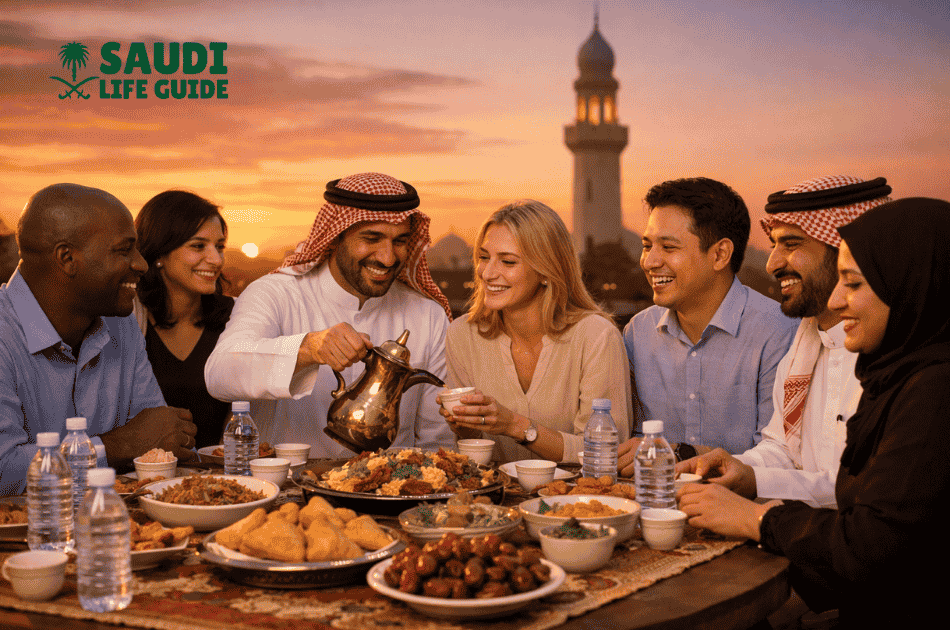
Experiencing your first Ramadan in Saudi Arabia can feel overwhelming if you’re unprepared. Many expats arrive in the Kingdom without fully understanding how dramatically life changes during Islam’s holiest month—and that lack of preparation often leads to confusion, workplace misunderstandings, and unintentional cultural missteps.
Based on real expat experiences living through multiple Ramadan seasons in Saudi Arabia, this guide walks you through everything you need to know: workplace changes, public behavior rules, dining options, cultural sensitivity, and practical survival tips that most generic travel sites won’t tell you.
Whether you’re Muslim or non-Muslim, working in Riyadh, Jeddah, or Dammam, this comprehensive guide ensures your first Ramadan experience in Saudi Arabia is smooth, respectful, and even spiritually enriching.
What Exactly Changes During Ramadan in Saudi Arabia?
Ramadan transforms daily life across the Kingdom in ways that catch many first-time expats completely off guard.
The Basics: Ramadan is the ninth month of the Islamic lunar calendar when Muslims fast from dawn (Fajr prayer) until sunset (Maghrib prayer). In Saudi Arabia—home to Islam’s two holiest mosques—Ramadan observance is strictly enforced through national laws, workplace regulations, and cultural expectations.
What This Means for Expats:
- Working hours reduce dramatically (typically 6 hours for private sector, less for government)
- All restaurants close during daylight hours (with very limited exceptions)
- Eating, drinking, or smoking in public becomes illegal
- Business operations slow significantly
- Traffic patterns change completely (quieter during day, chaotic before iftar)
- Social life shifts entirely to nighttime hours
Unlike Western countries where Ramadan observance is optional and personal, Saudi Arabia’s legal framework makes public respect for fasting mandatory—regardless of your religion. This isn’t about religious conversion; it’s about cultural respect and legal compliance in an Islamic state.
Fasting Rules for Non-Muslims: What’s Legal and What’s Not
This is the question nearly every expat asks before their first Ramadan in Saudi Arabia: “Do I have to fast if I’m not Muslim?”
The Clear Answer: No, non-Muslim expats are not required to fast during Ramadan in Saudi Arabia. Your personal eating and drinking decisions in private spaces remain your own.
However, Saudi law strictly prohibits:
- Eating in public view during fasting hours
- Drinking in public spaces (even water)
- Smoking in public areas
- Displaying food or beverages openly
What “Public” Actually Means: Based on real expat experience in KSA, “public” includes:
- Streets and sidewalks
- Parks and beaches
- Shopping malls and retail areas
- Office common areas and lobbies
- Company cafeterias (if visible to fasting colleagues)
- Your car if parked in public view with windows open
Private Spaces Where You Can Eat:
- Your private home or apartment
- Your hotel room
- Your private office with door closed
- Designated “eating rooms” in some international companies
- Your car while driving (windows up, not parked publicly)
Penalties for Violations: Eating or drinking publicly during Ramadan can result in:
- Warnings from religious police (Hai’a)
- Fines up to SAR 10,000
- Deportation in serious or repeated cases
- Workplace disciplinary action
Many expats in Saudi Arabia report that enforcement varies by city and location—Riyadh tends to be stricter than Jeddah—but the legal risk remains real regardless of location.
Ramadan Working Hours: How Your Schedule Will Change
Your work schedule during Ramadan in Saudi Arabia will change significantly, but the exact changes depend on your sector and employer.
Saudi Labor Law Requirements:
For private sector employees (the majority of expats):
- Normal months: 8-hour workday (48-hour week)
- Ramadan: Maximum 6-hour workday (36-hour week)
- Applies to: Both Muslims and non-Muslims
- Salary: Remains unchanged (you’re paid full salary for reduced hours)
For government employees:
- Often reduced to 5-hour workdays
- Typically 9:00 AM to 2:00 PM
- Service windows shortened dramatically
Typical Ramadan Work Schedules:
- Split shift companies: 9:00 AM – 12:00 PM, then 8:00 PM – 11:00 PM
- Single shift companies: 9:00 AM – 3:00 PM (most common for expats)
- Retail/hospitality: Varies widely; often opens after Asr prayer and stays open very late
Real Workplace Impact: Based on expat experiences across Saudi companies:
- Productivity drops 30-50% during Ramadan
- Decision-making slows significantly
- Project deadlines often shift automatically
- Meetings become shorter and less frequent
- Late-night work hours become more common
- International business communications experience delays
Pro Tip for Expats: Don’t schedule major deliverables, presentations, or critical negotiations during the last week of Ramadan. Energy levels hit rock bottom, and most Saudi colleagues are mentally preparing for Eid holidays.
Where Can You Eat During Ramadan? The Hidden Dining Options
This is where many expats struggle most during their first Ramadan in Saudi Arabia: finding food during daylight hours when 95% of restaurants are closed.
Option 1: Hotel Restaurants (Your Best Bet) Many international hotels operate “screening rooms” or “private dining areas” during Ramadan. These are typically:
- Located in hotels like Hilton, Marriott, Radisson, InterContinental
- Hidden from public view with curtains or separate entrances
- Open during daylight for hotel guests and sometimes non-guests
- Serving limited menus
- Requiring booking in some cases
Hotels Known for Ramadan Dining (Riyadh/Jeddah):
- Four Seasons Riyadh – Room service + screened dining
- Radisson Blu Jeddah – Private dining area
- Crowne Plaza Riyadh – Limited menu service
- Sheraton properties – Usually have options
Option 2: Private Clubs and Compounds
- Western compounds often maintain private dining facilities
- Some expat social clubs keep cafeterias open
- Access typically requires membership or residence
Option 3: Room Service and Takeaway
- Major hotel room service operates normally
- Some restaurants offer discreet takeaway through back doors
- Delivery apps (HungerStation, Jahez) operate with limited options
- Food gets delivered in unmarked packaging
Option 4: Home Cooking and Meal Prep Many expats in Saudi Arabia adopt meal-prepping during Ramadan:
- Cook large batches on weekends
- Stock up at Danube, Panda, or Tamimi supermarkets
- Frozen meals become essential
- Breakfast foods for lunch become common
What About Coffee? This is critical for caffeine-dependent expats: Starbucks, Costa, and Dunkin’ close during daylight hours. Your options:
- Hotel coffee shops (limited)
- Make coffee at home/office
- Cold brew prepared in advance
- Caffeine withdrawal is real—prepare accordingly
Sahur and Iftar: Understanding the Rhythm of Ramadan
To navigate your first Ramadan in Saudi Arabia successfully, you need to understand the two key daily events that structure everything.
Iftar (Breaking the Fast at Sunset):
- Happens at Maghrib prayer time (varies daily, around 6:00-6:30 PM)
- Entire Kingdom seems to stop for 30-45 minutes
- Mosques provide free community iftars
- Families gather for elaborate meals
- Restaurants immediately open and become packed
- Traffic becomes absolutely chaotic 30 minutes before iftar
Iftar Impact on Expats:
- Don’t schedule meetings 5:30-7:30 PM
- Roads become dangerous (hungry drivers rushing home)
- Plan your commute carefully
- Restaurants are fully booked (reserve ahead)
- Deliveries get delayed significantly
Sahur (Pre-Dawn Meal):
- Eaten before Fajr prayer (around 4:00-4:30 AM)
- Many Saudis stay awake until Fajr, then sleep
- Some restaurants and cafes open after Taraweeh prayers (around 10:00 PM) and stay open until Fajr
- Creates a unique late-night culture
The Nighttime Transformation: After iftar, Saudi Arabia becomes remarkably active:
- Malls stay open until 1:00-2:00 AM
- Restaurants remain packed until midnight
- Social visiting peaks between 9:00 PM-1:00 AM
- Streets that were empty during the day become vibrant
Many expats report that Ramadan nights in Saudi Arabia feel more alive than regular nights—it’s genuinely a unique cultural experience.
Cultural Etiquette: Respecting Ramadan as a Non-Muslim Expat
Showing cultural respect during Ramadan isn’t just about legal compliance—it’s about building positive relationships with Saudi colleagues and neighbors.
Do’s for Non-Muslim Expats:
- Lower your voice and music during fasting hours
- Dress even more modestly than usual (cover shoulders, longer garments)
- Avoid eating in front of fasting colleagues (even if legally allowed in your private office)
- Be patient with slower service everywhere
- Learn basic Ramadan greetings:
- “Ramadan Mubarak” (Blessed Ramadan)
- “Ramadan Kareem” (Generous Ramadan)
- Accept iftar invitations when offered (it’s a genuine honor)
- Express interest and ask questions about Ramadan’s spiritual significance
Don’ts That Will Offend:
- Don’t complain about reduced hours or slower business pace
- Don’t eat lunch at your desk where colleagues can see
- Don’t drink water openly in shared spaces
- Don’t schedule demanding work right before iftar
- Don’t make jokes about fasting or appear dismissive
- Don’t play loud music from your car or apartment
Real Expat Experience: Many non-Muslim expats in Saudi Arabia report that their Saudi colleagues actually appreciate when you ask genuine questions about Ramadan. Phrases like “This is my first Ramadan here—can you help me understand what I should know?” typically generate warm, helpful responses.
Shopping, Entertainment, and Services During Ramadan
Your access to normal services changes dramatically during Ramadan in Saudi Arabia.
Supermarkets and Grocery Stores:
- Generally remain open with modified hours
- Often close 30 minutes before iftar, reopen after
- Tamimi, Danube, Panda, Carrefour all adjust schedules
- Stock up on essentials to avoid iftar-time crowds
Shopping Malls:
- Close during daylight hours or open with limited stores
- Fully operational after Maghrib prayer
- Stay open until 1:00-2:00 AM
- Become family gathering spaces at night
Banks and Government Services:
- Dramatically reduced hours (often 9:00 AM-2:00 PM)
- Expect longer processing times
- Avoid the last week of Ramadan for critical paperwork
- Many services move entirely online
Medical Services:
- Hospitals operate 24/7 as normal
- Pharmacy hours may be reduced during day
- Emergency services fully available
- Private clinics often have modified hours
Entertainment:
- Cinemas open after Maghrib
- Theme parks operate evening hours only
- Concerts and events move to late night
- Family entertainment peaks after 8:00 PM
Preparing for Your First Ramadan: Practical Checklist
Based on what catches expats off-guard every year:
Before Ramadan Starts:
- Stock your pantry with 2 weeks of breakfast and lunch foods
- Download Ramadan timings app (Muslim Pro, Athan Pro)
- Identify nearby hotels with dining options
- Confirm your workplace’s Ramadan schedule
- Reschedule any medical appointments to morning hours
- Fill any prescriptions early
- Plan major purchases before Ramadan (shopping becomes difficult)
- Learn basic Ramadan greetings in Arabic
During Ramadan:
- Keep snacks in your car for emergencies (eat discreetly)
- Adjust your sleep schedule (you may need to adapt to nighttime life)
- Build iftar buffer into commute (30 minutes before sunset = traffic nightmare)
- Be extra patient everywhere
- Stay hydrated at night (especially if working outdoors during day)
Common Mistakes Expats Make During First Ramadan
These are the actual mistakes that catch newcomers in Saudi Arabia:
Mistake #1: Chewing Gum in the Car Even gum is considered eating. Keep it hidden.
Mistake #2: Forgetting Water in the Cup Holder Visible beverages = violation, even if not drinking.
Mistake #3: Scheduling Important Meetings Late Afternoon Your Saudi colleagues will be exhausted, distracted, and thinking only about iftar.
Mistake #4: Not Meal Prepping Finding food becomes genuinely difficult. Prepare accordingly.
Mistake #5: Underestimating the Eid Holiday Businesses often close for 7-10 days around Eid. Plan critical needs beforehand.
The Spiritual Opportunity for Non-Muslim Expats
Many non-Muslim expats in Saudi Arabia report that their first Ramadan becomes a surprisingly meaningful experience.
What Expats Often Discover:
- A deeper understanding of Islamic faith and practice
- Genuine connections with Saudi colleagues who appreciate your respect
- Personal reflection opportunities during quieter days
- A sense of shared community experience
- Appreciation for self-discipline and spiritual commitment
Optional Personal Participation: Some non-Muslim expats choose to:
- Try fasting for a day or two (as a personal challenge)
- Attend community iftars (often welcomed)
- Join late-night cultural events
- Learn about Islamic history and Ramadan’s significance
This is entirely personal and optional—but many expats report it enriches their Saudi experience significantly.
Your First Ramadan Survival Mindset
Here’s the reality: your first Ramadan in Saudi Arabia will feel disruptive, inconvenient, and challenging at times. That’s completely normal.
The Adjustment Period:
- First week: Frustrating (nothing is where it should be)
- Second week: Adaptation (you find your rhythm)
- Third week: Acceptance (you plan around it naturally)
- Fourth week: Almost over (everyone’s exhausted)
Pro Mindset Shift: Instead of viewing Ramadan as “a month to get through,” consider it an immersive cultural education you can’t get anywhere else. You’re witnessing Islam’s holiest month in its birthplace—that’s genuinely unique.
Final Thoughts: Embracing Your First Ramadan in Saudi Arabia
Your first Ramadan in Saudi Arabia will be unlike anything you’ve experienced before. It’s a month where the entire Kingdom slows down, turns inward, and prioritizes spiritual devotion over commercial productivity.
For expats, success during Ramadan comes down to three things:
- Preparation: Stock up, plan ahead, adjust expectations
- Respect: Honor the cultural and religious significance publicly
- Flexibility: Adapt your schedule and mindset to the new rhythm
Many expats who initially dreaded Ramadan report that by their second or third year, they actually appreciate the forced slowdown, the late-night vibrancy, and the genuine spiritual atmosphere that permeates Saudi Arabia during this month.
Understanding Ramadan is just one piece of the larger expat puzzle in Saudi Arabia. If you’re still getting your bearings on visa regulations, housing options, healthcare systems, or workplace expectations, our Saudi Life for Expats Guide 2026 provides the complete roadmap for navigating life in the Kingdom—covering everything from legal requirements to practical daily living tips that make your Saudi experience less stressful and more rewarding.
The Bottom Line: Ramadan in Saudi Arabia isn’t easy for newcomers, but it’s manageable with the right preparation and attitude. Respect the rules, plan your meals, be patient with service delays, and approach the experience with curiosity rather than resistance.
Your Saudi colleagues will notice and appreciate your efforts—and you’ll gain cultural insights that most tourists never access.
Ramadan Kareem, and welcome to a truly unique Saudi experience.
Can I drink water in my car during Ramadan in Saudi Arabia?
Yes, but only if your car windows are closed/tinted and you’re not parked in a highly visible public area. Many expats keep water bottles in their car but drink discreetly while driving.
Do hotels really serve food during Ramadan daylight hours?
Yes, most international hotel chains operate screened dining areas or room service during Ramadan. Call ahead to confirm availability and whether non-guests are allowed.
What happens if I accidentally eat in public during Ramadan?
If genuinely accidental and first-time, you’ll likely receive a warning. Repeated or intentional violations can result in fines (up to SAR 10,000) or deportation.
How long does Ramadan last?
Ramadan lasts 29-30 days (one lunar month), followed by Eid Al-Fitr, a 3-day celebration. Total business disruption typically spans about 5 weeks when including Eid holidays.

[…] Ahmad, A. (2026). Your First Ramadan in Saudi Arabia: A Complete Expat Guide. Diambil dari https://saudilifeguide.com/first-ramadan-in-saudi-arabia-complete-guide/. […]