
Last updated: 25 November 2026
The Saudi budget 2027 plans SAR 1,392.1 billion of spending against SAR 1,201.54 billion of revenue, leaving a deficit of SAR 190.56 billion, or 3.6% of GDP. The Council of Ministers, chaired by Crown Prince and Prime Minister Mohammed bin Salman, approved it in Riyadh on Tuesday 24 November 2026, and Finance Minister Mohammed Al-Jadaan presented the details the same evening.
Below are the official numbers from the Ministry of Finance budget statement, turned into five simple charts, plus a plain answer to the question most of our readers ask: does any of this change fees, tax or bills for expats?
Saudi budget 2027 at a glance
Spending is 3% lower than this year’s estimated actual, revenue is 1% higher, and the gap between them narrows from SAR 245 billion to about SAR 191 billion.
| Item | 2026 (estimated actual) | 2027 (budget) |
|---|---|---|
| Revenue | SAR 1,191 bn | SAR 1,201.54 bn |
| Spending | SAR 1,436 bn | SAR 1,392.1 bn |
| Deficit | SAR 245 bn (4.9% of GDP) | SAR 190.56 bn (3.6% of GDP) |
| Public debt (end of year) | SAR 1,733 bn (34.5% of GDP) | SAR 1,923 bn (35.9% of GDP) |
| Real GDP growth | minus 2.1% | 10.9% |
| Inflation | 1.9% | 2.3% |
In US dollars, spending is roughly $371 billion and the deficit about $51 billion at the fixed rate of SAR 3.75 to the dollar.
Follow Saudi Life Guide for Iqama, visa and job updates
New rules, fees and news as soon as we publish them. Join 137,000+ followers on Facebook.
Where the money goes: spending by sector
General items, the military and health with social development take more than half of all spending. Together they add up to SAR 791 billion out of SAR 1,392 billion.

“General items” is a catch-all line that the Ministry uses for large national projects and payments that do not sit under one ministry. Education gets SAR 195 billion and municipal services SAR 93 billion. Al-Jadaan grouped education, health and social development, and municipal services together as SAR 544 billion of social spending.
What changes compared with 2026
Most sectors get slightly less than they actually spent in 2026, with three exceptions: general items, the military and municipal services.
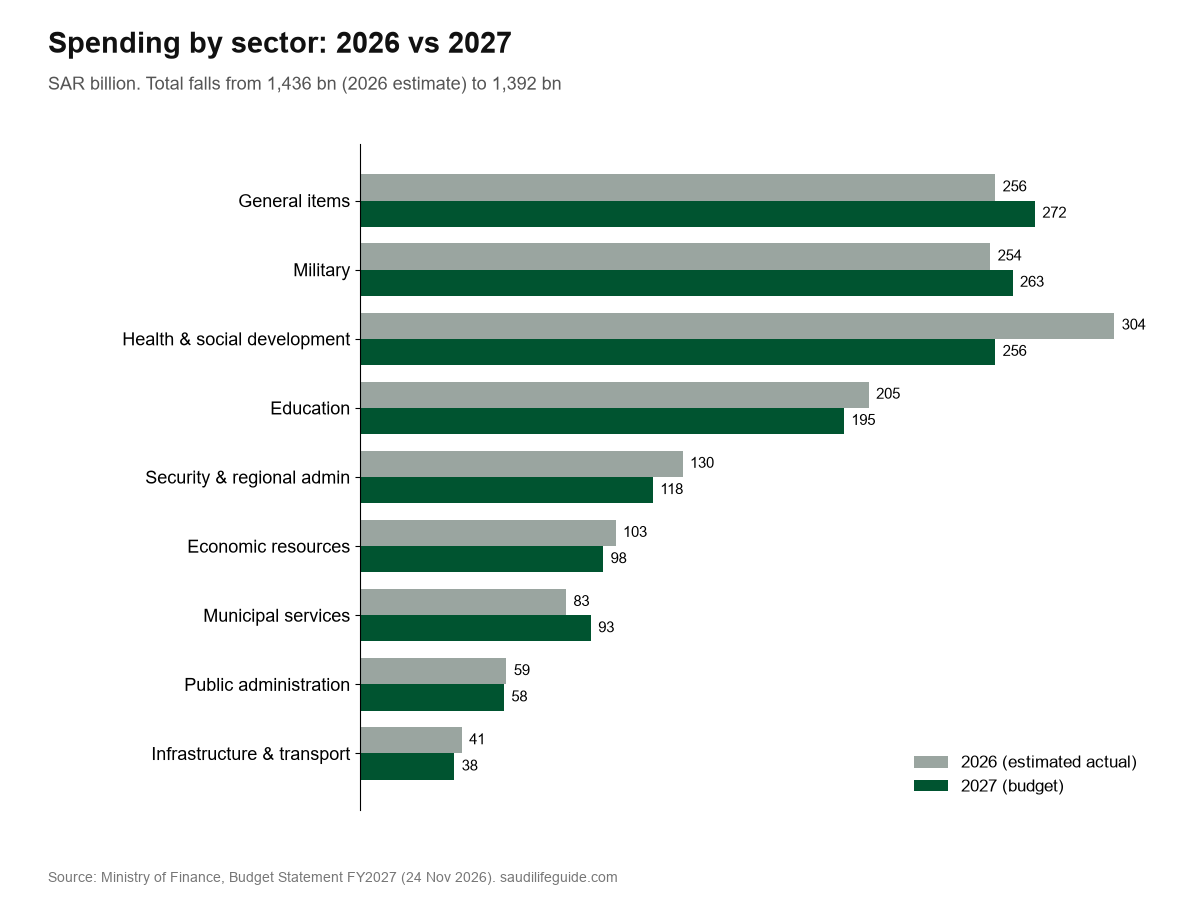
- Health and social development falls the most, from SAR 304 billion to SAR 256 billion. The 2026 figure was inflated by one-off items: health clusters moving to the Health Holding Company, and spending on hosting the AFC Asian Cup 2027.
- Municipal services rise 12%, from SAR 83 billion to SAR 93 billion. This is the spending you see in your own neighbourhood: roads, lighting, parks and city services.
- The military rises about SAR 9 billion to SAR 263 billion.
- Capital spending (new projects and assets) is SAR 178 billion, 12.8% of the total. The rest, SAR 1,214 billion, is operating spending such as salaries, goods and services.
Two smaller lines tell a bigger story. Interest payments on government debt jump 31%, from SAR 71 billion to SAR 93 billion. Subsidies drop 62%, from SAR 48 billion to SAR 18 billion, because the government reviewed the support it pays to the electricity and water companies. That second change is the one residents will feel, and we explain it in the expats section below.
Where the money comes from: oil and taxes
Taxes are expected to bring in SAR 414 billion in 2027, up 4.5%. The rest, SAR 787 billion, is “other revenue”, which includes oil income and returns on government investments.
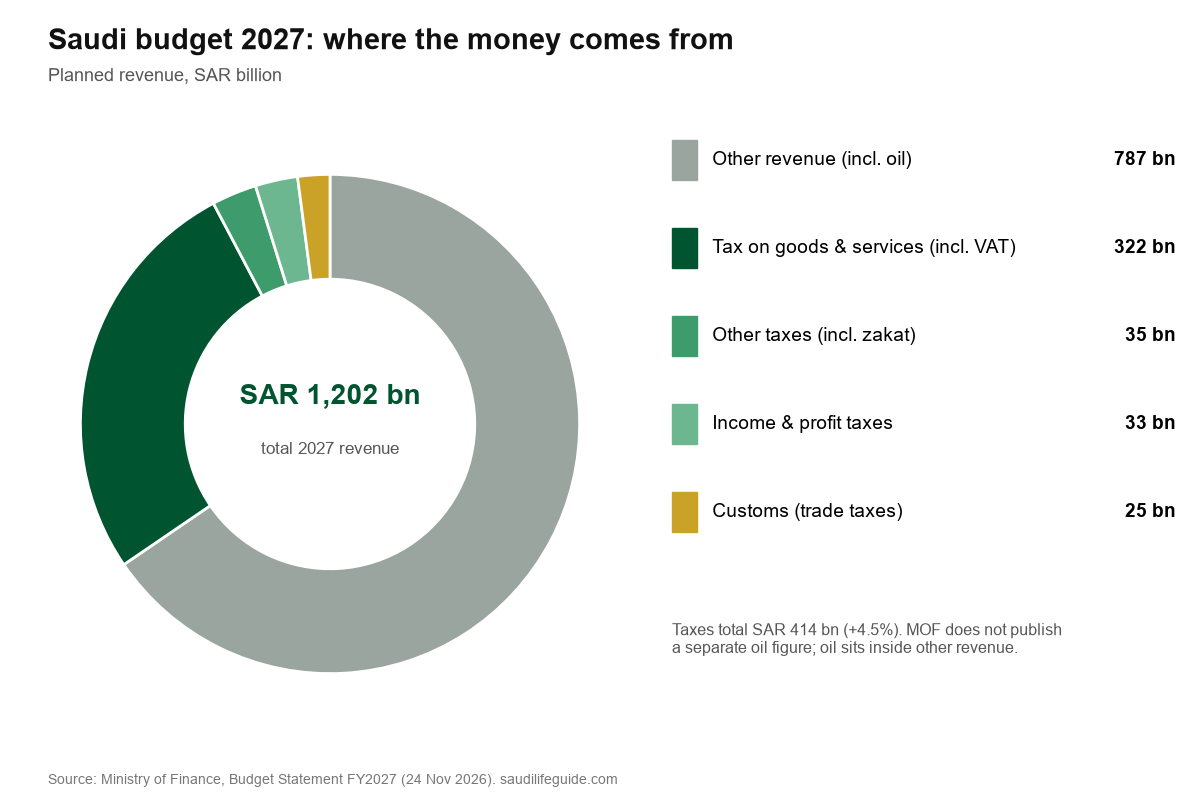
The biggest tax line by far is tax on goods and services, mainly VAT, at SAR 322 billion. It rises 6.6% because the Ministry expects people and companies to spend more, not because of any new rate. Income and profit taxes (paid by companies, not by salaried workers) stay at SAR 33 billion, and customs duties bring SAR 25 billion.
The Ministry does not publish a separate oil revenue figure for 2027. For context, the budget statement shows oil activity in the economy fell 14.6% in the first nine months of 2026, while non-oil activity grew 1.8%. Non-oil activities now make up a record 57.7% of the Saudi economy, according to the Ministry.
Why there is still a deficit
The Ministry of Finance projects a deficit every year up to 2029, but a smaller one as a share of the economy than in 2025 and 2026.
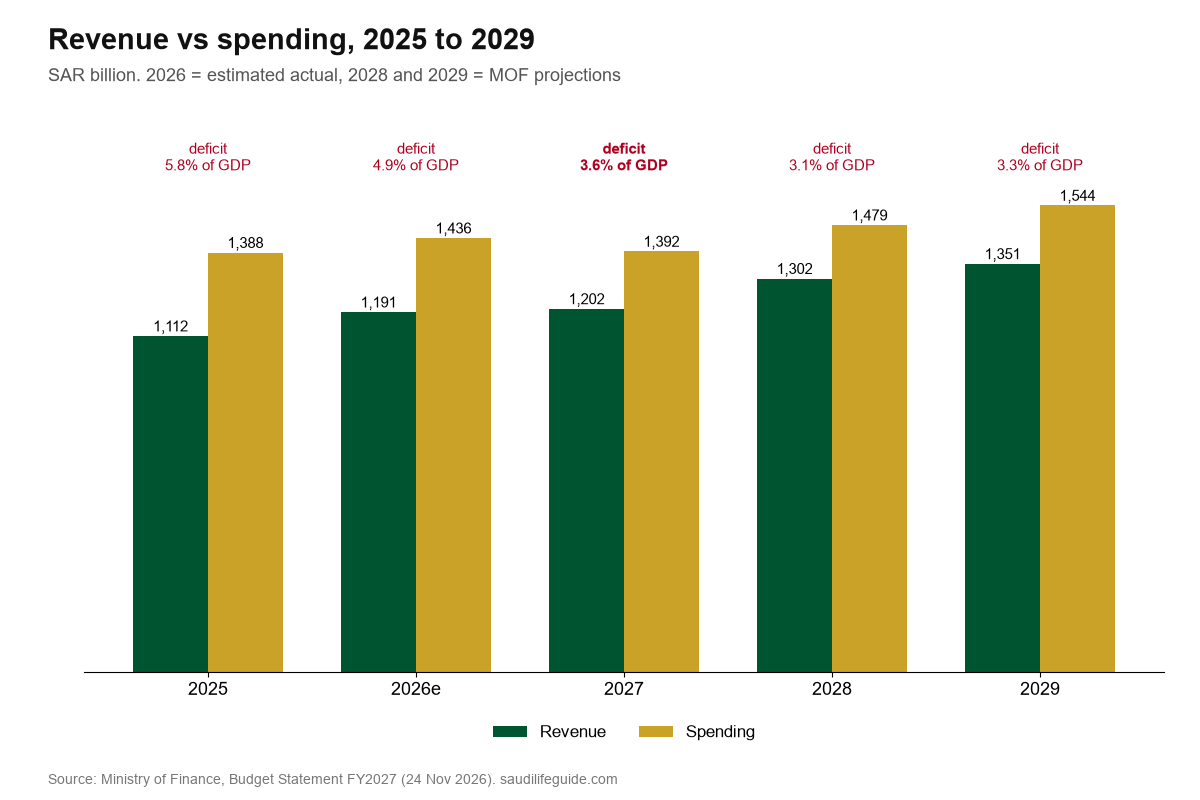
The 2026 deficit ended much wider than planned: SAR 245 billion against SAR 165 billion in the original budget. The National linked this to the regional conflict that disrupted oil exports from the end of February 2026. Al-Jadaan said the eastern ports were almost closed early in the year and trade was moved to the western ports, and that the government took more than 200 measures during the crisis.
The Ministry also published two alternative cases. If revenue comes in SAR 59 billion higher than planned, the 2027 deficit shrinks to about SAR 132 billion. If it comes in SAR 68 billion lower, the deficit grows to about SAR 259 billion.
Public debt and how the gap is paid for
The deficit is paid for mainly by borrowing, so government debt keeps rising: from SAR 1,733 billion at the end of 2026 to SAR 1,923 billion at the end of 2027.
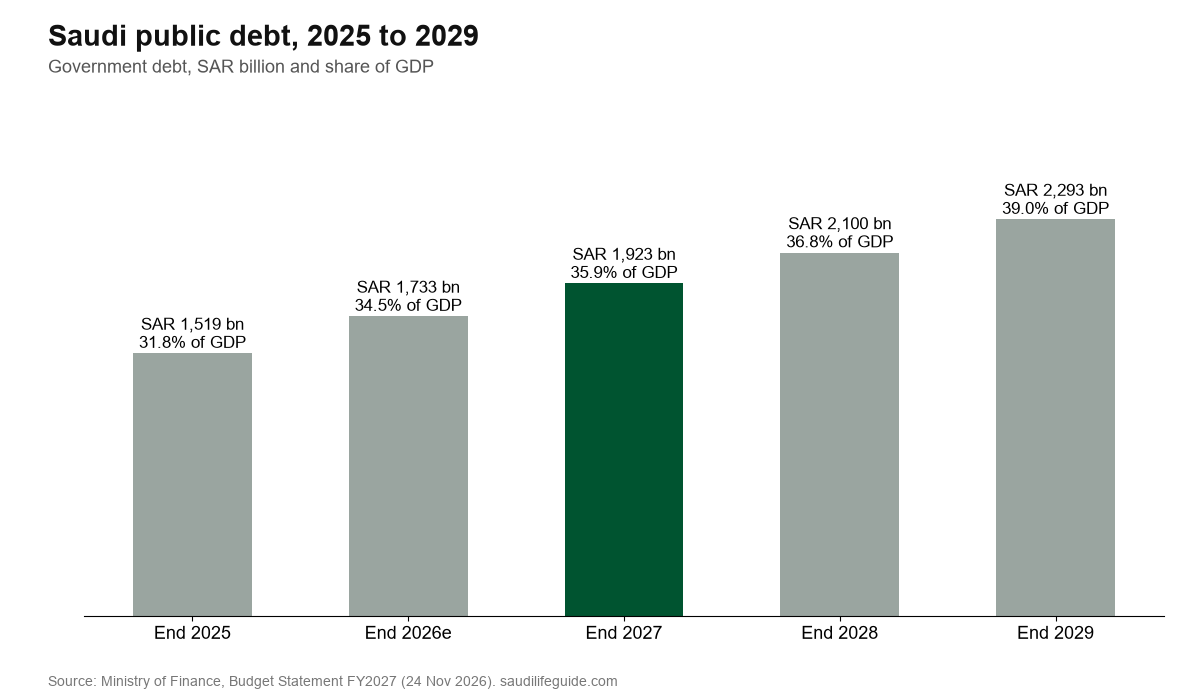
The plan is to borrow at home and abroad through bonds, sukuk and loans, and to use more project and export-credit financing. Government reserves at the Saudi Central Bank stay at SAR 399 billion. According to Al-Jadaan, around 90% of the debt is at fixed rates and more than half was borrowed below 3%.
Growth forecast: why 10.9% after a weak 2026
The Ministry expects the economy to shrink 2.1% in 2026 and then jump 10.9% in 2027, mainly as oil output returns to normal.
The 10.9% is lower than the 12.8% in the pre-budget statement of 30 September, because oil production rose in the last months of 2026, which raises the starting point. Non-oil growth for 2026 was revised down to about 2.5%, from 3.2%. The Ministry did not give a separate non-oil growth forecast for 2027. Inflation is expected at 2.3% in 2027, still low by world standards.
What the Saudi budget 2027 means for expats
The budget itself announces no new fee, levy or tax for expats. The changes residents will notice in 2027 come from decisions announced separately, mainly the new utility tariffs.
- Expat levy and dependant fees: no change announced. The budget statement does not mention the expat levy or dependant fees at all, and neither did the minister’s press conference. Current amounts are in our guide to iqama fees in Saudi Arabia.
- VAT: no rate change announced. VAT revenue rises only because spending is expected to grow.
- The “15% tax” headlines are not about your salary. From 1 January 2027, ZATCA applies a 15% minimum top-up tax to multinational groups with revenue of at least EUR 750 million. Saudi Arabia still has no personal income tax on salaries.
- Electricity and water bills go up from 1 January 2027. This is behind the 62% cut in subsidies. Water bills for homes using up to 30 cubic metres a month rise by no more than SAR 67 including VAT. The SAR 500 monthly support announced with the new tariffs is for eligible Saudi citizens only. See the new rates in our guides to the Saudi electricity tariff 2027 and the Saudi water tariff 2027, then work out your own bill with the electricity bill calculator and the water bill calculator.
- Support schemes in the news are for Saudis. SANED wage support, the Citizen Account and the new Riyadh housing plots (at no more than SAR 1,500 per square metre) are aimed at citizens.
- Big projects continue. The statement lists work on the Expo 2030 metro station in Riyadh, the Red Line extension to Diriyah, and stadiums for the AFC Asian Cup 2027 and FIFA World Cup 2034 (3 under construction and 8 more planned).
In practice, the budget line that touches most expat households is the utility bill. If you pay your own electricity and water, check your 2027 tariff now and budget for it, especially in the summer months when air conditioning pushes usage into the higher tiers. Planning your monthly costs? Our cost of living calculator helps you see the full picture.
Frequently asked questions
What is the Saudi budget for 2027?
The Saudi budget for 2027 plans spending of SAR 1,392.1 billion and revenue of SAR 1,201.54 billion, with a deficit of SAR 190.56 billion, or 3.6% of GDP. The Council of Ministers approved it on 24 November 2026, and the deficit will be covered mainly by borrowing.
Does the 2027 budget increase fees for expats in Saudi Arabia?
No, the 2027 budget does not announce any increase in the expat levy, dependant fees or VAT. The budget statement does not mention expat fees at all. The main cost change for residents in 2027 is the new electricity and water tariffs from 1 January 2027, which were announced separately in October 2026.
Which sector gets the most money in the Saudi budget 2027?
General items get the largest share of the Saudi budget 2027 at SAR 272 billion, followed by the military at SAR 263 billion and health and social development at SAR 256 billion. Education receives SAR 195 billion and municipal services SAR 93 billion.
Is there a new 15% income tax in Saudi Arabia from 2027?
No, there is no new income tax on salaries in Saudi Arabia. The 15% tax starting on 1 January 2027 is a minimum top-up tax on large multinational groups with annual revenue of at least EUR 750 million. Employees, including expats, still pay no personal income tax on their wages.
How much is Saudi Arabia’s public debt in 2027?
Saudi Arabia’s public debt is expected to reach SAR 1,923 billion by the end of 2027, or 35.9% of GDP, up from SAR 1,733 billion at the end of 2026. The Ministry of Finance projects it to reach SAR 2,293 billion, 39% of GDP, by the end of 2029.
Key takeaways
- Spending SAR 1,392.1 billion, revenue SAR 1,201.54 billion, deficit SAR 190.56 billion (3.6% of GDP).
- The deficit narrows from SAR 245 billion in 2026, which was hit by disrupted oil exports.
- Taxes bring SAR 414 billion; VAT and other goods and services taxes are SAR 322 billion of that.
- Subsidies fall 62% as utility support is reviewed; interest costs rise 31%.
- No change to the expat levy, dependant fees or VAT was announced. Utility tariffs rise from 1 January 2027.
Sources
Figures are from the Ministry of Finance General Budget 2027 page and its budget statement (24 November 2026), the cabinet decision reported by the Saudi Press Agency, and the minister’s press conference as reported by Arab News, Al Eqtisadiah and The National. Tariff details are from Saudi Electricity and the National Water Company announcements of 26 October 2026.
We are not a government office. This article explains official figures in simple words and is not financial or investment advice.
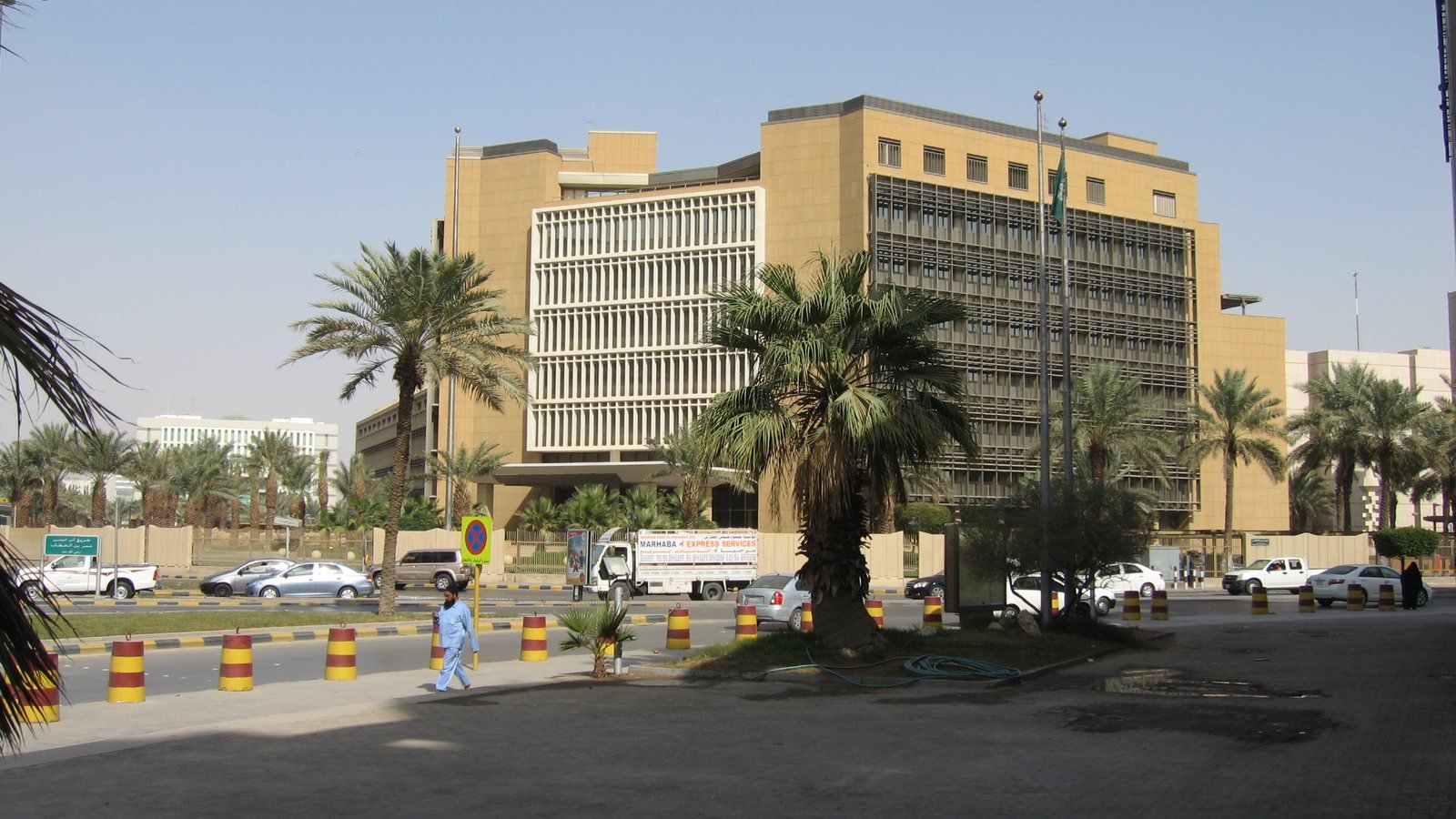
Featured photo: Ministry of Finance building, Riyadh. Albreeze, CC BY-SA 3.0, Wikimedia Commons.