



Summary
“Saudi Arabia’s Ministry of Human Resources and Social Development (HRSD) has issued a reminder that employers must provide dedicated seating for sales cashiers and reception staff during work hours. Chairs placed only in rest or break areas do not fulfill this legal requirement.”
In June 2026, Saudi Arabia’s Ministry of Human Resources and Social Development (HRSD) reminded private sector employers of a clear, existing obligation: employees working as sales cashiers and receptionists must have a chair at their workstation during working hours.
This is not a new law. The requirement sits within Saudi Labor Law’s occupational health and safety framework. But HRSD’s public reminder signals that many private sector businesses are still not compliant.
The announcement also carries a direct message to employees. If your employer is not providing workstation seating, you have the right to report it through the HRSD official application. Your complaint stays confidential. Your employer will not know who filed it.
What Did HRSD Actually Announce?
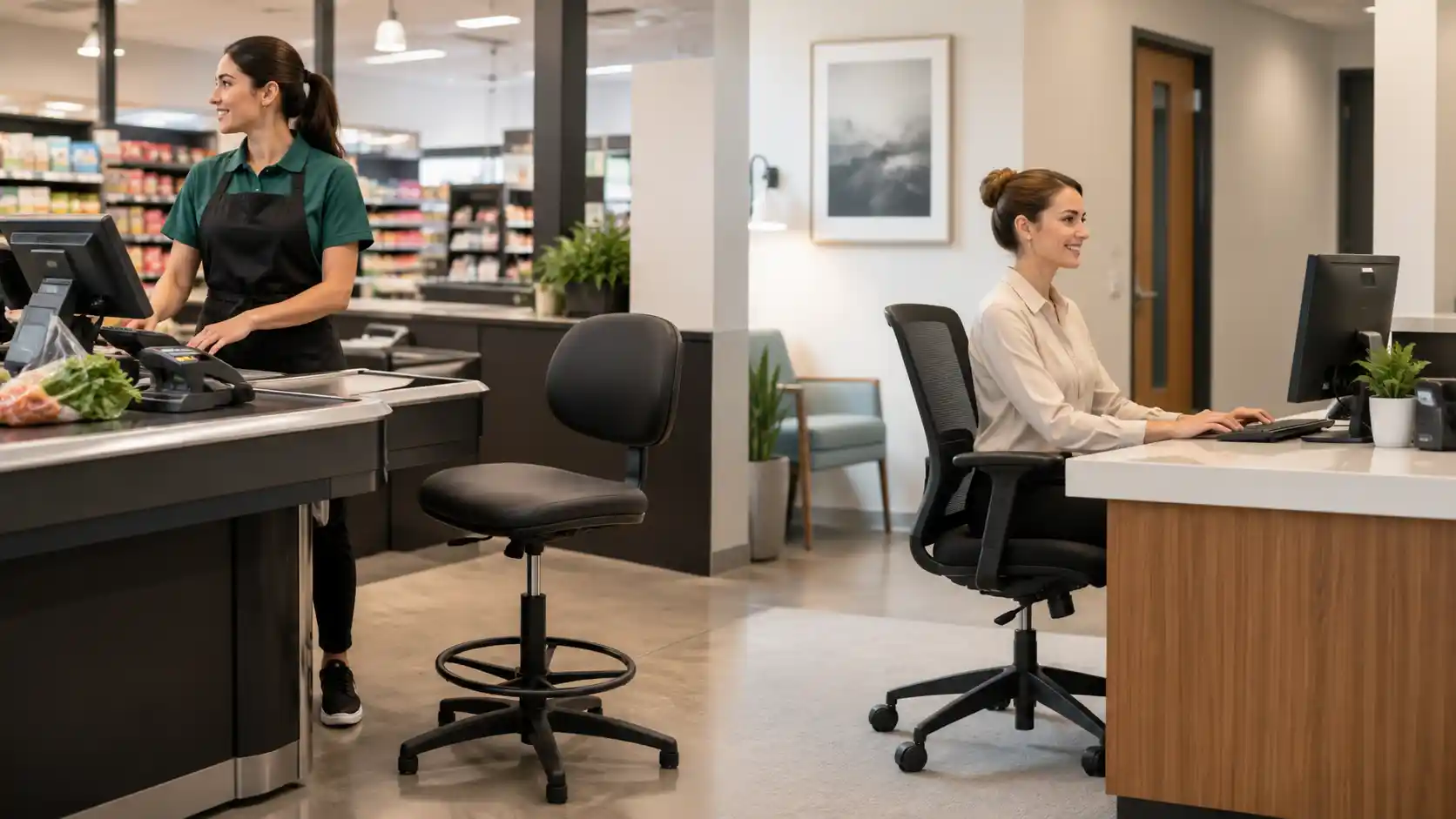
HRSD reminded all private sector establishments in Saudi Arabia that employers are legally required to provide chairs for employees working in sales cashier and reception roles. The chairs must be at or near the employee’s workstation and available for use during active working hours.
The ministry made one critical point very clear: chairs located in rest areas, break rooms, or prayer spaces do not count toward this requirement. Telling an employee to go to the break room to sit down when they need a rest is not compliance with this rule.
HRSD also encouraged employees affected by this issue to report violations directly through the ministry’s official mobile application.
Key Point: A chair in the break room does not replace a chair at the workstation. Both must exist separately for an employer to be compliant.
The reminder is part of HRSD’s broader, ongoing push to improve working conditions across Saudi Arabia’s private sector and bring workplace practices in line with the Kingdom’s Vision 2030 objectives.
Which Employees Does This Rule Cover?
The HRSD seating requirement specifically covers two job categories in the private sector:
Sales cashiers are employees who work at payment counters in retail environments. This includes workers at supermarket checkout counters, pharmacy payment desks, petrol station kiosks, retail store registers, and similar fixed-position roles.
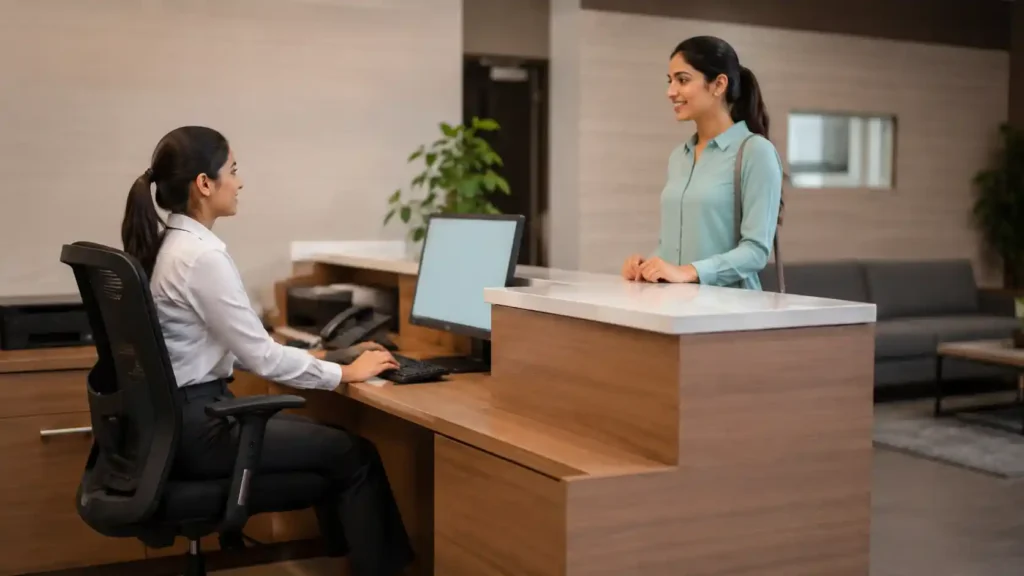
Reception staff are front desk and welcome area employees. This covers receptionists at hotels, medical clinics, corporate offices, beauty salons, government service centers, and any establishment where a staff member is stationed at a counter or desk to receive visitors or calls.
Both male and female employees in these roles are covered. Saudi Labor Law has long required seating for female employees in workplaces where women are employed. HRSD’s June 2026 announcement reinforces and broadens the focus to cover these specific job categories regardless of gender.
The common thread is this: if your job requires you to remain at a fixed workstation during your shift, your employer must provide a seat there.
| Job Role | Common Workplace Examples |
|---|---|
| Sales Cashier | Supermarkets, retail stores, pharmacies, petrol stations |
| Receptionist / Front Desk | Hotels, medical clinics, salons, offices, service centers |
| Ticket Counter Staff | Cinemas, transit stations, events venues |
| Bank Teller and Similar Roles | Banking branches, exchange offices |
What Does Saudi Labor Law Say About Workplace Seating?
The seating obligation comes from Chapter Eight of the Saudi Labor Law, which deals with occupational safety, worker health, and social care. Under this framework, employers are required to provide a safe and healthy working environment as a fundamental condition of employment.
HRSD’s national strategy on occupational safety and health states clearly that providing proper working conditions is essential for workforce productivity and directly supports Saudi Arabia’s broader economic goals.
Saudi Labor Law has included seating protections for female employees for years. The law states that in all workplaces where women are employed, the employer must provide them with seating. HRSD’s June 2026 reminder specifically targets cashier and reception roles and applies that standard broadly, covering all employees in those positions.
One legal protection that every employee should know about is Article 202 of the Saudi Labor Law. This article requires labor inspectors to treat all complaints with absolute confidentiality. An inspector who receives a complaint about a workplace violation cannot tell the employer or their representative who filed the complaint. This protection exists precisely to encourage employees to report violations without fear of retaliation.
Employers in the private sector are also subject to the updated penalty schedules introduced through the April 2025 amendments to the Saudi Labor Law Implementing Regulations. These amendments strengthened the financial consequences for non-compliance with workplace welfare rules.
Why This Rule Matters: Health Impact of Standing All Day
Requiring employees to stand for eight or more hours without access to proper seating is not just uncomfortable. It has real, documented health consequences.
Prolonged standing without rest causes chronic lower back pain and places excessive strain on hip, knee, and ankle joints. It restricts blood circulation in the legs, leading to swelling and, over time, varicose veins. Employees forced to stand all day also experience faster mental fatigue, which reduces accuracy and lowers customer service quality.
For employers, this translates into real business costs. Higher sick leave, lower staff retention, reduced service quality, and greater exposure to labor law penalties all follow from not providing proper workstation seating.
Providing a chair at the workstation costs very little but delivers measurable returns in productivity, attendance, and staff wellbeing.
| Health Risk from Prolonged Standing | Benefit of Proper Workstation Seating |
|---|---|
| Lower back and joint pain | Reduced musculoskeletal strain |
| Poor circulation in the legs | Better blood flow throughout shifts |
| Fatigue and reduced focus | Sustained concentration and accuracy |
| Higher rates of sick leave | Improved attendance and reliability |
| Long-term physical health costs | Lower healthcare burden on employees |
Employer Obligations: What You Must Provide
Compliance with the HRSD seating rule is not complicated, but it does require deliberate action. Here is what private sector employers must do:
Provide a chair at the workstation. The seat must be at or directly adjacent to the employee’s working area. A chair in a back office, storage room, or rest area does not qualify.
Allow the chair to be used during working hours. Some employers place a chair at the workstation but instruct employees not to sit while customers are present. This also violates the requirement. Employees must be free to use the provided seating throughout their shift, not only during breaks.
Apply the rule at every branch and location. The obligation covers every establishment the employer operates. A business cannot comply at head office while ignoring the rule at its retail outlets.
Brief managers and floor supervisors. Many violations happen because floor managers enforce a standing-only policy for appearance reasons without realizing it is a labor law breach.
Match the seating to the workstation. The law does not specify a chair type, but the seating must allow the employee to do their job. At a high counter, a taller stool works. At a standard desk, a regular chair is fine.
Important for Employers: If a chair exists in the break room but no chair is available at the cashier counter or reception desk, the employer is not compliant. Both must exist independently.
What Counts as a Violation?
Understanding where the line sits helps both employees and employers navigate this correctly.
The following situations are violations:
- No chair is provided at the cashier counter or reception desk at all
- A chair exists at the workstation but employees are told not to use it while on duty
- The only seating available is in a rest or break area, with no workstation chair present
- An employer verbally instructs employees to stand during their entire shift for appearance or customer service reasons
The following situations are not violations:
- A chair is available at the workstation and the employee personally chooses not to use it
- A shared workstation where multiple employees rotate and one chair is provided for use at that station
- A workstation design where seating is built into the counter setup (high stools, integrated seating)
The key test is simple: can the employee sit at their workstation during their shift if they want to? If the answer is no, the employer is likely in violation.
How to Report a Seating Violation to HRSD
If your employer is not providing workstation seating as required, you have a straightforward way to report it. HRSD has made the process fully digital and legally protected.
Step 1: Get the HRSD app. Download the official HRSD application from the App Store or Google Play. You can also access the service through the HRSD website at hrsd.gov.sa.
Step 2: Log in with Absher. The app uses Absher for identity verification. Use your national ID or Iqama number and your Absher credentials to sign in.
Step 3: Go to the complaints section. Inside the app, navigate to the labor violations or complaints section. Select the option to report a workplace violation.
Step 4: Fill in the details. Enter the name of your employer or establishment, the branch location, and a description of the violation. In this case, that is the failure to provide workstation seating for cashier or reception staff.
Step 5: Submit your report. Once submitted, your complaint enters the HRSD system. Under Article 202 of the Saudi Labor Law, the labor inspector assigned to your complaint is legally prohibited from revealing your identity to your employer. Your name stays out of it.
| Step | What to Do |
|---|---|
| 1 | Download the HRSD app or open hrsd.gov.sa |
| 2 | Log in using your Absher account |
| 3 | Go to “Report a Labor Violation” |
| 4 | Enter employer name, branch location, and violation details |
| 5 | Submit. Your complaint is fully confidential by law. |
You can also report through the Qiwa platform (qiwa.sa) if your employment contract is registered there.
What Happens After You File a Complaint?
Once you submit a complaint through the HRSD app, a labor inspector takes over.
The inspector reviews the details of your complaint and may visit the establishment in person to assess compliance. They do this without disclosing your identity or indicating that a complaint has been filed by a specific person.
If the inspector confirms the violation, the employer receives an official notification and is given a deadline to become compliant. For most basic violations like missing workstation seating, this means providing the required chair within the specified period.
If the employer fails to comply after notification, financial penalties apply under the updated Saudi Labor Law penalty schedules. The April 2025 amendments to the Implementing Regulations introduced stricter fines across several categories of workplace non-compliance.
Employers who receive a violation notice can submit a settlement request through the HRSD e-services portal within 90 days of the decision date. This does not remove the obligation to comply. It only affects the financial penalty resolution process.
For employees, the process typically ends at the submission stage. You file, the system handles the rest, and your employer has no legal way to identify you as the source.
What This Means for Private Sector Employers in 2026
HRSD has issued targeted compliance reminders throughout 2026 covering employment contracts, Hajj leave, domestic worker rules, Saudization targets, and now workstation seating. The pattern is deliberate. HRSD is proactively reminding employers of existing obligations and signaling that enforcement will follow.
The April 2025 amendments to the Saudi Labor Law Implementing Regulations gave HRSD a stronger penalty framework. Fines across multiple welfare-related violation categories were introduced or increased. Workstation seating falls within the same occupational welfare category.
The practical step for employers is an immediate internal audit. Check every branch. Confirm that every cashier counter and reception desk has a usable chair available during working hours. A chair at a workstation costs next to nothing. A labor violation notice and penalty cost considerably more.
Conclusion
The HRSD seating rule is clear. Private sector employers in Saudi Arabia must provide a chair at the workstation for employees in sales cashier and reception roles. A chair in the break room does not count. The seat must be at the workstation and available during working hours.
For employees, this is a legal right. If your employer is not providing it, report the violation through the HRSD app. Your identity is fully protected under Article 202 of the Saudi Labor Law.
For employers, the fix takes minutes. There is no reason to wait.
For more on Saudi Labor Law, employee rights, and workplace regulations in the Kingdom, visit Saudi Life Guide.
