


Last updated: 29 October 2026
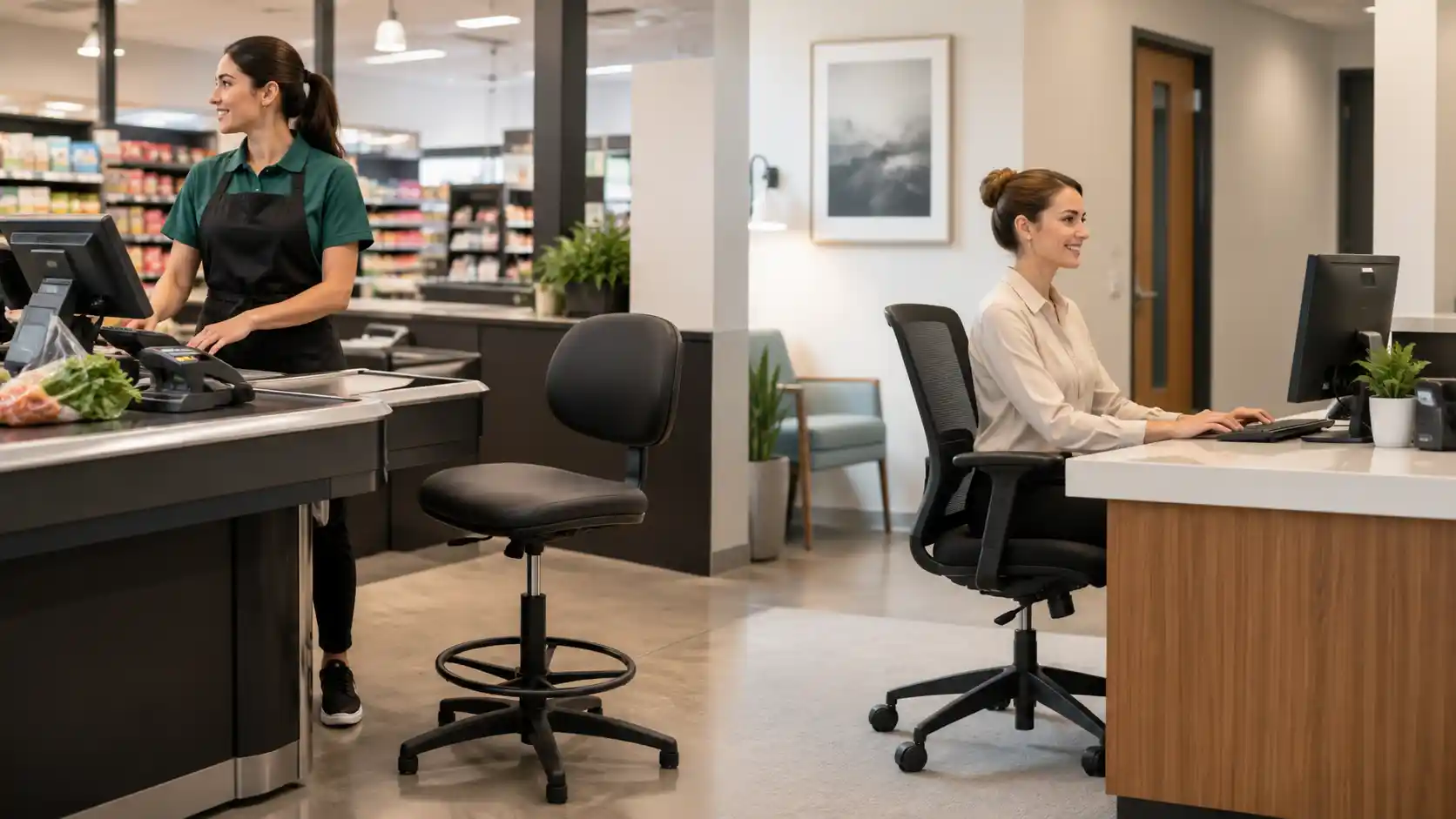
The HRSD seating rule means private sector employers in Saudi Arabia must give sales cashiers and receptionists a seat at their workstation during working hours. A chair in the break room does not count. The Ministry of Human Resources and Social Development (HRSD) restated this in mid-June 2026 and asked workers to report any establishment that does not comply.
This is not a new law. HRSD called it an existing regulatory requirement, and the Labor Law has required seats for women workers for years under Article 158. What changed in 2026 is the focus: the ministry named two standing-heavy jobs and made clear that a rest-area chair is not enough.
HRSD Seating Rule at a Glance
| Question | Answer |
|---|---|
| Who announced it | Ministry of Human Resources and Social Development (HRSD), June 2026 |
| Jobs named | Sales cashiers and reception staff in the private sector |
| What must be provided | A suitable seat at the workstation, usable during working hours |
| Break-room chair enough? | No. Work seats and rest seats are separate |
| Legal background | Labor Law Article 158 (seats for women in all occupations) and the employer duty to keep work safe and healthy |
| How to report | HRSD app, hrsd.gov.sa or 19911 |
| Your identity | Kept confidential by the inspector (Article 202) |
Follow Saudi Life Guide for Iqama, visa and job updates
New rules, fees and news as soon as we publish them. Join 101,000+ followers on Facebook.
What Did HRSD Announce?
According to Saudi daily Al-Watan, which reported the ministry statement on 14 June 2026, HRSD stressed that establishments must provide suitable seats for workers in sales cashier and reception jobs. It described seats during working hours as one of the regulatory requirements that improve working conditions.
The ministry made three points:
- Seats for work are different from seats for rest. They must be available while employees carry out their daily tasks.
- The aim is to reduce the physical strain of standing for long periods, support health and safety at work, and improve productivity and service quality.
- Workers should report any establishment that does not provide the seats, and the ministry will continue its inspections.
Key point: a chair in the break room does not replace a chair at the counter. If you cannot sit at your workstation during your shift, the requirement is not met.
Which Employees Does the Rule Cover?
The reminder names two job groups in the private sector:
- Sales cashiers: checkout and payment counter staff in supermarkets, pharmacies, retail stores, petrol station kiosks and similar shops.
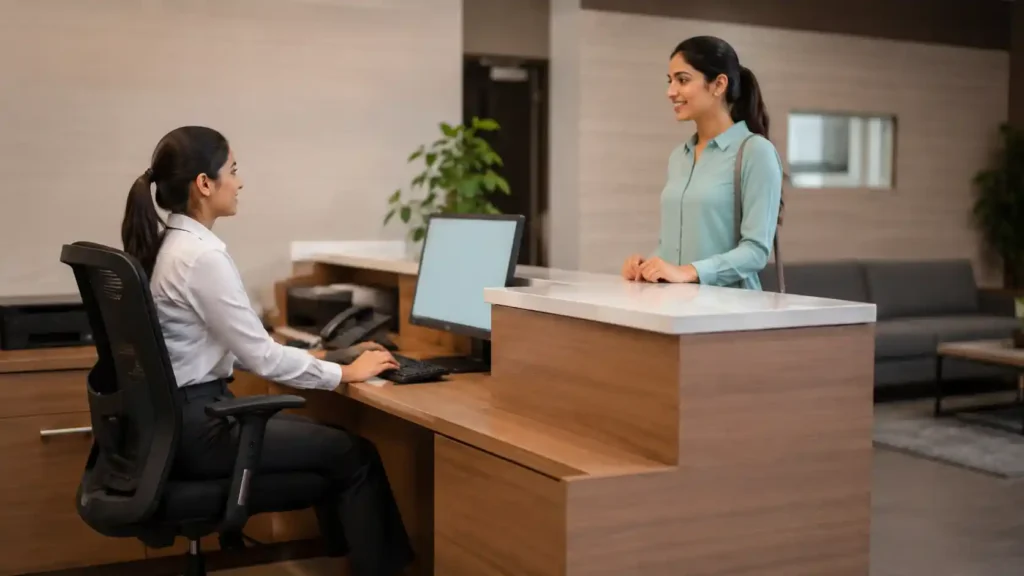
- Reception staff: front desk employees in hotels, clinics, offices, salons and any business where someone is stationed at a desk to receive visitors or calls.
HRSD did not publish a longer list. Other fixed-counter roles, such as ticket counters or service desks, are not named in the reminder, but the same logic applies: if the job keeps you at one counter for the whole shift, ask for a seat there. For women in any job, the seat obligation comes straight from Article 158, whatever the role.
For expats, note that cashier and receptionist posts are now among the administrative support jobs reserved for Saudis, as explained in our guide to the jobs shrinking and growing for expats. Expats who still work in shops, hotels and clinics in similar standing roles can rely on the same principles.
What Does Saudi Labor Law Say About Seats at Work?
Article 158 of the Saudi Labor Law says that in all places where women work, and in all occupations, the employer shall provide them with seats for their rest. HRSD lists it on its women’s rights at work page, next to the maternity and childcare articles. Our guide to women’s rights at work in Saudi Arabia covers those related articles.
The 2026 reminder goes beyond women: it applies to cashier and reception staff of either gender, and it treats the seat as part of the employer’s general duty to keep the workplace safe and healthy.
Article 202 matters just as much for workers. It requires the labor inspector to keep any complaint about a violation absolutely confidential, and not to tell the employer or its representative that an inspection followed a complaint.
Working Hours and Rest Breaks: The Rules Around Standing Jobs
The seat rule sits alongside the Labor Law limits on working time, which also protect cashiers and front desk staff:
- Normal hours (Article 98): up to 8 hours a day or 48 hours a week. In Ramadan, Muslim workers work up to 6 hours a day or 36 hours a week.
- Breaks (Article 101): working hours must include at least half an hour of rest, prayer and meals, so that no one works more than 5 hours in a row.
- Overtime (Article 107): extra hours are paid at the basic hourly wage plus 50%. Work out yours with our overtime calculator.
A break is not a substitute for a work seat, and a work seat is not a substitute for a break. You are entitled to both.
What Counts as a Violation?
Likely violations:
- No seat at the cashier counter or reception desk at all.
- A seat exists at the workstation, but staff are told not to use it while on duty.
- The only seats are in the rest or prayer area.
- A supervisor tells staff to stand for the whole shift for appearance reasons.
Usually not a violation:
- A seat is available at the workstation and the employee chooses to stand.
- Staff rotate on a shared counter that has a seat for whoever is on duty.
- Seating is built into the counter, such as a high stool at a tall checkout.
The simple test: can you sit at your workstation during your shift when you need to? If not, raise it.
What Employers Should Do
- Put a suitable seat at every cashier counter and reception desk, in every branch.
- Match the seat to the counter: a tall stool for a high checkout, a normal chair for a desk.
- Tell floor managers and supervisors in writing that staff may sit during their shift.
- Keep rest-area seating as well; it does not replace the workstation seat.
Is There a Fine for Not Providing Seats?
HRSD did not name a fine in its June 2026 reminder. Labor violations are fined under the ministry’s violations and penalties schedule. The current version is Ministerial Decision 112377, dated 21 Sha’ban 1447 (9 February 2026) and published on 25 February 2026.
Under that schedule, fines depend on the size of the establishment: 20 workers or fewer, 21 to 49, and 50 or more. Inspectors decide which item of the schedule applies, so treat any single fine figure you see on social media with care.
How to File an HRSD Complaint About Seating
If your employer does not provide a workstation seat, you can report it yourself:
- Open the official HRSD app or hrsd.gov.sa and sign in with your Absher or Nafath account.
- Go to the section for reporting a labor violation.
- Enter the establishment name, the branch location and what is missing (no seat at the cashier counter or reception desk).
- Add a photo if you can take one safely, then submit and keep the reference number.
- If you have trouble online, call the HRSD line 19911.
To follow up on a complaint, or if you need to visit an office, our Maktab Amal (labour office) guide lists the offices and helplines. Pay problems are a different case: for late or missing wages, follow our guide on what to do when your salary is delayed.
What Happens After You Report?
A labor inspector reviews the report and may visit the establishment. Under Article 202, the inspector must not reveal your identity or tell the employer that the visit followed a complaint.
If the inspector confirms the violation, the establishment can be fined under the violations schedule and is expected to fix the problem. In practice, for a missing seat, that means putting the seat in place.
Frequently Asked Questions
What is the HRSD seating rule?
It is the requirement, restated by the Ministry of Human Resources and Social Development in June 2026, that private sector employers give sales cashiers and receptionists a seat at their workstation during working hours. A chair in the rest area does not count.
Is the HRSD seating rule a new law?
No. HRSD described seats during working hours as an existing regulatory requirement. Article 158 of the Labor Law has long required employers to provide seats for women in all workplaces and occupations, and the 2026 reminder applies the same idea to cashier and reception posts.
Does a chair in the break room count?
No. HRSD said work seats are different from rest seats. The seat must be at the counter or desk and usable while you do your job, not only during your break.
How do I file an HRSD complaint about seating?
Report the establishment through the official HRSD app or hrsd.gov.sa, signing in with your Absher or Nafath account, or call the HRSD line 19911. Give the establishment name, the branch and what is missing.
Will my employer know I complained?
Article 202 of the Labor Law requires the labor inspector to keep any complaint about a violation confidential and not to tell the employer that an inspection followed a complaint.
What is the fine for not providing seats?
HRSD did not name a fine in its reminder. Labor violations are fined under the ministry violations schedule, currently Ministerial Decision 112377 of February 2026, where the amount depends on the size of the establishment.
Final Words
The HRSD seating rule is simple: cashiers and receptionists in the private sector must be able to sit at their workstation during working hours, and a chair in the break room does not count. Women in any job have the same right under Article 158.
If the seat is missing, report it through the HRSD app or 19911. The inspector keeps your identity confidential.
This article is for general information and is not individual legal advice.