


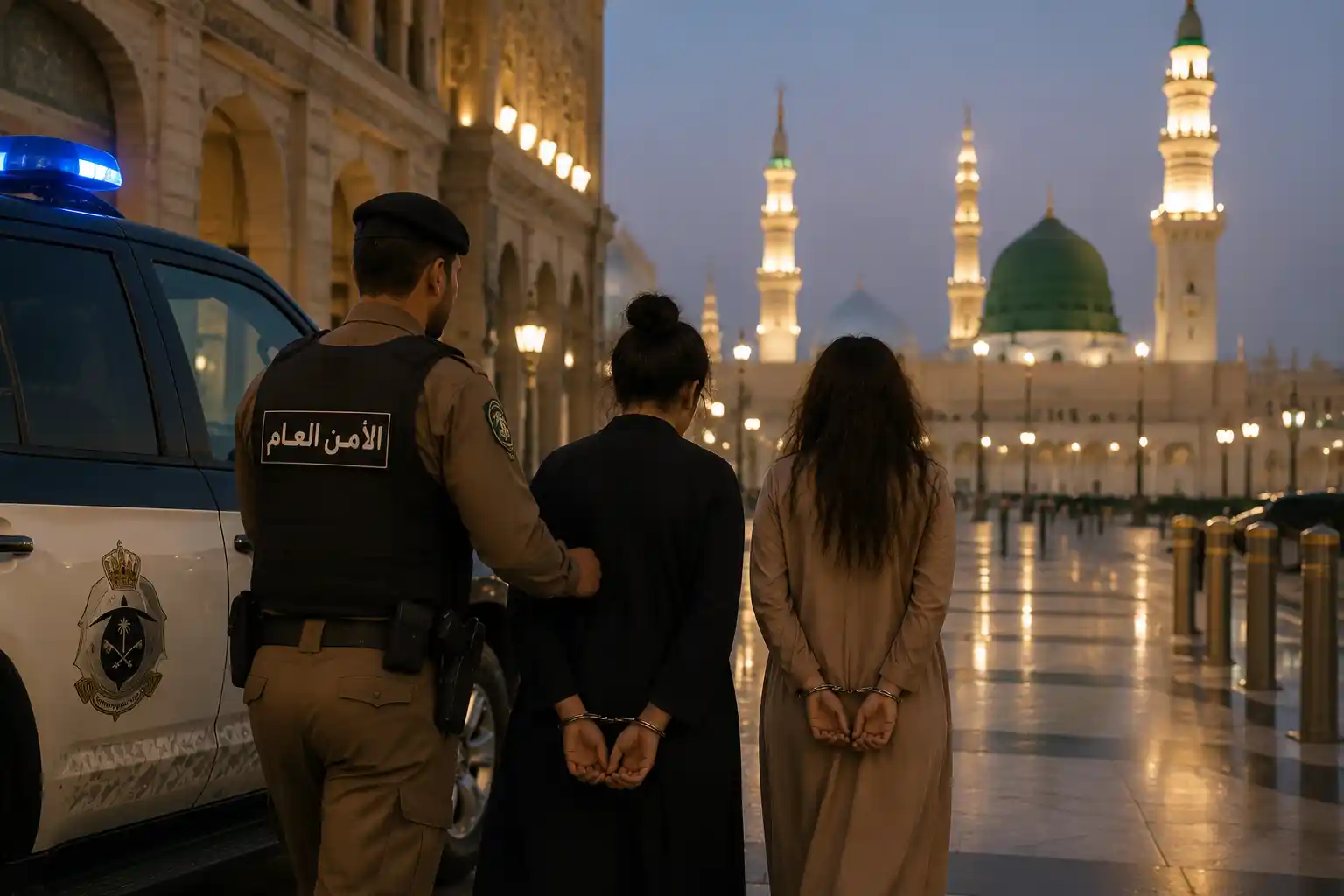
The latest Madinah prostitution arrest involves two expatriate women, detained by Madinah police and referred to the Public Prosecution, Okaz reported on 20 August 2026. The arrest came through the General Directorate of Community Security and Combating Human Trafficking. No nationalities were released, and no court verdict has been issued.
What we know so far
| Item | What was reported |
|---|---|
| Who | Two expatriate women |
| Where | Madinah region |
| Arresting body | Madinah region police |
| Coordinating unit | General Directorate of Community Security and Combating Human Trafficking |
| Allegation | Practising prostitution |
| Stage of the case | Referred to the Public Prosecution |
| Date reported | 20 August 2026 |
That is the entire confirmed record. Saudi police statements of this type are short by design: they name the region, the coordinating unit and the stage the case has reached, then stop. Nationality, age, employer and visa status are not released, so details circulating beyond that list have been filled in by someone, not reported.
Referral to the Public Prosecution is also not a conviction. It is the point where prosecutors take over the file and decide whether to bring charges. Many expats read “arrested and referred” as a finished story. It is the opening chapter.
Follow Saudi Life Guide for Iqama, visa and job updates
New rules, fees and news as soon as we publish them. Join 60,000+ followers on Facebook.
The unit behind these arrests
One body is named in almost every announcement of this kind. The Ministry of Interior created the General Directorate of Community Security and Combating Human Trafficking in February 2025, on the directive of the Crown Prince, and placed it under Public Security. Its remit covers crimes against personal rights, basic freedoms and individual dignity, with a stated focus on dismantling criminal networks rather than picking off individuals.
That mandate explains the pattern. Regional police run the operation, usually through the criminal investigation department, and the directorate joins because these cases are screened for trafficking indicators from the outset.
What the Madinah prostitution arrest tells expats about Saudi law
Prostitution is prosecuted as a criminal offence in Saudi Arabia. Where the facts also involve recruitment, movement, coercion, deception or exploitation of someone’s vulnerability, a much heavier framework switches on: the Anti-Trafficking in Persons Law, in force since 2009.
Three features of that law matter here:
- Sexual exploitation is a named purpose. The definitions set out by the Bureau of Experts list it alongside forced labour, begging, slavery and organ removal.
- Consent is not a defence. Saudi public guidance on the law is explicit that an alleged victim’s agreement carries no weight. Someone who says they came willingly can still be treated as a victim.
- The penalties are severe and stackable. The Human Rights Commission puts the headline penalty at up to 15 years in prison, a fine of up to SAR 1 million, or both. The Public Prosecution has said those penalties do not prevent a harsher sentence under another law.
Penalties rise further in defined circumstances, including offences committed by an organised group, against a woman or a child, across borders, or by someone holding authority over the victim.
Madinah has seen similar operations this year
This is not a one-off. On 2 July 2026, the criminal investigation department of Madinah police, again working with the same directorate, detained six expatriates at a massage and body care centre in the city over acts contrary to public decency. They were referred to the Public Prosecution, and the premises was separately cited under municipal penalty regulations.
That last detail is the one most people skim past. The business took a hit as well as the individuals. If you work at, manage or hold the lease on a salon, massage centre or furnished apartment, enforcement can reach the establishment even when staff are the ones facing charges.
What this means for expats
Most readers will never be near a case like this. The real exposure is indirect, and it sits in three places.
Your name on the lease. If you rent an apartment and sublet rooms informally, which is ordinary in shared expat housing, you are the person the file names. The risk is the vague arrangement with someone you barely know, not the rent.
How a job offer is described. Salon, spa or private massage work arranged outside a proper work permit is the exact recruitment pattern this law was written for. Anyone in that position is far better off getting the employment onto a legal footing, and our guide to jobs in Saudi Arabia for females sets out what the legitimate routes look like.
Irregular status. Someone reported absconding has no employer, no valid work permit and no straightforward way to complain, which is precisely the vulnerability recruiters look for. If you are unsure where you stand, start with the current Jawazat huroob rules.
If you genuinely suspect trafficking, report it. The Kollona Amn app takes human trafficking reports as a dedicated category. By phone, 911 covers the Makkah, Madinah, Riyadh and Eastern regions, and 999 works across the Kingdom. For how cases like this tend to unfold once they reach the courts, see our earlier report on the 18 expats arrested in the Eastern Province.
Frequently asked questions
What happened in the Madinah prostitution arrest?
Madinah region police, working with the General Directorate of Community Security and Combating Human Trafficking, detained two expatriate women over an allegation of practising prostitution. Legal procedures were completed and both were referred to the Public Prosecution. Okaz reported this on 20 August 2026. No nationalities or ages were released.
Have the two women been convicted?
No. Referral to the Public Prosecution means prosecutors have received the case file and will decide whether to bring charges before a court. No verdict has been announced and no sentence exists at this stage. Saudi police statements at this point describe an allegation, not a proven offence.
When does prostitution become a human trafficking case in Saudi Arabia?
When the facts show recruitment, transport, harbouring or receipt of a person for the purpose of exploitation, using coercion, deception, threats or abuse of a vulnerable position. Sexual exploitation is one of the named purposes in the definitions. That shift moves the case into a far heavier penalty range.
Does the alleged victim’s consent matter under Saudi law?
No. Saudi public guidance on the Anti-Trafficking in Persons Law states that a victim’s consent is not recognised in trafficking offences. Someone who says they agreed to the arrangement can still be treated as a victim, and the person who arranged it still faces the full penalty.
Is this the only recent case of its kind in Madinah?
No. On 2 July 2026, Madinah police detained six expatriates at a massage and body care centre over acts contrary to public decency and referred them to the Public Prosecution. The establishment was separately cited under municipal penalty regulations, so enforcement reached the business as well as the individuals.