



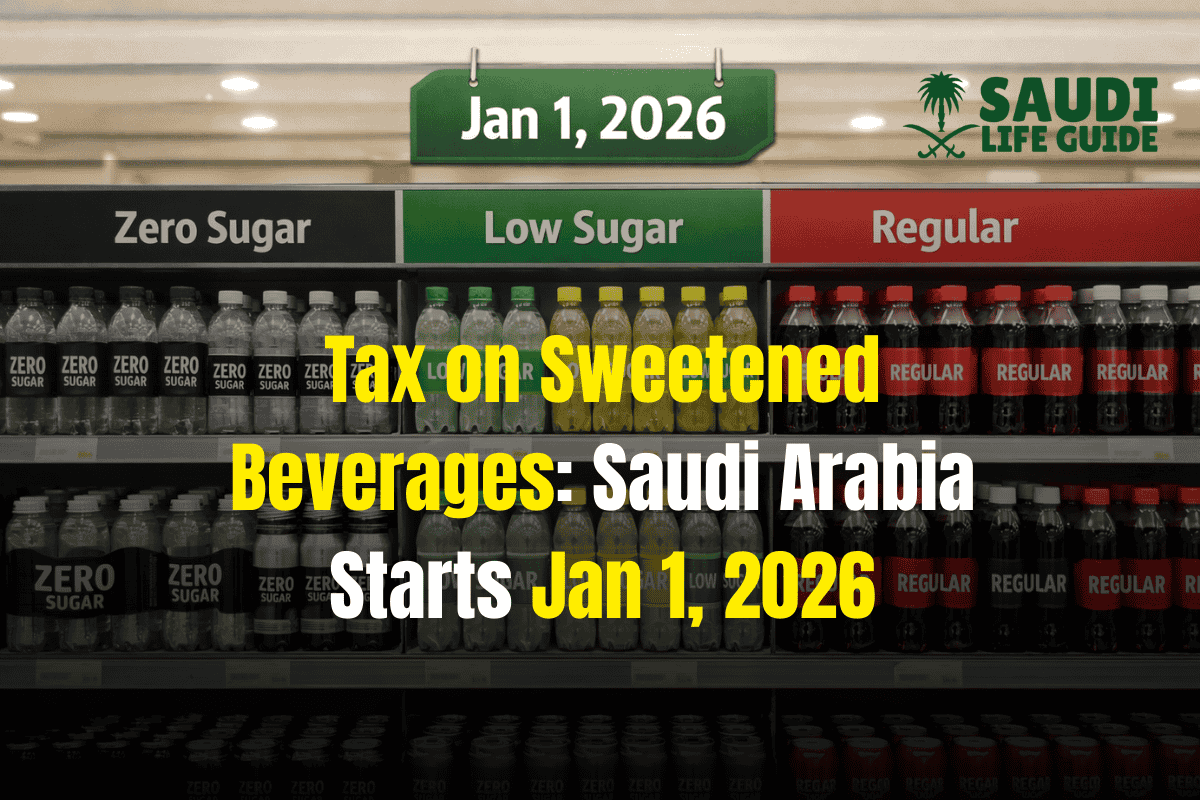
Saudi Arabia will apply a 4-tier excise tax on sweetened beverages from January 1, 2026, shifting away from the current flat-rate approach and linking taxation to sugar content per 100 ml. The change was announced by the Zakat, Tax and Customs Authority (ZATCA) and is tied to a broader GCC move toward sugar-based health taxation.
The upcoming implementation of the 4-tier excise tax on sweetened beverages is a significant shift in Saudi Arabia’s approach to health taxation, highlighting the importance of sugar regulation.
Based on real expat experience in KSA, changes like this usually show up quickly in supermarkets, cafés, vending machines, and delivery apps—so it’s worth understanding what’s changing, what’s exempt, and what it means for pricing.
What’s changing on Jan 1, 2026
This transition to the 4-tier excise tax on sweetened beverages reflects an increased awareness of the health implications associated with high sugar consumption.
Until now, the excise tax on sweetened beverages has commonly been understood as a fixed 50% rate calculated on retail price (for the taxable category). The new system replaces that with a tiered calculation based on total sugar concentration, measured in grams per 100 ml of ready-to-drink product.
ZATCA’s move follows approved amendments to the implementing/executive regulations and is positioned as a health-driven policy to reduce sugar consumption and push product reformulation.
The 4-tier excise tax on sweetened beverages initiated by ZATCA aims to create a healthier beverage market.
The new 4-tier brackets (sugar per 100 ml)
ZATCA’s framework divides sweetened beverages into four brackets, based on sugar levels per 100 ml:
Tier 1: Artificial sweeteners only (no added sugar)
- Drinks sweetened with artificial sweeteners only
- No added sugar
Tier 2: Low sugar
- Less than 5 grams per 100 ml
Tier 3: Medium sugar
- 5 to 7.99 grams per 100 ml
Tier 4: High sugar
- 8 grams or more per 100 ml
This structure matters because it makes sugar level—not just price—the driver of tax impact.
Expected tax amounts per liter (what’s known so far)
Multiple market summaries referencing the GCC methodology (and prior consultation details) indicate that Tier 1 and Tier 2 may be treated as SR0 per liter, while Tier 3 and Tier 4 apply per-liter charges. One widely circulated breakdown lists:
The implementation of the 4-tier excise tax on sweetened beverages underscores the government’s commitment to public health.
Consumers will navigate a market influenced by the 4-tier excise tax on sweetened beverages as they choose healthier options.
- Tier 1: SR 0 / liter
- Tier 2: SR 0 / liter
- Tier 3: SR 0.79 / liter
- Tier 4: SR 1.09 / liter
Important note (for accuracy): ZATCA communications emphasize the tiered method and sugar thresholds; the exact per-liter rates are typically referenced in regulatory/market summaries and consultation documentation. If you’re publishing this on SaudiLifeGuide, you can phrase it as “reported/outlined rates in consultation summaries” and then link to an official ZATCA page for the general excise framework.
What counts as “sweetened beverages” in Saudi Arabia
ZATCA’s definition is broad and includes:
- Ready-to-drink beverages
- Concentrates
- Powders
- Gels
- Extracts
- Or any form that can be converted into a drink
This matters in Saudi Arabia because many expats buy powdered mixes, syrups, or concentrates (especially for home use) thinking they’re “different” from soft drinks—regulators often treat them under the same umbrella if they become a sweetened beverage.
Why Saudi Arabia is doing this
Understanding the 4-tier excise tax on sweetened beverages is essential for consumers seeking to manage their sugar intake.
ZATCA frames the shift as a public-health measure designed to:
- Encourage reduced sugar consumption
- Incentivize producers/importers to lower sugar levels
- Align with “international best practices”
It also aligns with a GCC Financial and Economic Cooperation Committee decision to move toward a sugar-content-based approach for excise on sweetened beverages, with the Saudi policy taking effect on Jan 1, 2026.
Read Also: 12 Practical Ways to Save Money in Saudi Arabia(Real Tips)
What expats and consumers should expect next
Based on how tax and compliance changes usually play out in KSA:
- Price gaps will widen between regular sugary drinks and “zero/low sugar” options.
- Reformulated products may appear with updated nutrition labels (“reduced sugar” versions).
- Restaurants and cafés may adjust menu pricing—especially for high-sugar bottled/canned items.
- Expect more “0 sugar” marketing, because Tier 1 and Tier 2 categories are designed to reward lower sugar.
What businesses should prepare for (importers/producers)
If you’re an importer, distributor, or running a small F&B operation:
The 4-tier excise tax on sweetened beverages marks a pivotal change in Saudi Arabia’s taxation strategy.
- Sugar measurement accuracy becomes critical (per 100 ml).
- Ensure labeling and product specs are consistent—misclassification can create tax exposure.
- Stock decisions may change: high-sugar products could carry higher tax burden vs low/zero sugar lines.
- Monitor ZATCA updates and the excise tax services portal for compliance guidance.
- ZATCA Excise Tax overview page (official): Zakat, Tax and Customs Authority
FAQs
1) When does the 4-tier excise tax on sweetened beverages start in Saudi Arabia?
The 4-tier excise tax on sweetened beverages begins January 1, 2026. Saudi Arabia is moving from a flat mechanism to a tiered approach based on sugar content per 100 ml. This is part of a GCC-aligned methodology designed to encourage lower sugar consumption and product reformulation.
2) How are the tiers calculated?
The 4-tier excise tax on sweetened beverages is a vital element in the country’s public health agenda.
Tiers are defined by total sugar per 100 ml of the ready-to-drink beverage. The brackets include artificial sweetener-only drinks with no added sugar, low sugar (<5g/100ml), medium sugar (5–7.99g/100ml), and high sugar (≥8g/100ml). Tax impact increases with sugar concentration.
As the 4-tier excise tax on sweetened beverages comes into effect, awareness of sugar content will become increasingly important.
The aim of the 4-tier excise tax on sweetened beverages is to drive down sugar consumption among the populace.
3) Are sugar-free drinks taxed in Saudi Arabia under this new model?
The implications of the 4-tier excise tax on sweetened beverages will be felt across various sectors.
Sugar-free drinks (especially those with only artificial sweeteners and no added sugar) are categorized under the lowest tier in the new methodology. Many summaries indicate this tier may be treated as SR0 per liter, but the key is that classification depends on the product formulation and sugar measurement per 100 ml.
4) Does this apply only to soda and ready-to-drink beverages?
No. The definition includes beverages in multiple forms—ready-to-drink, concentrates, powders, gels, extracts, or anything that can be converted into a beverage if sweeteners or sugar are added. This is important for expats who often buy powdered drink mixes or syrups.
5) Why is Saudi Arabia making this change?
ZATCA has linked the new model to public health goals, aiming to reduce sugar intake by encouraging producers and importers to lower sugar content. The change also aligns with the GCC’s decision to adopt a sugar-based excise calculation approach across member states.
6) Will consumers notice price changes immediately?
In Saudi Arabia, price changes often show up quickly when tax methodology changes, especially for high-volume consumer goods. Expect clearer price differences between low/zero sugar options and high-sugar products. Some brands may reformulate products to fit lower tiers, and retailers may adjust pricing progressively as new stock arrives.
The 4-tier excise tax on sweetened beverages is designed to promote healthier drink choices.
With the introduction of the 4-tier excise tax on sweetened beverages, consumers can expect a shift in product offerings.
The anticipated effects of the 4-tier excise tax on sweetened beverages will ripple through the beverage industry significantly.
Producers will need to adapt to the new landscape created by the 4-tier excise tax on sweetened beverages.
The 4-tier excise tax on sweetened beverages is crucial for aligning consumer choices with health objectives.
