



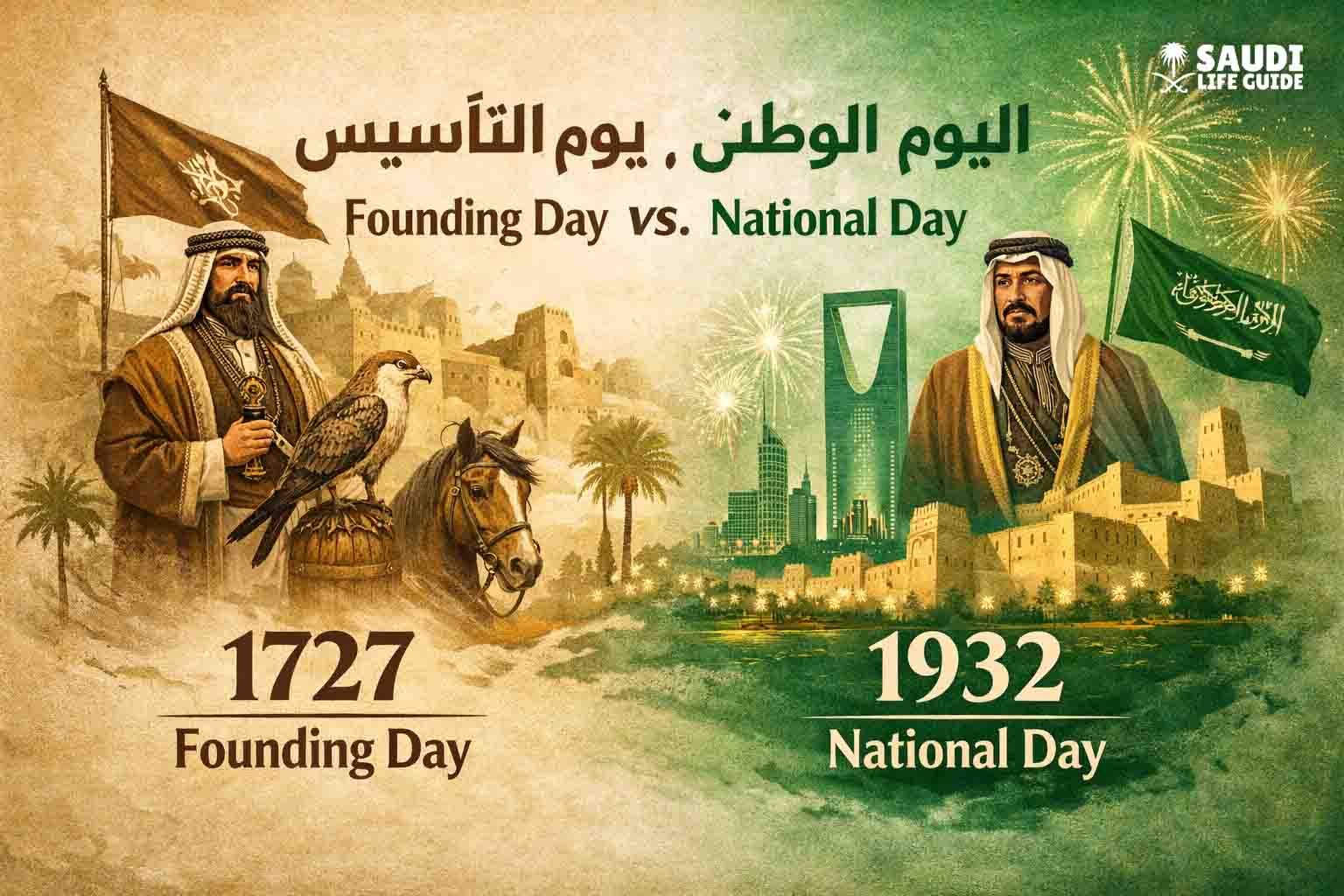
If you remember just one thing, make it this: Founding Day is about the roots (the First Saudi State in 1727), and National Day is about the modern nation (the unification and naming of today’s Kingdom in 1932).
Saudi Arabia intentionally celebrates both because they mark two different “beginnings” in one national story: the start of state-building in Diriyah nearly three centuries ago, and the completion of unification under one name and flag in the 20th century.
What is Saudi Founding Day?
Founding Day (يوم التأسيس) is observed every year on February 22. It commemorates the founding of the First Saudi State in 1727, when Imam Muhammad bin Saud assumed leadership in Diriyah and began building a stable political entity in central Arabia.
It is also a relatively new official holiday: it was approved by royal decree in 2022, designating February 22 as an annual official holiday called “Founding Day.”
Why 1727 specifically?
Saudi official references explain the date as the beginning of Imam Muhammad bin Saud’s rule in Diriyah and the start of the First Saudi State as a political project.
Some historical writing also notes that choosing 1727 emphasizes the state’s political foundations (leadership and governance) rather than defining the state’s origin around later milestones.
What Founding Day highlights (theme-wise)
• Deep roots and continuity of leadership across centuries
• Heritage and cultural diversity across regions
• Diriyah as a starting point for Saudi state-building, including well-known historic sites (like At-Turaif, listed by UNESCO in 2010).
What is Saudi National Day?
Saudi National Day (اليوم الوطني) is observed every year on September 23. It commemorates the unification of the Kingdom and the proclamation of the country under the name “Kingdom of Saudi Arabia” under King Abdulaziz.
Official history summaries note that a royal decree announcing unification was issued in September 1932, with the naming taking effect on September 23, 1932.
The key historical arc (National Day context)
National Day reflects the culmination of a long unification process that accelerated after King Abdulaziz recaptured Riyadh in January 1902, then unified regions over the following decades until the 1932 proclamation.
National Day as an “annual occasion” and as a “public holiday”
Many references agree that National Day became an official annual celebration in the 1960s, and later became an official public holiday in the mid-2000s (sources vary slightly on the exact year and policy step).
Founding Day vs National Day (comparison table)
| Category | Founding Day (Feb 22) | National Day (Sep 23) |
|---|---|---|
| What it commemorates | Founding of the First Saudi State in Diriyah | Unification + proclamation of the modern Kingdom under one name |
| Key figure | Imam Muhammad bin Saud | King Abdulaziz bin Abdulrahman Al Saud |
| Core idea | “Roots and origins” | “Unity and nationhood” |
| First official holiday recognition | Royal decree approved in 2022 | Became a public holiday later (mid-2000s; different sources cite different policy steps) |
| Typical celebration vibe | Heritage-first (traditional dress, cultural storytelling, historical identity) | Modern-national (green displays, fireworks, large public events, patriotic programming) |
Founding Day’s official framing is tied to 1727 and the First Saudi State.
National Day’s official framing is tied to September 23, 1932 and the unification proclamation.
Timeline chart (how the two days fit into one story)
This is the easiest way to “see” the difference: one date marks the start of statehood, the other marks the completion of unification under the modern name.
| Year | Milestone | Why it matters here |
|---|---|---|
| 1446 | Diriyah established (early roots of the area’s political center) | Context for why Diriyah becomes central later |
| 1727 | Imam Muhammad bin Saud begins rule in Diriyah | Start of the First Saudi State → Founding Day |
| 1902 | King Abdulaziz recaptures Riyadh | Launch point for modern unification push |
| 1932 | Royal decree + proclamation of the Kingdom under today’s name | National Day’s historical anchor |
| 2022 | Founding Day designated an official holiday | Modern formal recognition of the 1727 milestone |
How celebrations differ in real life (not just history)
People often ask, “Okay, but what’s different on the street?” The short answer: Founding Day looks and feels heritage-forward, while National Day looks and feels modern-national.
A practical “celebration matrix”
| Element | Founding Day | National Day |
|---|---|---|
| Colors & visuals | Earthy heritage palette; historic symbols | Green-white flag-forward visuals |
| Clothing | Traditional regional attire is front-and-center | Often modern patriotic outfits + flags |
| Programming | Heritage exhibitions, cultural performances, historical storytelling | Fireworks, concerts, city-wide decorations, national messaging |
| Emotional focus | Pride in origins, continuity, identity | Pride in unity, progress, national achievements |
This general pattern appears across multiple public explainers, even when details vary year to year.
Logos and symbols: why they look different
A big “tell” is the visual identity. Founding Day’s identity is explicitly built around historical symbols connected to early Saudi life and the First Saudi State.
Saudi sources describe Founding Day’s visual identity using symbols such as the flag/banner, palm tree, falcon, Arabian horse, and souq/market arranged around a central figure holding a flag.
Why those symbols?
• Palm tree: linked to daily life, prosperity, and material culture (dates and palm-based crafts).
• Banner/flag: represents unity and identity (historical naming and symbolism are discussed in Saudi references).
• Falcon/horse/souq: commonly used to represent heritage, strength, and historical lifeways in the Arabian Peninsula.
National Day visuals, by contrast, lean heavily into the modern Saudi flag identity and nationwide unity messaging (green themes are a standard part of National Day public celebration descriptions).
Common misconceptions (quick corrections)
Misconception 1: “Founding Day is just another name for National Day.”
No. Founding Day marks 1727 and the First Saudi State; National Day marks 1932 and the unification proclamation of the modern Kingdom.
Misconception 2: “Founding Day replaced National Day.”
No. Saudi sources and major explainers repeatedly describe them as complementary occasions two chapters, not a swap.
Misconception 3: “They’re based on the Hijri calendar.”
Both are fixed on the Gregorian calendar (Feb 22 and Sep 23), which is part of why the weekday changes each year.
What to say (and post) on each day
If you want to sound “right” without overthinking it:
Founding Day (roots / heritage)
• “Proud of our deep roots since 1727.”
• “Celebrating the beginning of the Saudi State in Diriyah.”
National Day (unity / modern Kingdom)
• “Celebrating unity and the proclamation of the Kingdom in 1932.”
• “Proud of the journey from 1902 to 1932 and what came after.”
FAQs
Is Founding Day a public holiday?
Yes. Saudi references explicitly designate it as an official holiday on Feb 22 via royal decree (approved in 2022), and regulatory notices reflect that holiday scheduling.
Why does Saudi Arabia celebrate two national occasions?
Because they represent two different milestones: the start of the First Saudi State (origins) and the unification/proclamation of the modern Kingdom (nationhood).
Which is older historically?
Founding Day points to 1727 nearly three centuries ago while National Day points to 1932 (the modern proclamation).
Do expats celebrate these days too?
Expats typically participate through public events, city decorations, workplace holiday schedules, and cultural programming. Founding Day especially tends to emphasize heritage exhibitions that are easy for non-Saudis to enjoy and learn from.
How is this different from Saudi Flag Day?
Flag Day is another national occasion (mentioned in some explainers as separate from both Founding Day and National Day).
