


Last updated: 3 November 2026
Summary
Medical insurance in Saudi Arabia is how almost every expat gets healthcare. Your employer must insure you and your family from your first working day, under rules set by the Council of Health Insurance (CHI). The basic policy covers up to SAR 500,000 per person a year at small and medium companies and SAR 1 million at large companies. A primary care visit costs you at most SAR 25, and there is no co-payment for emergencies or hospital admission. Across the market, the average health premium was about SAR 3,303 per insured person in 2025.
Not sure you are covered? Check your health insurance with your iqama number in a minute; see our health insurance check guide. For simple daily habits, from a 15-minute routine to the screening your policy covers, read our health tips for expats in Saudi Arabia. Planning a family budget? Add the costs that insurance does not cover to our cost of living calculator.
Saudi Arabia has invested heavily in a modern healthcare system that serves both its citizens and the growing expat community. As a foreign resident, you will find modern hospitals, qualified doctors and specialists, and insurance that pays for most of your care. To use it well, you need to know your rights, your obligations and what your policy actually says.
Healthcare for expats in Saudi Arabia runs on a mandatory insurance system regulated by the Council of Health Insurance (CHI, formerly the Council of Cooperative Health Insurance or CCHI). Unlike many countries where health insurance is optional, every expat working in the Kingdom must have valid medical cover, and your residency permit (iqama) cannot be issued or renewed without it.
The healthcare landscape has changed a lot under Vision 2030, with more private sector hospitals, digital services such as the Sehhaty app, and hospital groups opening new branches across the major cities. Whether you are moving to Riyadh, Jeddah, Dammam or a smaller city, the rules below are the same.
Follow Saudi Life Guide for Iqama, visa and job updates
New rules, fees and news as soon as we publish them. Join 125,500+ followers on Facebook.
Medical Insurance in Saudi Arabia at a Glance
| Question | What applies in 2026 |
|---|---|
| Who pays | Your employer, from your first working day (probation included) |
| Who is covered | You, your wife or husband, sons up to 25 and unmarried daughters on your iqama |
| Annual limit (Basic policy) | SAR 500,000 at small and medium companies, SAR 1 million at large companies |
| GP or family doctor visit | 0 to 5% co-payment, capped at SAR 25 |
| Specialist with a referral | 0 to 10% co-payment, capped at SAR 75 |
| Emergency and hospital admission | No co-payment |
| Pregnancy and delivery | Up to SAR 15,000 per policy period; complications under the full policy limit |
| Newborn baby | Covered on the mother’s policy for up to 30 days |
| Basic dental | Up to SAR 1,200 with no co-payment |
| Average premium (market) | About SAR 3,303 per insured person a year in 2025 (Insurance Authority) |
| Check your policy | IA or CHI online check with your iqama number |
Understanding Saudi Arabia’s Healthcare System
Saudi Arabia runs a dual healthcare system with a public and a private sector, each serving different groups of patients.
The Ministry of Health (MOH) runs the public system, which mainly serves Saudi nationals through hospitals, primary healthcare centres and specialist facilities. Public healthcare is free for Saudi citizens.
As an expat, you will use private facilities for almost all your care. Life-threatening emergencies must be treated at any hospital regardless of nationality, but follow-up care and non-emergency services go through your insurance network.
The private healthcare sector is where most expats are treated. It includes hospital groups, specialist centres, polyclinics, private clinics and diagnostic centres. Many private hospitals hold Joint Commission International (JCI) accreditation and employ multilingual staff.
Major hospital groups such as Saudi German Hospitals, Dr. Sulaiman Al Habib Medical Group, Mouwasat Medical Services and International Medical Center run facilities in several cities.
Two bodies regulate private health insurance. The Council of Health Insurance (CHI) decides who must be insured, sets the benefits every policy must include, accredits hospitals and clinics, fines employers and handles complaints about providers and employers. Since 4 March 2024 the Insurance Authority (IA) supervises the insurance companies themselves and handles complaints against insurers (IA FAQ).
Mandatory Medical Insurance for Expats
Medical insurance in Saudi Arabia is not optional for expats: it is a legal requirement under the Cooperative Health Insurance Law, and Jawazat checks it before it issues or renews an iqama. Private sector employers must insure their employees and the family members on their iqama.
Employer Responsibilities
Your employer must insure you from your first working day, including the probation period, keep the cover running without gaps and pay the premium. You should not be asked to pay for your own mandatory policy. The employer must also add your eligible family members and renew the policy before it expires.
If the employer does not insure you, your iqama renewal gets stuck and the employer faces penalties. CHI fines are real: in the third quarter of 2025 alone, the council issued 140 penalty decisions against employers worth SAR 828,321 in total (Okaz). Employees can file a confidential complaint against an employer that has not insured them; you log in with Nafath and your name is not shared with the employer.
Basic, Gold and Platinum: The Official Policy Tiers
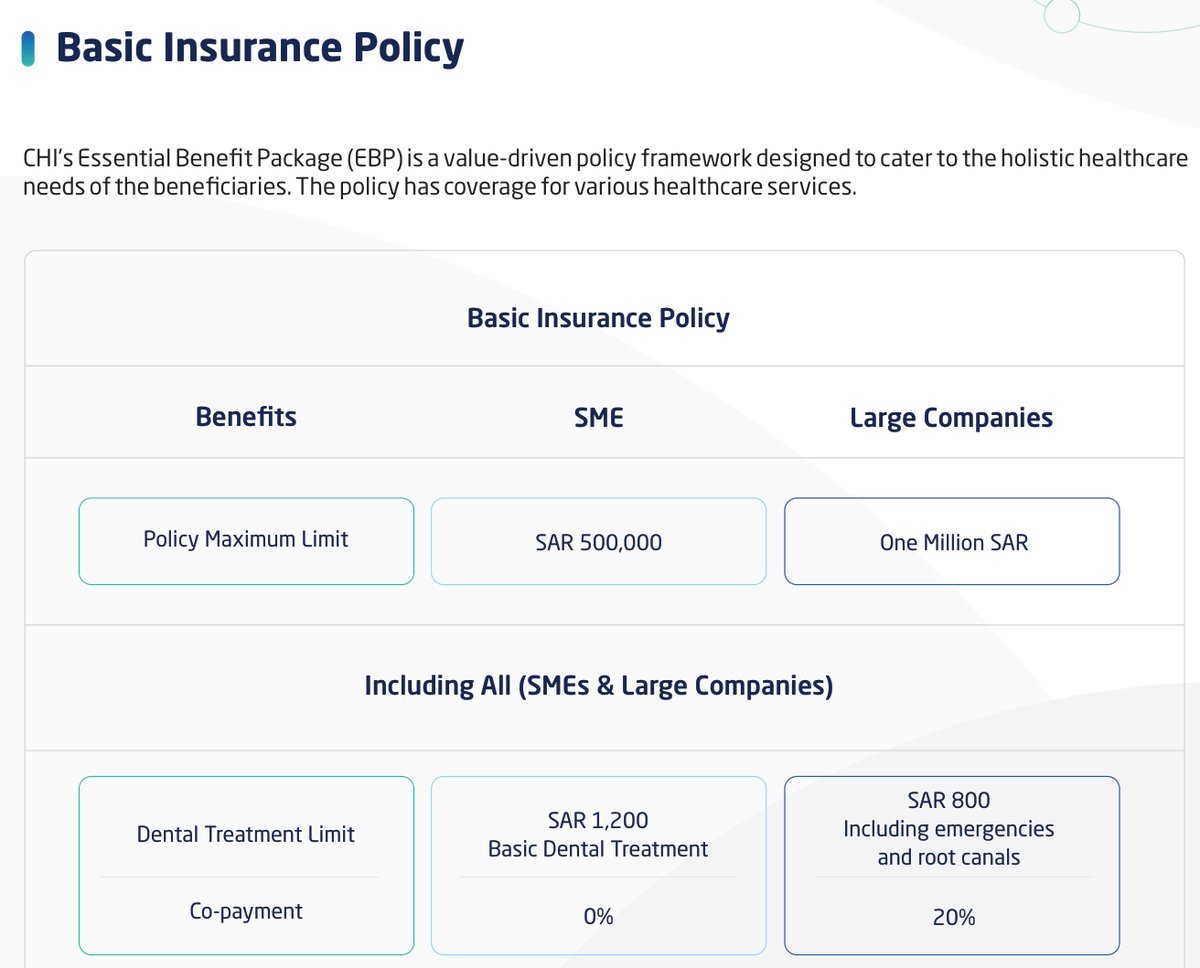
Since 1 October 2022, every private health insurance policy follows CHI’s Essential Benefit Package (EBP). The official CHI booklet defines three tiers. Basic is the minimum every employer must buy. Gold and Platinum are optional upgrades an employer can agree with the insurer.
| Tier | Annual limit per person | Dental | Mental health |
|---|---|---|---|
| Basic (mandatory) | SAR 500,000 (SMEs) or SAR 1 million (large companies) | SAR 1,200 basic treatment at 0%, plus SAR 800 for root canals and emergencies at 20% | SAR 50,000 at 0% |
| Gold (optional) | SAR 1 million | SAR 1,200 basic, crowns and bridges at 10%, plus SAR 4,800 for root canals and emergencies at 0% | SAR 30,000 at 10% or SAR 50,000 at 0% |
| Platinum (optional) | SAR 1.5 million | SAR 10,000, all dental at 0% | SAR 50,000 at 0% |
What About Class A, B and C Insurance?
Your insurance card probably says VIP, A, B or C. These are the insurance companies’ own class names, not official CHI categories. Every class must give at least the Basic policy benefits above. What changes between classes is the hospital network you can use, the room type (private or shared), the co-payment percentage within the official caps, and extras such as a higher limit or wider dental cover.
In practice, a Class C card often limits you to clinics and smaller hospitals, while Class A or VIP cards open the big hospital groups. Ask HR for your Table of Benefits and the network list; those two documents tell you more than the class letter.
What the Basic Policy Covers
The Basic policy is the floor for all medical insurance in Saudi Arabia. It covers consultations, diagnosis, tests, medicines, surgery, hospital stays, emergencies, maternity, vaccinations and screening. These are some of the limits per person per policy period from the CHI booklet:
| Benefit | Basic policy limit |
|---|---|
| Hospital room | Shared room up to SAR 600 a day, no co-payment |
| Patient’s escort | Shared room up to SAR 150 a day |
| Pregnancy and delivery | Up to SAR 15,000; complications covered up to the full policy limit |
| Newborn on the mother’s policy | Up to 30 days from birth, until added to their own policy |
| Premature babies | Up to the full policy limit |
| Spectacles (children aged 14 and under) | Up to SAR 400 |
| Hearing aids | Up to SAR 6,000 |
| Dialysis | Up to SAR 180,000 |
| Kidney transplant | Up to SAR 250,000 |
| Autism | Up to SAR 50,000 |
| Repatriation of a deceased person | Up to SAR 10,000 |
| Coverage area | Inside Saudi Arabia only |
Home Healthcare and Telemedicine
All three tiers cover home care for patients who can finish treatment at home: wound care, intravenous (IV) medicines and urinary catheter care. Our guide to home healthcare insurance in Saudi Arabia explains how to ask for it before discharge. Telemedicine from a centre licensed by the Ministry of Health is also covered under the policy benefits.
Family and Dependent Cover
Many expats only find gaps in their family’s medical insurance in Saudi Arabia at a hospital desk, so check this part early. The employer must insure your wife or husband, sons up to the age of 25 and unmarried daughters who are on your iqama. CHI has said an employer may not limit the number of children on the policy. Parents and brothers or sisters are not the employer’s duty: if they live with you on your sponsorship, you buy their policy yourself.
Family members on a visit visa are covered by the visitor policy bought with the visa, which pays for emergencies only. See our guide to Saudi visit visa medical insurance. If you are bringing your family to live with you, our permanent family visa guide explains the steps and fees.
Pregnancy and delivery are covered up to SAR 15,000 per policy period on the Basic policy, with any complications of pregnancy and delivery covered up to the full policy limit. Register the baby and add them to your policy quickly: the newborn rides on the mother’s policy for 30 days at most. CHI has also said an insurer may not ask for a medical disclosure form when you add a newborn to a running policy, and at renewal it may not ask for a new disclosure form from anyone insured for 11 months, even if the wife became pregnant during the policy year (Okaz).
Checking Your Cover
Ask HR for your policy details as soon as you arrive: insurer name and phone number, membership number, class, expiry date, network list and co-payment table. Then confirm the policy is active with the free IA Check Health Insurance Service or the CHI inquiry, using your iqama number. Our health insurance check guide shows both services step by step, including what to do if a family member is missing.
Types of Healthcare Facilities Available
Saudi Arabia offers a wide choice of healthcare facilities. Which ones you can use depends on your insurance network.
Private Hospitals
Private hospitals are the backbone of expat healthcare in Saudi Arabia. The large groups run emergency departments, operating theatres, intensive care units, maternity wards and specialist centres for cardiology, oncology, orthopaedics and other fields.
Polyclinics and Medical Centers
Polyclinics offer several specialties under one roof without full hospital services. They suit specialist consultations, minor procedures, tests, follow-up visits and routine checks. Lower-class policies often send you to a polyclinic first for non-emergency care.
Primary Care Centers
Primary care clinics handle everyday needs: GP consultations, vaccinations, minor illness and referrals. Under the CHI rules a primary care visit has the lowest co-payment (capped at SAR 25), so start here for anything that is not urgent.
Specialized Centers
Specialty centres focus on dental care, eye care, fertility, diagnostics and physiotherapy. Many need a referral, and coverage rules can differ from general medical care.
Pharmacies
Pharmacies are everywhere in Saudi cities. The big chains include Nahdi, Al Dawaa and United Pharmacy, and many branches open 24 hours, especially near hospitals and on main roads.
Top Hospitals for Expats by City
The right hospital is the one that is in your insurance network, close to home and strong in the specialty you need.
Riyadh
Dr. Sulaiman Al Habib Medical Group runs several hospitals in Riyadh, including its Takhassusi hospital. Kingdom Hospital is popular with expats for its service and English-speaking staff. Saudi German Hospital Riyadh has strong surgical and emergency departments.
Jeddah
International Medical Center (IMC) is one of Jeddah’s best-known private hospitals. Dr. Sulaiman Al Habib Hospital and Saudi German Hospital Jeddah also have large expat patient bases and 24-hour emergency departments.
Dammam and Eastern Province
Dr. Sulaiman Al Habib Hospital Al Khobar, Saudi German Hospital and Mouwasat Hospital Dammam serve the large expat population in the Eastern Province.
When you choose from your network, look at JCI accreditation, languages spoken, the specialties you need, distance from home and work, 24-hour emergency services and recent patient reviews.
How Much Does Medical Insurance Cost in Saudi Arabia?
For your own policy and the family on your iqama, the premium is your employer’s cost, not yours: you pay only co-payments. The price matters when you buy cover yourself, for example for parents living on your sponsorship, when you run a small business, or when HR offers an upgrade to a higher class.
CHI and the Insurance Authority do not publish a price list for Class A, B or C cards. The best official benchmark is the Insurance Authority’s Saudi Insurance Market Report 2025, published in July 2026, which divides all health premiums by the number of insured people:
| Year | Health premiums, all insurers | Insured people | Average premium per person |
|---|---|---|---|
| 2021 | SAR 25.1 billion | 9.8 million | About SAR 2,562 |
| 2024 | SAR 42.2 billion | 13.1 million | About SAR 3,225 |
| 2025 | SAR 47.8 billion | 14.47 million | About SAR 3,303 |
What Changes the Price of a Policy
- Class and network: a Class C card limited to clinics and smaller hospitals usually costs less than a Class A or VIP card that opens the big hospital groups. Every class must still give the Basic policy benefits.
- Age: in 2025, premiums for the 35 to 65 and over-65 age bands kept rising while the under-35 band fell, according to the Insurance Authority. Cover for older parents costs the most.
- Group size: a company policy spreads the risk across many staff, so a large employer usually pays less per person than a small business or a single buyer.
- Medical inflation: insurers reprice policies at renewal, and the Insurance Authority notes that medical claims costs may run above headline health inflation.
If you need a quote for a parent, ask two or three licensed insurers to price the same Table of Benefits, so you compare like with like, and add the yearly premium to your budget in our cost of living calculator. A parent who comes on a visit visa is covered by the visitor policy bought with the visa instead; see Saudi visit visa medical insurance.
Healthcare Costs and Co-Payments
Medical insurance in Saudi Arabia keeps most bills small, but you still pay co-payments and anything outside the policy.
Co-Payments Set by CHI
The CHI booklet caps what you pay at a clinic visit:
- Primary care (GP, family doctor, general paediatrician, internist, general gynaecologist): 0 to 5%, up to SAR 25 a visit
- Specialist with a referral from primary care or the emergency department: 0 to 10%, up to SAR 75 a visit
- Specialist without a referral: 0 to 5%, with a cap of up to SAR 500
- Emergency and hospital admission: no co-payment
The percentage on your card is agreed between your employer and the insurer, which is why two friends with the same insurer can pay different amounts.
Paying Without Insurance
Without insurance (for example, a parent on a visit visa seeing a doctor for something that is not an emergency), you pay the hospital’s cash price. A GP consultation at a private hospital is typically a few hundred riyals, a specialist more, and a normal delivery or caesarean section can run into thousands or tens of thousands of riyals. Prices vary a lot between hospitals, so ask for a written estimate first. These are rough guides, not official prices.
Dental and Optical
Basic dental care is covered: consultations, fillings, cleaning, scaling and extractions up to SAR 1,200 with no co-payment, and root canals and dental emergencies up to SAR 800 with a 20% co-payment. Crowns, bridges and cosmetic work usually need a Gold or Platinum level policy.
Optical cover is limited. The Basic policy pays for spectacles for children aged 14 and under, up to SAR 400. Adults usually pay for glasses and contact lenses themselves unless the employer bought extra cover. That floor is the same whichever company is on your card, Bupa Arabia, Tawuniya or any other insurer; adult glasses depend on the Table of Benefits your employer bought, not on the insurer’s name.
Prescription Medication Costs
The Basic policy sets medicine co-payments by type. If a brand-name drug has a generic alternative, the co-payment can be 0 to 50%, as agreed between your employer and the insurer. For a brand-name drug without a generic alternative, the co-payment is 20% with a maximum of SAR 30.
Payment Methods
With insurance, direct billing is the norm: you show your card or iqama at reception, pay any co-payment, and the hospital bills the insurer. Hospitals accept cards and cash for co-payments and cash patients. Keep every receipt and report in case you need to claim.
Accessing Healthcare Services
Knowing where to go and who to call saves time and money.
Booking Appointments
Private hospitals take bookings through their apps, websites and call centres. The Sehhaty app from the Ministry of Health serves citizens and residents; it books primary healthcare centre appointments and gives access to consultations, sick leave and medical reports. Book specialists a few days ahead, because popular doctors fill up.
Specialist appointments are cheaper with a referral, because the referral lowers your co-payment cap from SAR 500 to SAR 75.
Emergency Services
Call 997 for an ambulance (Saudi Red Crescent). For medical advice at any hour, call the Ministry of Health’s 937 line, which runs 24/7 and has served callers in Urdu, English and other languages (MOH). In an emergency you can go straight to the nearest emergency department; emergencies carry no co-payment, and a life-threatening case must be treated wherever you arrive.
Using Your Insurance Card
Most hospitals find your policy from your iqama number, but carry the card or a photo of it. Your insurance details also appear in the Tawakkalna app and in CHI’s Daman app, which shows your cover, family members and network. At registration, give your iqama, confirm the hospital is in your network, pay the co-payment and keep the receipt.
Language Support
Major hospitals employ multilingual staff who speak Arabic, English, Urdu, Hindi, Filipino and other languages. English-speaking doctors are common in private hospitals.
Medical Records
Keep your own medical records: vaccinations, chronic conditions, surgeries, medicine lists, allergies and recent test results. Sehhaty also keeps a record of services at participating facilities.
Understanding Your Insurance Coverage
The policy document decides what your insurer pays, so read it once and keep a copy on your phone.
Reading Your Policy Document
Your policy shows the annual limit, network, co-payment table, services that need pre-approval, exclusions, how to claim and the insurer’s contact numbers.
Network Hospitals
In-network hospitals bill the insurer directly at agreed rates. Out-of-network providers may ask you to pay first and claim later, with a higher share for you. Emergencies are the exception: get treated first and sort out the paperwork afterwards.
Pre-Authorization Requirements
Planned surgery, expensive scans (MRI, CT), non-emergency admission, maternity services and specialist treatments usually need pre-approval from the insurer. The hospital normally sends the request; check it is approved before the procedure.
Common Exclusions
Policies typically exclude cosmetic procedures, experimental treatments, treatment outside Saudi Arabia, self-inflicted injuries and some high-risk activities. Adult glasses and advanced dental work are often outside the Basic policy too. Read your own exclusion list, because insurers can add cover above the minimum.
Filing Claims
If you paid upfront, file a reimbursement claim with the claim form, original receipts and invoices, medical report and prescriptions, any referral letter, and copies of your insurance card and iqama. Submit it within the deadline in your policy.
Prescription Medications and Pharmacies
Getting medicine in Saudi Arabia is easy, with pharmacies in every district.
Major Pharmacy Chains
Nahdi has the largest network, followed by Al Dawaa; United Pharmacy has also grown in Riyadh and Jeddah. Most insurers have pharmacy partners where you can collect a prescription with only the co-payment.
Prescription Requirements
Prescription medicines need a doctor’s prescription. Controlled medicines (narcotics, psychotropics and some painkillers) are tightly regulated, and you will need your iqama to collect them. If you bring personal medicines into the Kingdom, carry the prescription.
Insurance Coverage for Medications
Insurance covers medicines prescribed by network doctors, with the co-payments described above: up to 50% for a brand-name drug that has a generic alternative and 20% (maximum SAR 30) for one that does not. Asking for the generic is the easiest way to pay less.
Generic vs. Brand-Name Medications
Generic medicines are widely available, cheaper and approved by the Saudi Food and Drug Authority (SFDA) to the same standards as brand-name products.
24-Hour Pharmacies
Many 24-hour pharmacies operate near major hospitals and on main roads. Nahdi and Al Dawaa both have many all-night branches, and their apps show the nearest open branch.
Important Considerations and Tips
These tips come from the problems expats meet most often with medical insurance in Saudi Arabia. Good insurance habits also help you save money in Saudi Arabia.
Pre-Existing and Chronic Conditions
Tell the insurer about existing conditions such as diabetes, high blood pressure or asthma. Employer policies under the CHI rules cover chronic disease management within the policy limits. Policies you buy yourself, for example for parents, can apply waiting periods or extra conditions, so read the terms before you pay.
Second Opinions
For a serious diagnosis, a recommendation for surgery or a long treatment plan, a second opinion is normal practice. Ask your insurer first how a second consultation is covered, and get a referral to keep your co-payment low.
Patient Rights
You have the right to respectful treatment, privacy, informed consent, access to your medical records, refusal of treatment and to complain about poor care.
Filing Complaints
Start with the hospital or the insurer and keep dates and reference numbers. If that fails, complain about an insurance company to the Insurance Authority (IA Care, 8001240551), about a hospital, clinic or an employer that has not insured you to CHI (920001177), and about the quality of care to the Ministry of Health through 937.
Health Checkups and Preventive Care
Annual health checkups are a good habit, and the EBP includes screening and adult vaccination programmes. Many hospitals also sell health check packages; compare prices before you pay. Our health tips for expats cover simple daily routines and the screening worth asking for.
Frequently Asked Questions
Is medical insurance mandatory in Saudi Arabia for expats?
Yes. Under the Cooperative Health Insurance Law, every private sector employer must insure its expat employees from the first working day, including probation, and must also insure the family members on their iqama. Jawazat checks for valid insurance before it issues or renews an iqama, so a lapsed policy blocks the renewal. You should not pay for your own mandatory policy.
How much does the basic medical insurance policy cover in Saudi Arabia?
The Basic policy in the CHI Essential Benefit Package covers up to SAR 500,000 per person per year at small and medium companies and SAR 1 million at large companies. It includes consultations, tests, medicines, surgery, hospital stays and emergencies, with set limits such as SAR 15,000 for pregnancy and delivery, SAR 1,200 for basic dental care and SAR 50,000 for mental health.
Does my employer have to insure my wife and children?
Yes, if they live with you on your iqama. The employer must insure your wife or husband, sons up to the age of 25 and unmarried daughters, and it may not limit the number of children on the policy. Parents and brothers or sisters are not the employer’s duty. Family members on a visit visa are covered by the visitor policy bought with the visa.
What is the difference between Class A, B and C medical insurance in Saudi Arabia?
Class names such as VIP, A, B and C are labels used by insurance companies, not official CHI categories. Every class must give at least the Basic policy benefits. Higher classes usually mean a wider hospital network, a private room, lower co-payments and extras such as better dental cover. Ask HR for your Table of Benefits and network list to see what your class includes.
Is pregnancy covered by medical insurance in Saudi Arabia?
Yes. The Basic policy covers pregnancy and delivery up to SAR 15,000 per policy period, and complications of pregnancy and delivery are covered up to the full policy limit. Premature babies are also covered up to the policy limit. A newborn is covered on the mother’s policy for up to 30 days, so add the baby to the family policy soon after birth.
How much does medical insurance cost in Saudi Arabia?
For an employee and the family on the iqama, the employer pays the premium, so your own cost is the co-payments. As a market benchmark, the Insurance Authority reports an average health premium of about SAR 3,303 per insured person in 2025. Class C cards usually cost less and Class A or VIP cards more, and cover for older people costs the most. CHI does not publish fixed prices, so ask licensed insurers for quotes on the same Table of Benefits.
Conclusion
Medical insurance in Saudi Arabia gives expats access to good private healthcare, as long as you know what your policy says. The Basic policy is the minimum every employer must buy: up to SAR 500,000 or SAR 1 million a year, low capped co-payments for clinic visits, nothing to pay for emergencies or admission, and set limits for pregnancy, dental and other benefits.
Learn your class, your network and your co-payments, and get referrals for specialists. Check your family’s cover before an iqama renewal or a hospital visit, and plan for what the policy leaves out, such as adult glasses and advanced dental work.
With the right hospital in your network and your policy details on your phone, you can deal with most medical needs in the Kingdom without stress.
For more about living and working in Saudi Arabia, explore our other guides on Saudi Life Guide. For a common health worry among expats, see our guide to hair loss causes and when to see a doctor.
Sources: Council of Health Insurance, Tiers Benefit Package for Private Health Insurance Beneficiaries; Insurance Authority, FAQs; Ministry of Health, Sehhaty and 937 call centre; Insurance Authority, The Saudi Insurance Market Report 2025.