
Last updated: 20 October 2026
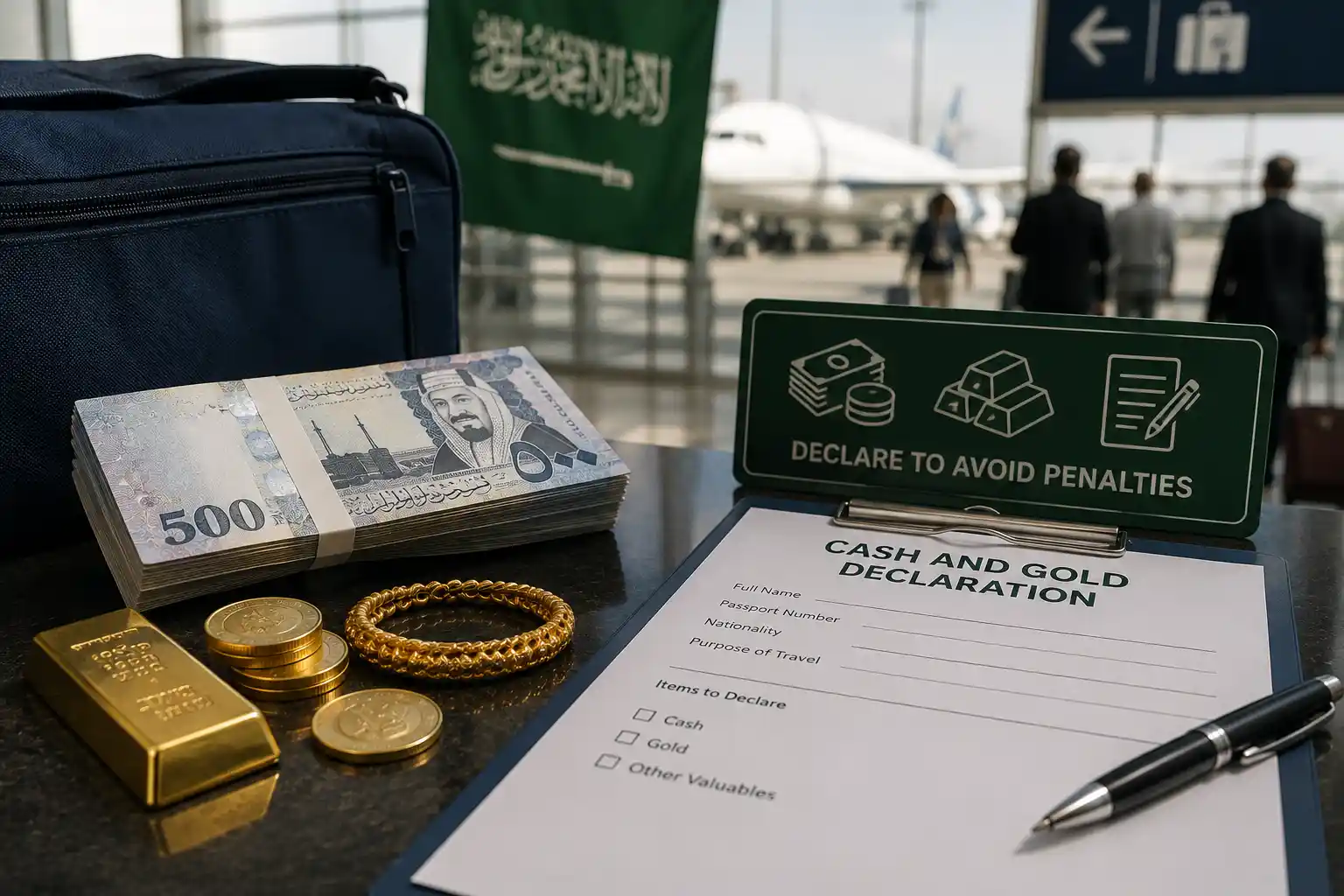
The Saudi Arabia cash declaration limit has dropped from SAR 60,000 to SAR 40,000. Anyone entering or leaving the Kingdom with cash, bearer financial instruments, gold bullion, precious metals, gemstones or jewellery worth SAR 40,000 or more must now file a written customs declaration at the border.
The change came through an update to the Executive Regulations of the Anti-Money Laundering Law, published in the official gazette Umm Al-Qura on Friday 26 June 2026 (Decision No. 266507 of the President of State Security). It applies at every land, sea and air port, in both directions, and to each traveller. The Zakat, Tax and Customs Authority (ZATCA) has updated its traveller declaration rules to match.
What changed
| Old rule | Current rule | |
|---|---|---|
| Declaration threshold | SAR 60,000 | SAR 40,000 |
| Rough US dollar value | About USD 16,000 | About USD 10,670 |
| Applies when | Entering or leaving | Entering or leaving |
| Ports covered | Land, sea, air | Land, sea, air |
| Form of declaration | Written | Written (online or paper form) |
The threshold counts the combined value of what you are carrying, not each item separately. Two thousand riyals in your wallet and a jewellery set worth SAR 39,000 puts you over the line.
Follow Saudi Life Guide for Iqama, visa and job updates
New rules, fees and news as soon as we publish them. Join 118,500+ followers on Facebook.
What counts toward the SAR 40,000
The regulations name six categories:
- Currency, Saudi riyals or any foreign currency
- Bearer negotiable instruments, meaning cheques and similar paper payable to whoever holds it
- Gold bullion
- Other precious metals
- Precious stones
- Worked jewellery and items of the same nature
ZATCA asks for official papers that prove you own the money or goods and explain where they came from. For gold and jewellery, that means the purchase invoice; without it, an officer has to estimate the value. For cash, bring the bank withdrawal slip or statement. Jewellery counts whether it is new, used or worn, so a bridal set you are wearing is included.
How the Saudi Arabia cash declaration limit works at the border
Allow extra time at the airport if you need to declare. Being stopped by an officer without a declaration is a very different experience.
- Add up everything before you pack. Cash in every currency, gold, jewellery, gemstones.
- Convert foreign currency to riyals at roughly the current rate. If the total is anywhere near SAR 40,000, declare.
- File the declaration online through the ZATCA app or the Submit Customs Declaration for Travelers e-service, which is free, and keep the reference number.
- Carry the invoices and proof of source with the items, not in checked baggage.
- Go to the customs declaration office at the port with the reference number, the money or gold and your papers. ZATCA says this visit is still required for cash, bearer instruments and precious metals even after you declare online. When leaving, the office is before security; when arriving, it is before passport control or in the baggage hall. Paper forms are available there too.
Many expats in Saudi Arabia assume the red channel is only for people carrying something illegal. It is not. Declaring protects you, because undeclared gold looks the same as smuggled gold until you explain it.
Fines for not declaring
| Situation | Consequence |
|---|---|
| First failure to declare or a false declaration, no money laundering suspicion | Fine of 25 percent of the value of the seized items (ZATCA). Some press reports of the 2026 regulations give a range of 10 to 25 percent |
| Repeat violation | Fine of 50 percent of the value |
| Suspicion of money laundering or another crime | The full amount can be seized and the case referred to the Public Prosecution. On conviction: up to 10 years in prison and/or a fine of up to SAR 5 million |
| Any of the above, or suspicion even below SAR 40,000 | Customs may hold the cash or valuables for up to 72 hours; the Public Prosecution can extend this to 60 days |
The separate SAR 3,000 rule
The SAR 40,000 threshold sits alongside an older requirement that still applies. Arriving travellers must declare goods, purchases and gifts worth more than SAR 3,000, along with anything in commercial quantities and any goods subject to excise tax. Those are two different rules with two different numbers, and people mix them up constantly. One is about taxable goods, the other about money and precious metals.
Carrying cash or gold for someone else
The declaration is made by the person carrying the money or goods. If a friend asks you to take cash or gold home for their family, it counts towards your SAR 40,000 and you must be able to explain where it came from. Do not split one person’s money across several family members’ bags to stay under the limit; that can be treated as a false declaration.
Hajj and Umrah pilgrims
The same SAR 40,000 rule applies to pilgrims on every visa type, on arrival and when leaving with gold gifts. Older advice that pilgrims could carry up to SAR 60,000 or about USD 16,000 in cash is out of date. Check the gold rate in Saudi Arabia today before you buy, because a few heavy 22K sets can pass SAR 40,000 on their own.
What India checks when you land
Arriving in India, you must fill in a Currency Declaration Form if your foreign currency notes are worth more than USD 5,000, or all your foreign exchange together is worth more than USD 10,000. Indian rupee notes are allowed up to INR 25,000, according to the Reserve Bank of India. Gold has its own duty-free limits, explained in our guide below. Our SAR to INR rate helps you check the dollar value before you fly.
What this means for expats
If you are flying home on annual leave with gold for the family, this is the change that affects you most. A single bridal jewellery set can clear SAR 40,000 on its own, so plenty of travellers who never had to think about declaring now do. Build the check into your departure routine, next to sorting out your exit and re-entry visa status and the cabin baggage rules such as the restrictions on power banks.
The Saudi declaration is also completely separate from what your home country allows on arrival. Filing correctly at Jeddah or Riyadh does not exempt you from Indian customs duty, and the gold allowance for travellers from Saudi Arabia to India is governed by the India Baggage Rules 2026, which took effect in February 2026. You need to satisfy both sides.
Bank and remittance transfers are not part of the customs declaration, although your bank runs its own anti-money laundering checks. Comparing the best money transfer services in Saudi Arabia is usually cheaper than the risk of an argument at customs, and holding an account with one of the best banks in Saudi Arabia for expats gives you the statement you may be asked for anyway.
Sources: ZATCA, Submit Customs Declaration for Travelers and Declaration pages (updated June to August 2026); Umm Al-Qura, Decision No. 266507, 26 June 2026; Reserve Bank of India FAQ.
Frequently asked questions
Is SAR 40,000 the maximum I can carry out of Saudi Arabia?
No. There is no cap on how much you may carry. SAR 40,000 is the point at which declaring becomes compulsory. You can travel with more than that legally, provided you file the written declaration and can show where the money or gold came from.
Do I have to declare jewellery I am wearing?
Yes, if its value counts toward the SAR 40,000 total. The regulations cover worked jewellery, not just bullion, and they do not carve out items worn on the body. Carry the purchase invoice so the officer can verify the value quickly.
What happens if I forget to declare?
For a first offence with no suspicion of money laundering, ZATCA states a fine of 25 percent of the value of the seized items, rising to 50 percent for a repeat. Customs may hold the money or valuables for up to 72 hours, which the Public Prosecution can extend to 60 days, and if money laundering is suspected the full amount can be seized.
Does this apply to Umrah and Hajj pilgrims?
Yes. The rule applies to everyone crossing a Saudi border, on any visa type, entering or leaving. Pilgrims carrying gold gifts or large amounts of cash are covered in exactly the same way as residents and visitors.