



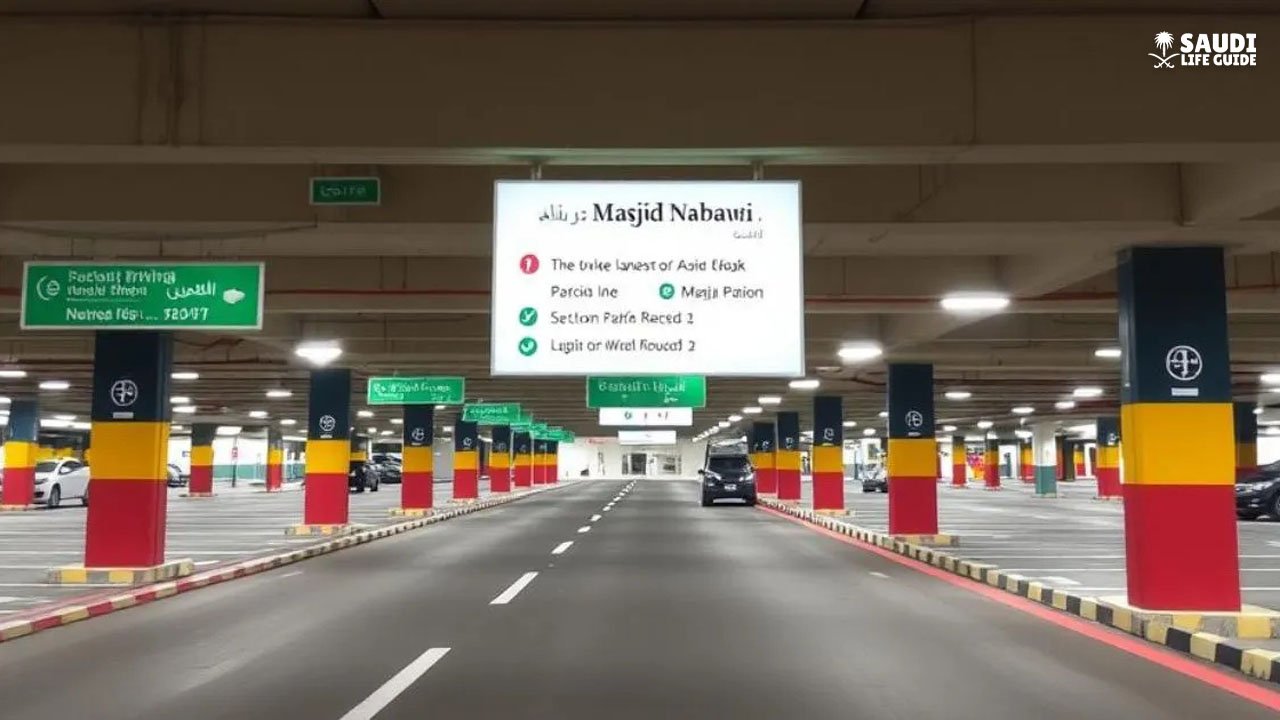
The underground car park beneath the Prophet’s Mosque holds around 4,300 vehicles across 24 separate zones. That scale is the whole story: it is the reason you can almost always find a space outside peak times, and the reason people spend twenty minutes looking for their car afterwards.
This guide covers what the facility actually costs, how to book a space before you arrive, and what to do when it is full.
Quick Answers
- Free alternative: yes, several surface lots within walking or shuttle distance
- Capacity: approximately 4,300 vehicles
- Zones: 24
- Hours: 24 hours
- Booking: yes, through the Mawgif app
- Cost: charged hourly on a rising scale, with the rate increasing after 2 hours and again after 8
The Facility
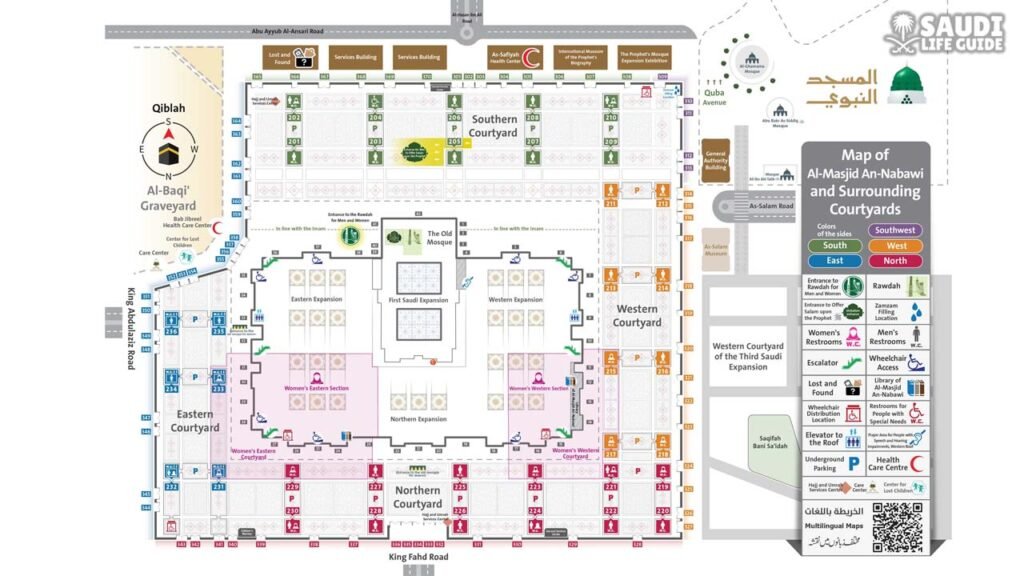
Official figures describe the parking as 24 units with capacity for up to 184 vehicles each, which works out to roughly 4,400 spaces. The Ministry of Hajj and Umrah gives the total as 4,300 when the garage was opened for advance booking. Either way, you are dealing with a facility of around 24 zones and something over four thousand spaces.
Access is via multiple entry and exit ramps positioned around the mosque, and escalators distributed through the levels bring visitors up directly into the mosque courtyards rather than out onto the street.
The practical consequence of 24 zones. Noting that you parked “underground” tells you nothing useful two hours later. The zone identifier is the only thing that will get you back to your car, and it is the single most common thing visitors forget to record.
Parking Fees and Why They Look Odd
Fees are charged hourly on a rising scale:
| Duration | Rate per hour |
|---|---|
| First 2 hours | SR 1.15 |
| Hours 2 to 8 | SR 2.30 |
| Beyond 8 hours | SR 3.45 |
Those numbers are not arbitrary. SR 1.15 is one riyal plus 15% VAT. SR 2.30 is two riyals plus VAT. SR 3.45 is three riyals plus VAT.
The underlying structure is simply one, two and three riyals per hour depending on how long you stay. Once you see that, the amounts stop looking random and become easy to estimate: a three-hour visit is roughly SR 4.60, and a full day works out to a modest sum by the standards of any major mosque or city centre car park.
What this means in practice. Parking here is inexpensive. If you have read elsewhere that a day costs SAR 40, that figure is wrong by a wide margin. If you have read that it is free, that is also wrong. It is cheap, but it is charged.
Rates can change during Ramadan, Hajj and other peak periods. Confirm before you travel if you are visiting during a busy season.
Paying
Payment is handled through self-service machines positioned near the stairway exits, of which there are a substantial number spread through the facility, or electronically by scanning the barcode on your parking ticket. Card and mada payments are accepted, and the Mawgif app handles it without any kiosk visit at all.
Booking Ahead: The Mawgif App
The Ministry of Hajj and Umrah launched Mawgif, which lets you reserve and pay for a space in this garage before you arrive.
For anyone visiting during Ramadan, Hajj season, or simply arriving close to Maghrib, this removes the main uncertainty of the trip. You are no longer gambling on availability at the moment you most need it.
Download it before you travel rather than trying to set it up in the car at the ramp.
If a guide tells you to use Eatmarna, stop reading it. Eatmarna has been retired and its functions folded into Nusuk. An earlier version of this page recommended it, which we have corrected. Any guide still recommending Eatmarna has not been updated in years, and that tells you what to assume about the rest of its content, including its parking fees.
Entrances
Entry points are distributed around the mosque so that visitors can approach from whichever direction they are travelling. Official descriptions name entrances associated with Abu Bakr Al-Siddiq to the north, Quba to the south, Umar bin Al-Khattab to the west, and Prince Abdulmohsin Road.
The rule that saves you a long walk: the ramps connect through the facility, so the entrance you drive into does not determine where you park. Drive through to the zone nearest your hotel or your preferred mosque gate rather than taking the first available space near the ramp.
Visitors who ignore this end up parking at the opposite end of the mosque from their accommodation and walking that distance several times a day.
Finding Your Car Again
In a facility of this size this is a genuine problem, not a minor inconvenience.
Photograph the zone marker. Not the pillar, not the general area. The zone identifier is what the signage inside is organised around.
Note which gate you surface at. The mosque gates are numbered and they are the reference point you will actually remember. “I came up at Gate 15” is more retrievable hours later than a zone code.
Use the Mawgif app’s saved location if you booked through it.
Agree a surface meeting point with your family before separating. Reuniting underground is considerably harder than reuniting at a named gate.
Timing Your Visit
Congestion tracks prayer times closely.
Quietest: between Fajr and Dhuhr on weekdays. Tahajjud is quieter still.
Busy: Asr through Maghrib on weekdays, with Maghrib the sharpest peak because arrivals compress into a short window before the Adhan.
Heaviest: Jummah, Ramadan evenings, and public holidays. For Friday prayers, plan on arriving a couple of hours ahead rather than thirty minutes. During Ramadan the Taraweeh crowd builds well before the prayer itself.
Work backwards from the Adhan rather than from your own schedule. Check prayer times for Madinah before you set out.
Exit timing matters too. Leaving immediately after a major prayer puts you in the same queue as everyone else. Waiting twenty minutes inside usually gets you home sooner than joining it.
If you are planning an Umrah trip, the 1448 AH Umrah visa season dates determine how busy Madinah will be during your visit, which is worth checking before you finalise travel dates.
Free Parking Near Masjid al-Nabawi
When the underground facility is full, or if you would rather not pay at all, several surface parking areas operate around Madinah within walking or shuttle distance of the Haram.
The pattern is consistent and worth understanding: the closer the lot, the earlier it fills. Lots within roughly ten to twenty minutes’ walk are usually full well before major prayers. Lots at twenty-five to forty minutes almost always have space, and many are served by shuttle buses running to the mosque.
How to use them well:
- Pick a first choice and a backup before you set out. Deciding while circling is how people end up parking badly.
- For the closer lots, arrive 60 to 90 minutes before Fajr, Maghrib or Isha. Anything later and you are relying on luck.
- Park only in marked bays and follow attendant instructions. Fines and towing are both real.
- Factor the walk into your prayer timing. A thirty-minute walk each way changes when you need to leave.
For most visitors the underground facility is the better option simply because the cost is low and the walk is nil. The free lots make sense if you are staying all day, arriving during Hajj or Ramadan peak, or parking overnight.
Safety and Emergency Protocols
Emergency Features
- Fire suppression systems on all levels
- Emergency evacuation routes clearly marked
- Direct communication with Madinah Civil Defense
- Medical emergency response teams on standby
- Vehicle breakdown assistance available
Emergency Contact Numbers
| Service | Contact Number |
| Parking Management | 920000786 |
| Madinah Traffic Police | 993 |
| Civil Defense | 998 |
| General Emergency | 911 |
Practical Tips
- Arrive earlier than you think for Maghrib and Jummah. The window between “plenty of space” and “full” is short.
- Keep your ticket or booking somewhere fixed. Not loose in a pocket you will empty at wudu.
- Carry water. The walk from the far zones to the mosque is longer than it looks on a map, and Madinah summers are unforgiving.
- Plan your exit. Leaving immediately after a major prayer means queuing with everyone else. Waiting twenty minutes usually costs less time than joining the queue.
Planning the rest of your trip
FAQs
Is there underground parking at Masjid al-Nabawi?
Yes. The facility sits beneath the Prophet’s Mosque, holds approximately 4,300 vehicles across 24 zones, and operates 24 hours a day.
How much does Masjid al-Nabawi parking cost?
Charges rise with duration: SR 1.15 per hour for the first two hours, SR 2.30 per hour from two to eight hours, and SR 3.45 per hour beyond that. Those figures are one, two and three riyals plus 15% VAT, which is why they look unusual. A short visit costs a few riyals.
Is Masjid al-Nabawi underground parking free?
No. It is charged hourly, though the rates are low. Free parking is available at surface lots elsewhere in Madinah, typically fifteen to forty minutes’ walk from the Haram.
Can I book a parking space in advance?
Yes. The Ministry of Hajj and Umrah launched the Mawgif app for this facility, allowing visitors to reserve and pay before arriving.
How do I find my car afterwards?
Photograph the zone marker and note the number of the mosque gate you surface at. Across 24 zones, remembering the level alone will not be enough.
