


The National Early Warning Platform is the Civil Defense system that sends danger alerts straight to the phones of everyone in an area at risk, and on Thursday 15 October 2026 it went off in Najran and Jazan. Both warnings were lifted within minutes, but they came after alerts in Riyadh earlier in the week, so a lot of expat households are asking the same question: what exactly are we supposed to do when that message lands?
The General Directorate of Civil Defense has answered with an official bilingual guide, shown in full below. This article takes its nine instructions one by one, adds the practical detail the official guide leaves out, and covers the questions our readers keep sending us: which number to call, whether you can film, and why some phones stay quiet.
What the National Early Warning Platform is
The National Early Warning Platform for Emergencies is the Civil Defense channel for warning people in a specific area about a threat. When it is triggered, an alert pops up on phones in that area with the warning in Arabic and English, and Civil Defense posts the same notice on its official X account, @SaudiDCD.
The alerts this month have described a “potential danger” without naming it. In practice they have come on the same days as missile and drone interceptions reported over Saudi cities, which is why the instructions are about getting indoors and away from glass rather than about rain or dust.
Weather is handled by a different system. The National Center for Meteorology early warning page issues yellow, orange and red alerts for storms, dust and floods. If you want the seasonal picture, our Saudi Arabia weather calendar covers it. And if you hear an outdoor siren rather than a phone alert, our guide to Saudi warning siren tones explains what the intermittent, wavy and steady tones mean.
Get Iqama, visa and job updates on WhatsApp
Follow the Saudi Life Guide channel to get new rules, fees and news as soon as we publish them.
Follow on WhatsAppThe 9 official Civil Defense instructions, explained
The Civil Defense guide lists nine instructions. Here they are in the official order, with what each one means in an ordinary Saudi villa, flat, office or car.
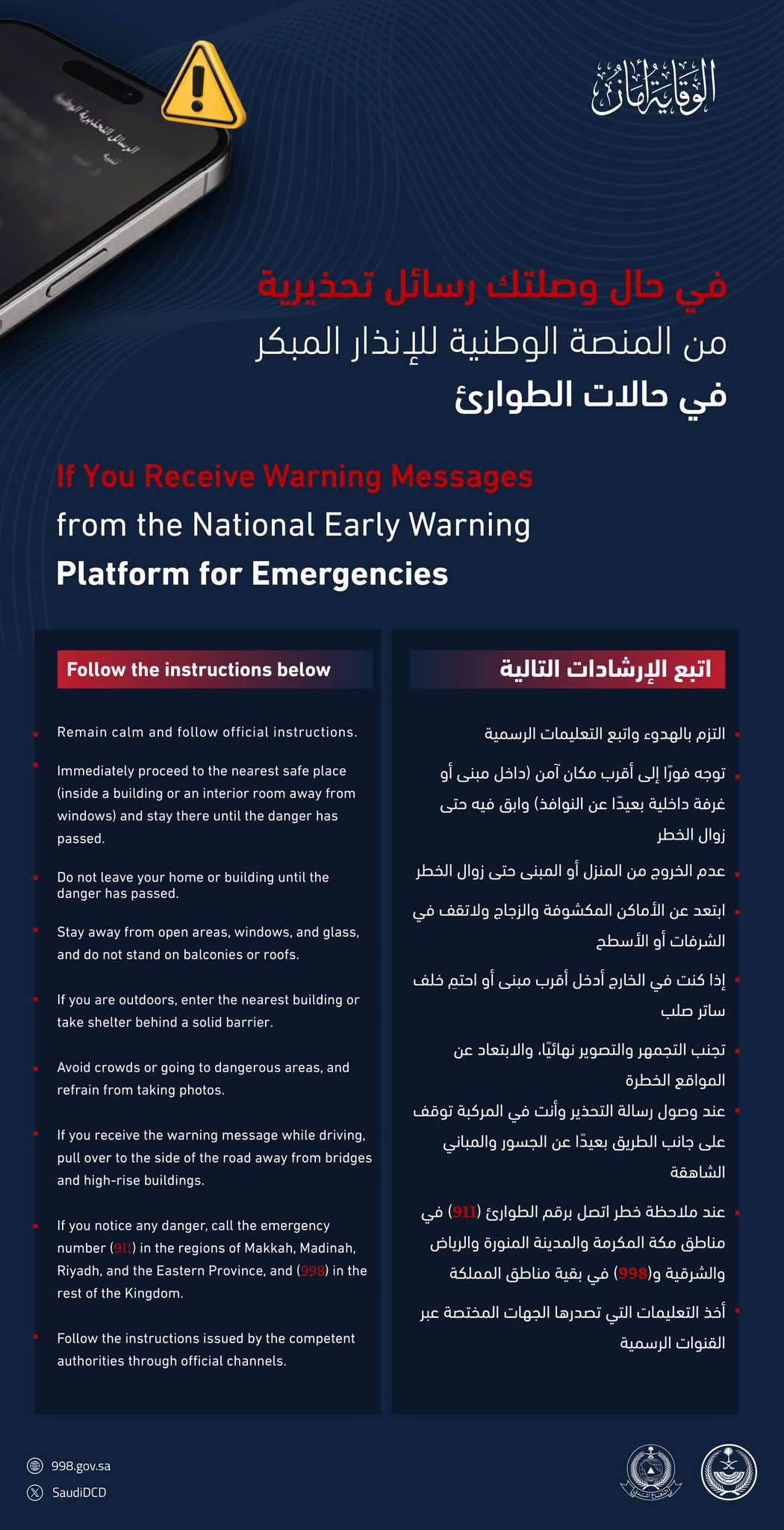
- Remain calm and follow official instructions. Panic is what gets people hurt on stairs and in basement car parks. Read the whole alert once, check that it names your city or region, then act.
- Go immediately to the nearest safe place and stay there until the danger has passed. Civil Defense describes that safe place as inside a building, or an interior room away from windows. In most homes that is a corridor, an inner bathroom or a storeroom with no outside glass. Pick yours today, not while the phone is going off.
- Do not leave your home or building until the danger has passed. Several alerts this week were lifted within minutes, which tempts people to step out early. Wait for the official all-clear message instead.
- Stay away from open areas, windows and glass, and do not stand on balconies or roofs. This is the instruction people break most often. The roof is where curious neighbours go to look, and it is the most exposed spot in the building.
- If you are outdoors, go into the nearest building or take shelter behind a solid barrier. A shop, a mall, a mosque or an office lobby all count. Do not stand in an open car park or a wide street waiting to see what happens.
- Avoid crowds and dangerous areas, and do not take photos. Do not walk or drive towards a sound, smoke or an impact site. Emergency teams need the roads clear, and filming carries a real legal risk, explained further down.
- If you get the alert while driving, pull over to the side of the road away from bridges and high-rise buildings. On big Riyadh roads such as King Fahd Road or the ring roads, that means not stopping under an overpass or right beside a tower, even if it looks like shelter.
- If you notice any danger, call the emergency number. That is 911 in the Makkah, Madinah, Riyadh and Eastern Province regions, and 998 in the rest of the Kingdom. The full breakdown is in the table below.
- Follow the instructions issued by the competent authorities through official channels. Official channels means Civil Defense on X (@SaudiDCD), the Civil Defense website at 998.gov.sa, the Saudi Press Agency and official media. Civil Defense has also asked people to ignore rumours and stop passing on unknown videos, which travel fastest through WhatsApp groups.
What to do in the first five minutes
The first few minutes decide whether a household follows its plan or improvises. A short routine works for most families.
- Move everyone to the inner room you picked in advance, and close the door behind you.
- Take your phone and charger with you, because the all-clear arrives on the same phone.
- Keep children away from windows, and do not let anyone go up to the roof to look.
- If a household worker or a relative sleeps in a roof annex or a separate room, call them in or phone them. They may not have seen the alert.
- Check the official Civil Defense account for updates rather than group chats.
Many expats in Saudi Arabia live in towers with glass fronts and a balcony on every flat. If that is your building, the corridor or bathroom in the middle of the flat is the closest thing you have to the interior room Civil Defense describes.
When the danger has passed
Civil Defense ends an alert with a separate message saying the danger has passed in your city or region. That all-clear now arrives as an ordinary text-style notification without the loud danger tone, so it is easy to miss if your phone is in another room.
The all-clear Civil Defense issued for Jazan on 15 October asked people to keep following its instructions and to avoid gathering and taking photos entirely, and gave 998 as the emergency number for that region. Treat that as the standard advice for the hours after any alert.
After the all-clear, do not go looking for fragments or impact sites. If you find debris near your home or car, leave it alone, keep people away from it and report it on 911 or 998, depending on your region. Our report on the Riyadh missile debris that injured four people shows why: falling fragments, not the missiles themselves, caused the injuries and damage to homes.
Filming and sharing interceptions can bring legal action
Filming, publishing or sharing information about missile and drone interceptions or their impact sites can expose you to legal accountability, the Ministry of Interior has warned. Civil Defense repeated that warning when it lifted the Najran and Jazan alerts on 15 October.
Circulating counts, not only recording. A clip that arrives in a family group and gets forwarded is still being circulated, and the person who forwards it is part of that chain. The safe habit is simple: do not record it, do not post it and do not forward it.
Which emergency number to call
Call 911 in four regions and 998 everywhere else, according to the Civil Defense guide. Saudi Arabia has 13 administrative regions, so the split looks like this:
| Region | Number to report danger |
|---|---|
| Riyadh Region | 911 |
| Makkah Region (including Jeddah and Taif) | 911 |
| Madinah Region | 911 |
| Eastern Province (including Dammam, Khobar and Jubail) | 911 |
| Najran, Jazan, Asir, Al-Baha, Qassim, Hail, Tabuk, Al-Jouf and Northern Borders | 998 |
Save the right number for where you live, and for any city you drive to often. A family in Khamis Mushait and a family in Riyadh dial different numbers for the same emergency.
Make sure your phone receives the alerts
Alerts only help if they reach you. Civil Defense has asked residents to check two things: that the emergency alert feature is switched on, and that the phone’s operating system is up to date.
- iPhone: open Settings, tap Notifications, scroll to Government Alerts and make sure the alerts and testing alerts are on.
- Android: open Settings, go to Notifications, then Advanced settings, then Wireless Emergency Alerts. Menu names differ between brands, so if you cannot find it, type “emergency alerts” into the Settings search bar.
- Software: install the latest system update for your phone.
- Signal: a phone in flight mode, or without a Saudi mobile signal, cannot receive the alert.
Several readers on our Facebook page said this week’s alerts reached them as a vibration and a pop-up with no sound. How an alert behaves depends on the phone and its settings, so if your phone buzzes at an odd hour, look at the screen.
Recent alerts in October 2026
The platform has been used several times this week, in the capital and in the south. Each alert was followed by an all-clear.
| Date | Area | What was reported |
|---|---|---|
| Tuesday 13 October | Riyadh and the Eastern Province | Warnings issued and lifted. Two Houthi cruise missiles were shot down over Riyadh; debris injured four people and damaged about 15 homes. |
| Wednesday 14 October | Riyadh City and Al-Kharj | Warnings issued and lifted. Debris from an intercepted ballistic missile injured one resident and damaged a house and a vehicle in Riyadh. |
| Thursday 15 October | Najran and Jazan | Warnings issued and lifted within minutes. Civil Defense shared its official instruction guide and repeated the filming warning. |
Civil Defense has not said what the “potential danger” was in each case. If your flight plans are affected by the wider disruption, our guide to flight delays, cancellations and GACA compensation explains what airlines owe you.
Common mistakes during an alert
Most of the risky behaviour during alerts comes from curiosity, not panic. These are the mistakes we see most in comments and group chats.
- Going up to the roof to watch. The roof is exactly where Civil Defense tells you not to be.
- Filming from the balcony. It breaks two instructions at once: stay away from glass and balconies, and do not take photos.
- Stopping under a bridge. It feels like cover, but the guide says to pull over away from bridges and tall buildings.
- Going out because nothing seems to be happening. Stay inside until the all-clear message arrives.
- Switching off emergency alerts after a night-time alert. The next one could matter more. Keep them on.
- Trusting forwarded voice notes. Check @SaudiDCD and official media before believing or sharing anything.
Prepare your household before the next alert
Ten minutes of planning now makes the next alert far calmer, especially with children at home.
- Choose your inner room and tell everyone, including children and any household worker, where it is.
- Save 911 or 998, whichever applies to your region, in every phone in the house.
- Keep a torch, water, a power bank and any regular medicines near that room.
- For the car, check our list of safety essentials to keep in your vehicle.
- Register with your embassy if you have not already, so it can reach you in an emergency.
Frequently asked questions
What is the National Early Warning Platform in Saudi Arabia?
The National Early Warning Platform is the Saudi Civil Defense system that sends emergency warnings to phones in an area facing a threat. Alerts arrive with Arabic and English text and tell people to move to a safe place. A separate message confirms when the danger has passed, and Civil Defense posts the same alerts on its official X account.
What should I do when I get a National Early Warning Platform alert?
Go straight to the nearest safe place, ideally an interior room away from windows, and stay there until the danger has passed. Keep off balconies and roofs, avoid crowds and do not film anything. If you are driving, pull over away from bridges and tall buildings, and follow updates from Civil Defense only.
Which number do I call to report danger in Saudi Arabia?
Call 911 if you are in the Makkah, Madinah, Riyadh or Eastern Province regions, and 998 anywhere else in the Kingdom, according to Civil Defense. 911 is the unified emergency number in those four regions. In Najran, Jazan, Asir and the other regions, 998 connects you to Civil Defense directly.
Is it illegal to film a missile interception in Saudi Arabia?
Filming, publishing or sharing information about missile and drone interceptions or their impact sites can lead to legal accountability, the Ministry of Interior has warned. Civil Defense repeats this in its all-clear messages. Forwarding someone else’s clip also circulates it, so the safest choice is not to record, post or forward any such material.
Why did my phone not receive the emergency alert?
Your phone may have emergency alerts switched off, may need a software update, or may have been outside the area the alert covered. On iPhone check Settings, Notifications, Government Alerts. On Android check Wireless Emergency Alerts in Settings. Civil Defense has asked residents to keep the feature on and update their phones.
How do I know the danger is over?
Civil Defense sends a second message saying the danger has passed in your city or region, and posts the same notice on its official X account. The all-clear now arrives as a normal text-style notification without the loud tone, so check your screen. Even after it, stay away from impact sites and do not gather or take photos.
Key takeaways
- A National Early Warning Platform alert means go to an interior room away from windows and stay there until the all-clear.
- Keep off balconies and roofs, avoid crowds and never film or share interceptions or impact sites.
- Drivers should pull over away from bridges and tall buildings.
- Call 911 in Riyadh, Makkah, Madinah and the Eastern Province, and 998 in every other region.
- Keep emergency alerts switched on and your phone updated, and pick your safe room before the next alert.
This guide follows the official instructions published by the General Directorate of Civil Defense. Always act on the latest message from the National Early Warning Platform and @SaudiDCD.