



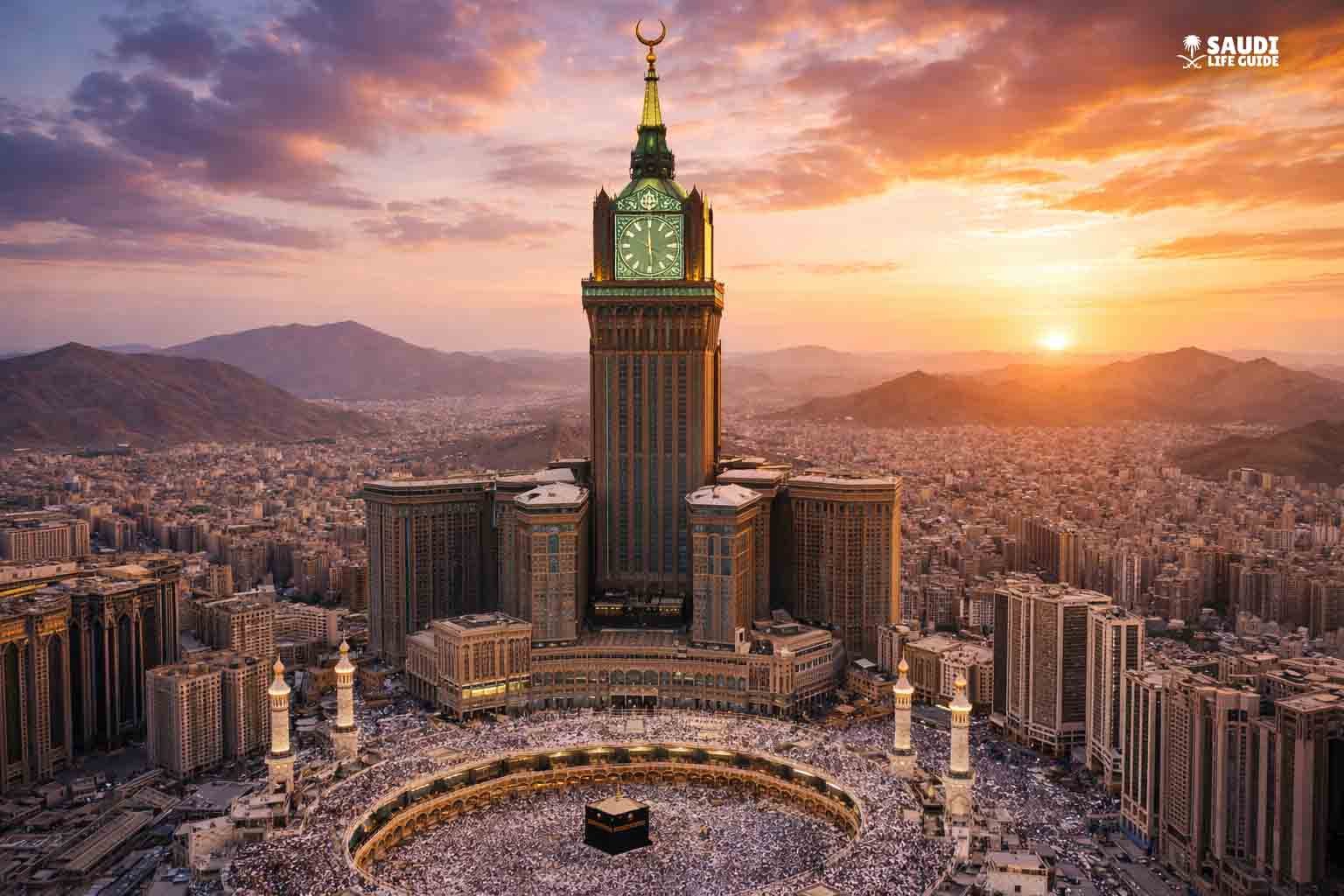
The Makkah Clock Tower has 120 above‑ground floors. This count includes hotel floors, observation decks, clock levels, mechanical floors, and cultural spaces.
This number is widely cited in architectural databases, official building fact sheets, and global skHajj & Umrah Guideyscraper registries. It makes the tower one of the tallest structures in the world and the tallest clock tower globally as of 2026.
Note: Some travel guides or promotional sites inaccurately list smaller counts (e.g., “60 floors”), often confusing the hotel portion with the total structure. The authoritative technical floor count for the main tower is 120.
Breakdown of the 120 Floors
While a full architectural floor‑by‑floor breakdown isn’t publicly available in detail, we can generally categorize them as follows:
- Lower Floors (1–15+): Retail, shopping arcades, services, and public access spaces.
- Hotel Floors: Large sections are dedicated to the Fairmont Makkah Clock Royal Tower Hotel luxury accommodation.
- Upper Levels: Observation levels, the clock infrastructure, astronomical measurement center, and museum.
- Top Floors (near 120th): Observation deck and museum levels overlooking the city and Haram.
Why Floor Count Matters: Architectural and Cultural Significance
The 120‑floor count is not just a statistic—it reflects the tower’s engineering ambition, its multi‑purpose role, and its symbolic place in Islamic heritage.
Engineering and Scale
At approximately 601 meters tall, the tower’s 120 floors are supported by a blend of reinforced concrete and steel structures allowing mixed use (hotel, observation, research, and hospitality) in one of the world’s busiest religious tourism hubs.
Cultural Impact
Being visible across Mecca from miles away, the Makkah Clock Tower provides timekeeping for pilgrims and residents and acts as a landmark symbol reinforcing Mecca’s identity as a spiritual and cultural center. The clock faces themselves are among the largest in the world and are visible for many kilometers.
Comparison: Makkah Clock Tower Floors vs Other Tall Structures
Here’s how the Makkah Clock Tower compares with other well‑known tall buildings:
| Building | Location | Floors | Height |
|---|---|---|---|
| Makkah Clock Tower | Makkah, Saudi Arabia | 120 | ~601 m |
| Burj Khalifa | Dubai, UAE | 163 | 828 m |
| Shanghai Tower | Shanghai, China | 128 | 632 m |
| Taipei 101 | Taipei, Taiwan | 101 | 508 m |
This shows the Makkah Clock Tower’s position as a global architectural icon and its significance within the realm of supertall structures.
What’s Inside: Key Uses of the Floors
The 120 floors host a variety of uses and attractions:
- Luxury Hotel
The bulk of the floors are dedicated to the Fairmont Makkah Clock Royal Tower Hotel with hundreds of rooms, suites, and facilities for visitors. - Observation Deck
The highest floor serves as an observation deck offering panoramic views of Makkah and the Grand Mosque. - Clock Tower Museum
There’s a Clock Tower Museum inside the top floors, dedicated to time measurement and Islamic history of astronomy. - Services & Amenities
Lower floors include retail, restaurants, and services for hotel guests and visitors.
FAQs
Q: How many floors does the Makkah Clock Tower have?
A: 120 floors above ground.
Q: Is the Makkah Clock Tower the tallest in the world?
A: It is the tallest clock tower and one of the tallest buildings in the world, but not the tallest building overall.
Q: Does the floor count include underground levels?
A: Standard architectural descriptions count above‑ground floors; the official number is 120. Some technical sources note basements but they are not included in this count.
Q: Are all floors open to visitors?
A: Not all. Many floors are private hotel areas. Public access is typically limited to the museum, observation decks, and select floors.
Conclusion
As of 2026, the Makkah Royal Clock Tower unquestionably has 120 floors, making it both Saudi Arabia’s tallest building and the tallest clock tower in the world. Each of these floors contributes to its mixed uses—from retail and hospitality to astronomical research and panoramic viewpoints—serving millions of worshippers and tourists annually.
