


Last updated: 8 November 2026
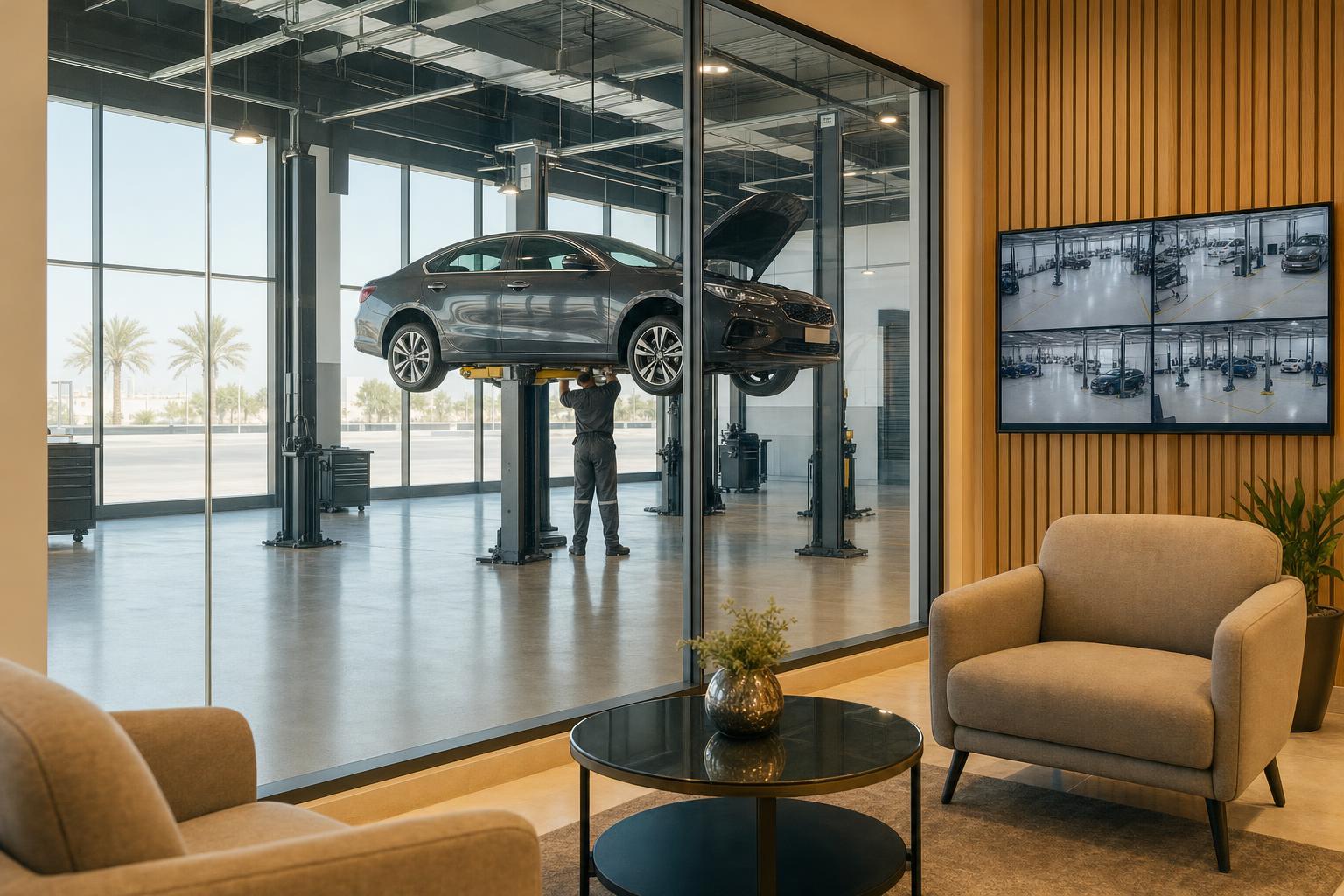
Car workshop rules in Saudi Arabia now put the customer first: every vehicle repair workshop must have an air-conditioned waiting area and let you watch your car being repaired, either through glass windows or, where that is not possible, through a live camera feed. The requirements come from the Ministry of Municipalities and Housing (MOMAH), Okaz and Al-Eqtisad reported on 22 October 2026.
Many expats in Saudi Arabia have handed over their car keys at a small industrial-area workshop and then waited outside in the heat with no idea what was being done to the car. These rules are meant to end that.
What the car workshop rules mean for customers
| Requirement | What you should see at the workshop |
|---|---|
| Waiting area | An air-conditioned area for customers |
| Watching the repair | Glass windows onto the work area, or a live camera feed if a direct view is not possible |
| Payment | Working electronic payment methods (mada, cards, wallets) |
| Licence check | The unified QR code shown clearly on the front, so you can check the licence and official documents |
| Parking | Customer cars parked inside the workshop, not on the sidewalk or the street |
| Workers | Professional certificates for jobs that need them |
Follow Saudi Life Guide for Iqama, visa and job updates
New rules, fees and news as soon as we publish them. Join 107,000+ followers on Facebook.
Rules for the workshop itself
The same MOMAH requirements also cover how a workshop is run:
- All work stays inside the licensed premises. Sidewalks and setback areas cannot be used for repairs.
- The building must follow the Saudi Building Code and fire protection rules, with suitable equipment and a first-aid kit.
- An oil interceptor must stop oil reaching the sewer network, and it must be checked at least once every three months.
- Used oil goes into dedicated tanks and is handed to recyclers or approved waste carriers. Any spill is cleaned up straight away.
- The workshop and the area around it must be kept clean, and facades, signs and floors maintained. Service pipes and AC units should not spoil the facade.
- The premises must meet universal access requirements for people with disabilities.
When MOMAH approved the workshop requirements in December 2025, it also grouped workshops by activity: mechanical repair, electrical repair, bodywork, painting, tyre services and oil services, and required surveillance cameras on site. Regional municipalities (amanas) check that workshops follow the rules.
What has not been announced yet
The reports do not give a start date, a grace period for existing workshops or the penalty for breaking these rules. MOMAH violations for shops are normally handled by the local amana under the municipal penalties schedule. We will update this page when the ministry or Balady publishes those details.
How to use these rules as a customer
- Scan the QR code on the front before you hand over the car. It shows whether the workshop is licensed.
- Ask to wait in the waiting area and keep an eye on your car through the glass or on the screen, especially for jobs like brake pads, oil changes or battery replacement.
- Ask for a written quote or job card before work starts, listing the parts and labour.
- Pay electronically and keep the receipt. It is your proof if a repair fails or the bill does not match the quote.
- Before a long trip, also check our list of safety essentials to keep in your car.
If a workshop works on the street, has no waiting area or refuses electronic payment, you can report it to the municipality through the Balady app or the 940 hotline.
Related car guides
- Repairs done before your inspection? Book it with our Fahas (MVPI) appointment guide.
- After an accident repair, check your vehicle insurance validity and our car insurance guide.
- Parking on the sidewalk outside a workshop can still cost you: see the traffic violations and fines list.
Getting a fair repair: practical tips
The new rules let you see the work, but a good outcome still depends on what you agree before the job starts. Based on real expat experience in KSA, these habits prevent most arguments over repairs:
- Agree on the parts. Ask the workshop to write on the quote whether each part is original (agency) or a commercial copy, and the price of each. The cheaper option is not always wrong, but you should choose it knowingly.
- Ask for the old parts back. Seeing the worn brake pads or the failed battery is the simplest proof that a part really was replaced.
- Check the warranty booklet first. If your car is still under the manufacturer’s warranty, read its conditions before using an independent workshop for major work.
- Approve extra work in writing. If the mechanic finds another problem, ask for a new price and agree to it by message before they continue.
- Test the car before you pay. A short drive with the mechanic often reveals a noise or warning light that is easier to fix on the spot.
Accident repairs paid by insurance
If the repair follows an accident and you plan to claim on insurance, get the accident report before any work starts. In most cities, accidents are reported through Najm, by phone or through the Najm app, when at least one driver has valid insurance. The insurer then asks for the Najm report, the claim form and a copy of the policy.
Take photos of the damage from several angles before the car goes into the workshop, and keep your driving licence, vehicle registration and insurance details ready. Repairing first and claiming later usually causes delays. A claim can also affect your renewal price, which our guide to the no claim discount on car insurance explains.
Do car workshops in Saudi Arabia have to let me watch the repair?
Yes. Under the MOMAH requirements, workshops must let customers watch through glass windows or, where that is not possible, through a live camera feed.
How can I check whether a workshop is licensed?
Scan the unified QR code that must be displayed on the front of the workshop. It shows the licence and official documents.
Can a workshop refuse card payment?
No. Workshops must offer working electronic payment methods such as mada, cards and wallets.
Sources: Okaz and Al-Eqtisad, 22 October 2026, and Al Weeam, 18 December 2025, citing the Ministry of Municipalities and Housing requirements for vehicle repair workshops.