



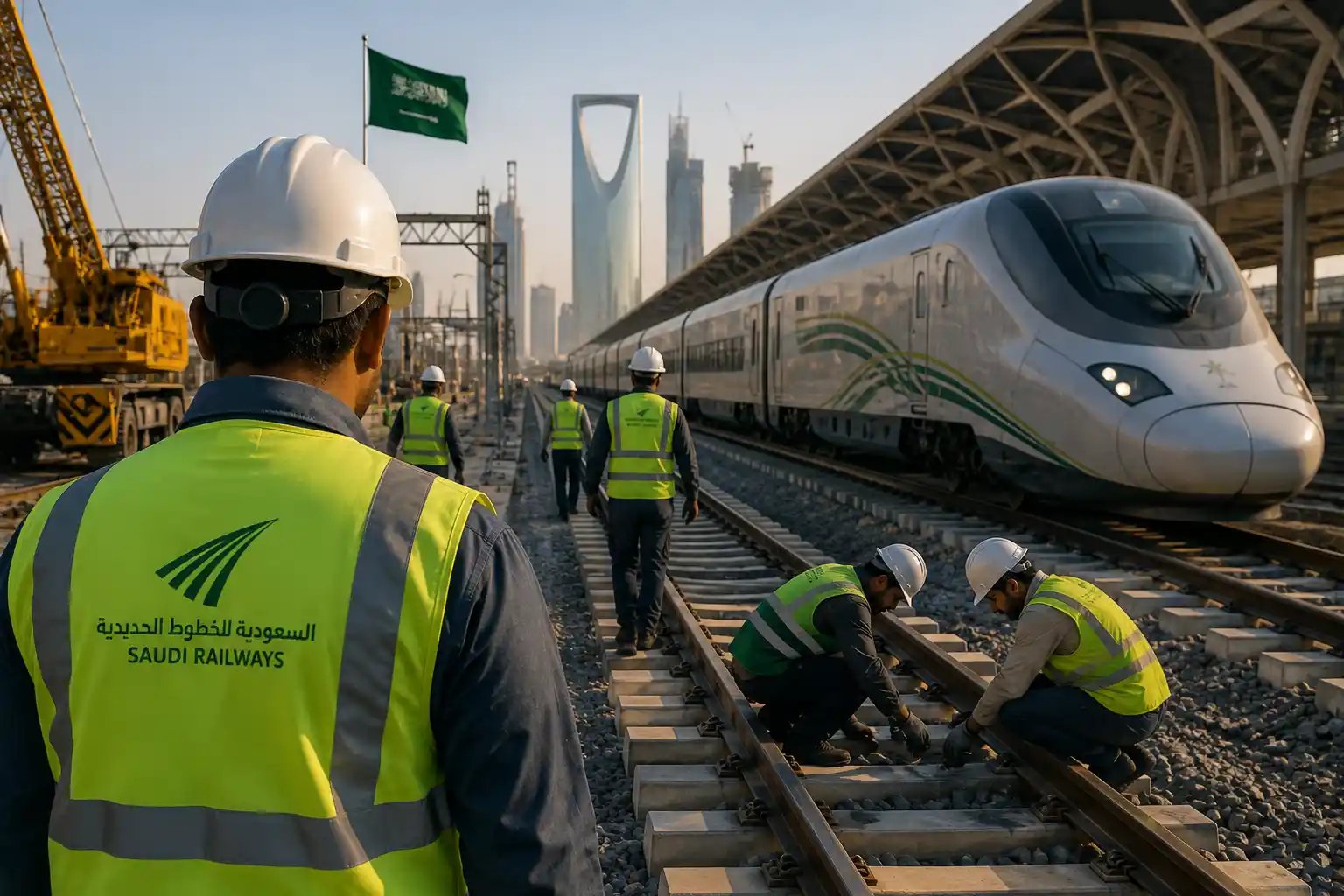
Saudi Arabia is targeting around 100,000 railway jobs by 2030, up from about 13,000 today, according to Fawaz Al-Suhaili, head of the Transport General Authority. The growth follows a long building programme covering metro, high speed and freight lines. Most front line operating roles are being filled through Saudi-only training pipelines.
What changed
Al-Suhaili set out the figure in an interview with the Saudi business daily Al-Iqtisadiah, reported on 14 August 2026. It is a workforce target for the rail sector as a whole, not a recruitment announcement, and no ministry decision or new regulation sits behind it.
| Item | Figure | Where it comes from |
|---|---|---|
| Rail sector jobs today | About 13,000 | Head of the Transport General Authority, August 2026 |
| Target for 2030 | About 100,000 | Head of the Transport General Authority, August 2026 |
| Rail passengers, first half of 2026 | More than 83 million | Transport General Authority data |
| Change against first half of 2025 | Up 16 percent | Transport General Authority data |
| Freight and minerals moved, first half of 2026 | 7.7 million tonnes | Transport General Authority data |
| Gulf Railway full operation | December 2030 | GCC Railways Authority |
Why the rail sector is hiring at all
The passenger numbers explain the ambition better than any strategy document. Saudi Arabia’s rail network carried more than 83 million passengers in the first six months of 2026, roughly 11.5 million more journeys than in the same period a year earlier. Riyadh Metro alone accounted for 60.7 million of those, and the Haramain High Speed Railway carried 3.6 million between Makkah and Madinah. On the freight side, trains moved 7.7 million tonnes of minerals and goods over the same six months.
Three build programmes sit behind the hiring plan. The Gulf Railway, a 2,177 km link running from Kuwait City to Muscat through Saudi Arabia, was reported at around half complete in May 2026 and is due to be fully operational by December 2030. Domestically, public transport projects are running in more than 17 Saudi cities. And in November 2024 the transport ministry launched the Asasat programme with Saudi Railways Company and the Local Content Authority, a SAR 15 billion push to build rolling stock and components inside the Kingdom rather than importing them.
That last piece matters most for employment. A network you only operate needs drivers and station staff. A network you also manufacture for needs factories, and factories need a workforce that does not exist yet.
Where the railway jobs actually sit
The 100,000 figure covers the rail sector broadly, not just train crews. In practice the roles fall into five groups:
- Operations: train drivers, controllers, station staff, dispatch and control room teams.
- Maintenance: rolling stock technicians, track and infrastructure crews, signalling and telecoms specialists.
- Manufacturing and supply chain: the Asasat side, covering component plants, assembly and logistics.
- Engineering and project delivery: design consultancies, civil and systems engineers, site supervision on lines still under construction.
- Safety and regulation: inspection, compliance and licensing work under the Transport General Authority.
Expat hiring has historically clustered in the construction and consultancy end, because those jobs attach to projects with fixed end dates rather than to permanent operating headcount. Rail specialists sit near the top of the highest paying jobs in Saudi Arabia for exactly that reason.
The part the headline leaves out
Reports of the target do not break the 100,000 down by nationality, and that gap is worth understanding before anyone plans a career move around it.
Look at how the Kingdom is building its rail workforce. The Saudi Railway Technical Institute reopened registration in June 2026 for a diploma in railway trades: two academic years plus six months of field training at Saudi Railways Company, a monthly stipend of SAR 2,000 in the first year rising to SAR 3,000 in the second, GOSI registration from day one, and direct employment with the company at the end. Eligibility is Saudi nationals only, science-track secondary graduates under 23 with at least 80 percent.
That is a deliberate national cadre pipeline for train maintenance, locomotive work, signalling and infrastructure. Those are precisely the front line technical roles that make up the bulk of any railway’s headcount. Many expats in Saudi Arabia have watched the same pattern play out elsewhere, most recently with the Saudization rules now applied to procurement roles. The sector grows, and the entry level operating jobs inside it are built for Saudi graduates first.
What this means for expats
Treat the 100,000 as a signal about where money and projects are going, not as an open hiring queue.
The realistic openings for expats are senior, specialist or project-linked: rail systems engineering, tunnelling and civil works, depot and plant commissioning, signalling design, and the manufacturing setup work Asasat is funding. Contractor and consultancy payrolls are the practical entry point, not the national operator.
If you are weighing an offer, check the pay against the Saudi Arabia salary guide first, because rail packages vary sharply between operator and contractor roles. Moving from one Saudi employer to a rail employer runs as a normal sponsor transfer, and you can check your sponsor transfer status yourself rather than relying on the new employer’s word. Most of those 83 million journeys, incidentally, were on the network covered in our Riyadh Metro ticket prices and timings guide.
Frequently asked questions
Are the 100,000 Saudi Arabia railway jobs open to expats?
The target covers the rail sector as a whole and has not been broken down by nationality in any report we could verify. Expat hiring is concentrated in engineering, construction and manufacturing roles attached to projects, while entry level operating and maintenance roles are being filled through Saudi-only training programmes.
How many people work in Saudi Arabia’s rail sector now?
About 13,000, according to the head of the Transport General Authority speaking in August 2026. He said the sector’s workforce has expanded significantly over the past four years, though the exact multiple was reported in Arabic and we have not seen it confirmed in a second independent report.
Which projects are driving railway jobs in Saudi Arabia?
The Gulf Railway, a 2,177 km link from Kuwait City to Muscat due to be fully operational by December 2030, urban transport schemes running in more than 17 Saudi cities including Riyadh Metro, and the Asasat programme, a SAR 15 billion effort to manufacture railway equipment inside the Kingdom.
Can an expat train as a train driver or rail technician here?
Not through the Saudi Railway Technical Institute, whose diploma requires Saudi nationality. Expats with existing rail qualifications from another country can be hired directly by operators and contractors, but there is no publicly advertised local training route into railway trades for non-Saudis at present.
Do I need a new visa to move to a railway job?
Not a new entry visa if you are already resident. Moving to a rail employer is handled as a standard sponsor transfer, and your iqama profession is updated with the new contract. Confirm the job title on your contract matches the role, because a mismatch causes problems later.
