

Last updated: 25 October 2026
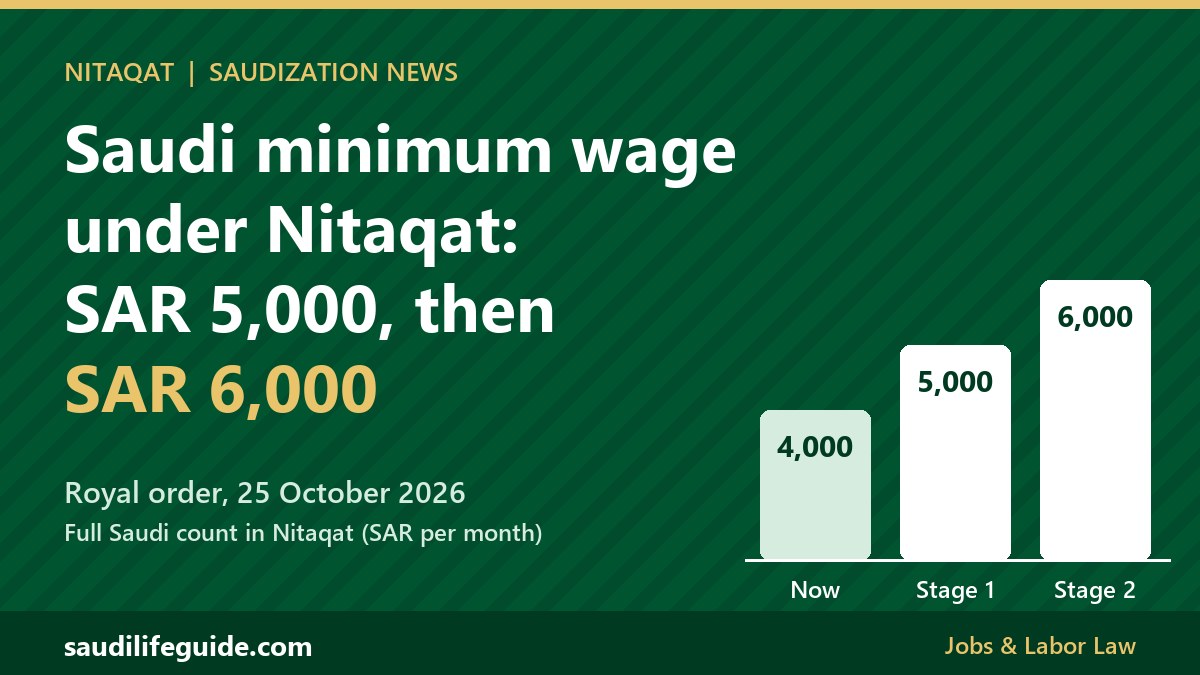
The Nitaqat minimum wage for Saudi employees in the private sector is going up from SAR 4,000 to SAR 5,000 a month, and then to SAR 6,000. King Salman issued the order on Sunday 25 October 2026, on the recommendation of Crown Prince and Prime Minister Mohammed bin Salman, as part of a package of support measures for citizens. The same package gives a SAR 500 monthly allowance to government employees, retirees and social security families, alongside the new electricity and water tariffs that start on 1 January 2027.
This is not a general minimum wage for everyone working in Saudi Arabia. It is the salary a Saudi employee must earn to count as one full Saudi in the employer’s Saudization ratio. Below we explain the dates, what it does to a company’s Nitaqat colour, what it means for expats, and what employers and employees should do now. For the full picture of salary floors in the Kingdom, keep our evergreen guide to the minimum salary in Saudi Arabia open alongside this news.
What the royal order says about the Nitaqat minimum wage
According to the order, as reported by the Saudi Press Agency and Saudi newspapers, the change has two stages:
- Stage 1: the minimum wage needed to count a Saudi worker in full in the Nitaqat Saudization ratio rises to SAR 5,000. It applies 6 months after the start date of the measure.
- Stage 2: the Nitaqat minimum wage rises again to SAR 6,000, 12 months after the first increase takes effect.
The stated aim of the higher Nitaqat minimum wage is to raise wage levels and support the long-term employment of Saudis in the private sector. The order speaks of private-sector establishments and the Nitaqat programme, which the Ministry of Human Resources and Social Development (MHRSD) runs.
Follow Saudi Life Guide for Iqama, visa and job updates
New rules, fees and news as soon as we publish them. Join 67,000+ followers on Facebook.
Nitaqat minimum wage timeline
The order fixes the gaps between the stages, but the text published so far does not give a calendar date for the start of the measure. The table below shows the structure, with two possible readings of the start date. Treat the months as estimates until MHRSD announces the exact date.
| Stage | Full Nitaqat count for a Saudi | When it applies | If counted from 25 Oct 2026 | If counted from 1 Jan 2027 |
|---|---|---|---|---|
| Today | SAR 4,000 a month | Current rule | Until stage 1 | Until stage 1 |
| Stage 1 | SAR 5,000 a month | 6 months after the measure starts | About late April 2027 | About July 2027 |
| Stage 2 | SAR 6,000 a month | 12 months after stage 1 | About late April 2028 | About July 2028 |
Linked dates in the same package: the SAR 500 allowance and the new electricity and water tariffs both tie to 1 January 2027, the day the Saudi Electricity Company and the National Water Company start billing under the new rates.
What changes for Saudi employees in the private sector
Under the current rules, a Saudi earning SAR 4,000 or more (the wage registered with GOSI) counts as one full Saudi in Nitaqat. A Saudi earning between SAR 3,000 and SAR 3,999 counts as half, and below SAR 3,000 does not count. Our minimum salary guide explains that counting table in detail.
Once the new Nitaqat minimum wage of SAR 5,000 applies, a Saudi employee paid SAR 4,000 to SAR 4,999 will no longer count as one full Saudi. The order does not say how the half-count band will move, so we do not know yet whether someone on SAR 4,500 will count as half or not at all. That detail should come in the MHRSD implementing decision.
In practice, many Saudi employees on SAR 4,000 to SAR 5,999 can expect their employers to review salaries before each stage, because a company that wants to keep its Saudization score has two choices: raise the pay of these employees, or hire more Saudis to make up the shortfall.
The order does not say that private-sector employees will receive the SAR 500 allowance. Their benefit in this package is the higher Nitaqat minimum wage.
How the Nitaqat minimum wage affects your employer’s colour
Nitaqat rates each establishment as Platinum, High Green, Medium Green, Low Green or Red, based on the share of Saudis it employs compared with the target for its activity and size. If several Saudi employees drop from a full count to a half count or zero, the Saudization ratio falls even though nobody has left the company.
| Saudi employee’s registered wage | Counts as one full Saudi today? | After stage 1 (SAR 5,000) | After stage 2 (SAR 6,000) |
|---|---|---|---|
| SAR 4,000 to 4,999 | Yes | No | No |
| SAR 5,000 to 5,999 | Yes | Yes | No |
| SAR 6,000 and above | Yes | Yes | Yes |
Companies sitting just above a band limit, especially Low Green, are the most exposed. A drop to Red stops new work visas, work permit renewals, profession changes and transfers into the company. Our guide on how to check your iqama colour and Nitaqat status explains what each colour allows.
What it means for expats
Expat salaries are not covered by this order. The Nitaqat minimum wage only decides how Saudi employees are counted. There is still no statutory minimum wage for expats in the private sector, and your pay stays whatever your contract says, protected through the Wage Protection System.
Many expats in Saudi Arabia will still feel the effects, though:
- Your employer’s colour matters. If your company has many Saudi staff on SAR 4,000 to 5,999 and does not adjust, its Nitaqat colour can slip. A Red employer cannot renew work permits or sponsor transfers, which directly affects your iqama.
- Hiring budgets may shift. Higher costs per Saudi employee may slow new expat hiring in some low-margin sectors, while other companies may hire more Saudis to protect their ratio. This is our reading of the incentives, not something the order states.
- Job changes need more checks. Before you accept a transfer, check the new employer’s Nitaqat colour and ask how it plans to meet the new Nitaqat minimum wage.
- No SAR 500 allowance for expats. The allowance is part of a package for citizens. Expats will pay the new utility tariffs from 1 January 2027 without this support.
For other recent Saudization changes that affect expat jobs, see our reports on accounting Saudization at 50% and project management Saudization at 70%.
Who gets the SAR 500 monthly allowance
The SAR 500 is a separate part of the same package, meant to ease the effect of the new electricity and water tariffs. The reports list these groups:
- Civil and military employees on civil service pay scales and employment programme items (government employees).
- Retirees.
- Family members of a deceased subscriber or retiree covered by the social insurance system.
- Families on social security (Daman), who receive SAR 500 a month as monthly support under the rules that govern the programme.
None of the reports we checked lists private-sector employees or expats among the groups who get the SAR 500. The payment mechanism and start month for each group had not been published at the time of writing.
Electricity and water tariffs from 1 January 2027
The support measures were announced the same day the Saudi Electricity Company and the National Water Company announced new tariffs. For homes, electricity rises from 18 to 21 halalas per kWh for the first 6,000 kWh a month and from 30 to 33 halalas above that, and a fixed monthly charge of SAR 70 to SAR 100 (by breaker size) replaces the meter reading and billing fee. Prices exclude VAT. Read more in our report on the new Saudi electricity tariff for 2027, and use our Saudi electricity bill check guide to see your current bill.
Water moves to four residential tiers, from SAR 1 per cubic metre for the first 15 cubic metres up to SAR 6 above 45 cubic metres, with sewage charged on top and a fixed monthly fee by meter size.
Nitaqat minimum wage: what employers and employees should do now
For employers and HR teams
- Pull a list of every Saudi employee and the wage registered with GOSI. That registered wage is what Nitaqat reads, not the figure in the offer letter.
- Mark who is on SAR 4,000 to 4,999 (affected at stage 1) and SAR 5,000 to 5,999 (affected at stage 2).
- Run your Nitaqat calculator in Qiwa with those employees counted lower, to see whether your colour would drop.
- Budget the salary increases or extra Saudi hires before the SAR 5,000 Nitaqat minimum wage applies, and update GOSI records when pay changes so the new wage is counted.
- Watch for the MHRSD implementing decision with the exact start date and any change to the half-count band.
For Saudi employees
- Check the wage your employer has registered for you in the GOSI app. If it is lower than your actual pay, ask HR to correct it.
- If you earn below SAR 5,000, expect your employer to review your salary before the new Nitaqat minimum wage applies. Get any increase in writing in your Qiwa contract.
- If you work in government or are retired, follow official channels for when the SAR 500 allowance starts.
For expats
- Check your employer’s Nitaqat colour now and again before stage 1.
- If your company is Low Green or Red, keep an eye on your iqama and work permit renewal dates.
- Plan for higher utility bills from January 2027. Our cost of living calculator helps you budget, and the end of service benefit calculator shows what you would receive if you change jobs.
Is this the same as the minimum salary guide?
No. This page covers the royal order of 25 October 2026 and its timeline. Our minimum salary in Saudi Arabia guide covers all salary floors, including sector minimums, dependent visa salary rules and expat pay ranges, and the Saudi Arabia salary guide covers typical pay by job.
FAQ
What is the new Nitaqat minimum wage?
SAR 5,000 a month for a Saudi to count as one full employee in Nitaqat, rising to SAR 6,000 a month 12 months after the first increase. Today it is SAR 4,000.
When does the SAR 5,000 Nitaqat minimum wage start?
Six months after the measure starts. The exact calendar date has not been published yet. MHRSD is the body to watch for the confirmed date.
Is this a minimum wage for expats?
No. It only decides how Saudi employees count in Saudization. Expat pay remains set by contract, and there is no statutory minimum wage for expats in the private sector.
Do private-sector employees get the SAR 500 allowance?
The reports do not list private-sector employees. The SAR 500 goes to civil and military government employees, retirees, family members of deceased subscribers or retirees under social insurance, and social security families.
Can my company turn Red because of this?
Yes, if many of its Saudi staff earn less than the new Nitaqat minimum wage and it does not raise their pay or hire more Saudis. Check your iqama colour regularly.
Does the Nitaqat minimum wage change the half-count rule?
The order does not mention it. Today a Saudi earning SAR 3,000 to 3,999 counts as half. Whether that band moves up will be set in the implementing rules.
Sources
- Saudi Gazette: King Salman orders SR5,000 minimum wage under Nitaqat (25 October 2026, citing the Saudi Press Agency).
- Sabq: support measures and SAR 500 monthly allowance (Arabic, 25 October 2026).
- Al-Jazirah: royal directive on support measures for citizens (Arabic, 25 October 2026).
- Sabq: new electricity and water tariffs from 2027 (Arabic, 25 October 2026).
- Ministry of Human Resources and Social Development for the implementing decision.