

Saudi Arabia is celebrating its 96th National Day on September 23, 2026, with streets, homes and public places across the Kingdom decorated in green.
The Saudi national flag is an important part of the celebrations. However, residents and businesses should be aware that there are specific rules for displaying and handling the flag.
Because the Saudi flag carries the Shahada, it holds special religious and national significance and must always be treated with respect.
Important Saudi Flag Rules
The Saudi national flag must never be flown at half-mast. This rule also applies to the King’s flag and other Saudi flags containing the Shahada or Quranic verses.
The flag should never touch the ground or water and must always be displayed in a way that protects its dignity.
A Saudi flag that becomes torn, faded or damaged should no longer be displayed. Flags that are no longer suitable for use should be handled and disposed of according to the applicable rules.
The national flag must also not be used improperly as a commercial trademark or for advertising purposes. Businesses should therefore be careful when using the Saudi flag in promotional materials, especially during National Day celebrations.
The flag should not be used for wrapping, tying or carrying objects. It is also prohibited to add slogans, logos, phrases or other markings to the official Saudi flag.
When displayed on a flagpole, the flag should be allowed to hang and fly freely instead of being tightly wrapped or secured around the pole.
The Saudi flag should also be stored carefully to prevent it from becoming dirty, damaged or worn.
Displaying the flag upside down is prohibited. It should also not be placed or printed on animals or used in any other way that could be considered disrespectful.
Follow Saudi Life Guide for Iqama, visa and job updates
New rules, fees and news as soon as we publish them. Join 95,500+ followers on Facebook.
Why Is the Saudi Flag Special?
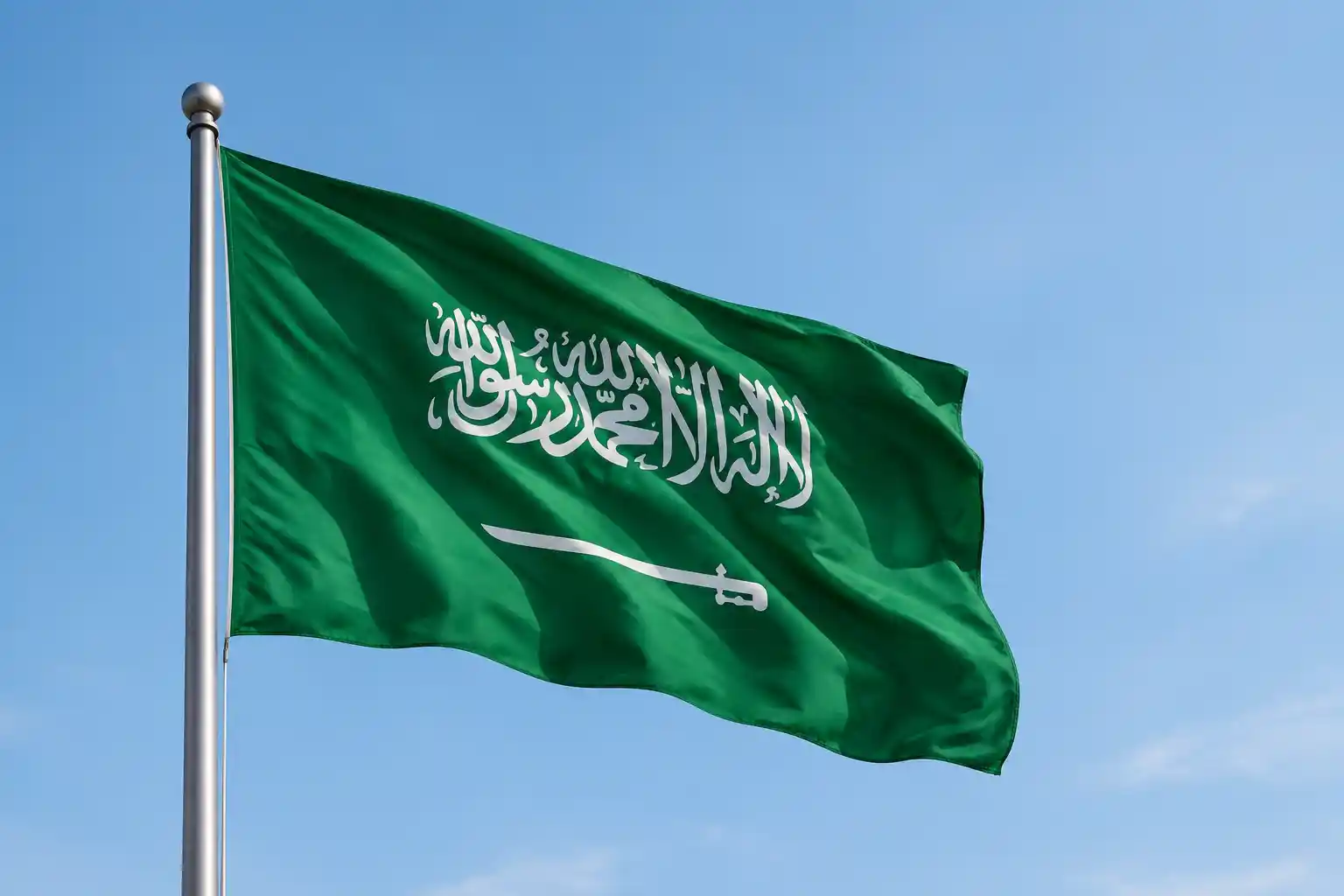
The Saudi national flag features a green background with the Shahada written in white and a white sword underneath.
The Shahada represents the Kingdom’s Islamic foundation, while the sword is associated with strength and justice.
The current form of the Saudi flag was approved by King Abdulaziz on March 11, 1937. This date is now commemorated annually as Saudi Flag Day on March 11.
As Saudi Arabia celebrates its 96th National Day, residents, visitors and businesses should follow these rules when displaying the national flag. Proper handling helps ensure that one of the Kingdom’s most important national symbols is treated with the dignity and respect it deserves.
What the Saudi Flag Law Says
The rules above come from the Law of the Flag, issued by Royal Decree on 4 February 1973. Many expats in Saudi Arabia only hear about it around National Day, but it applies all year, to residents, visitors and businesses alike.
The law also fixes the design. The flag is a green rectangle whose width is two-thirds of its length. The Shahada is written in Thuluth script in the centre, and the white sword under it is three-quarters the length of the phrase. When you buy a flag, a correct one keeps these proportions and the text is printed so it reads properly from the front.
Flying the Saudi Flag Next to Other Flags
Offices, schools and community events often show the Saudi flag alongside the flags of other countries. The law gives the Saudi flag the place of honour:
- With one other flag: the Saudi flag goes on the right of the building as seen from the front.
- With several flags: it goes in the centre when the number is odd, and in the centre-right position when the number is even.
- In halls: it may hang horizontally above the speaker and the audience.
- In processions: it is carried at the centre or on the right, depending on the direction of the march.
On government buildings and public institutions, the law says the flag is raised from sunrise to sunset on weekends and holidays.
Penalty for Disrespecting the Saudi Flag
Anyone who publicly drops, destroys or insults the national flag, the King’s flag or another Saudi emblem, out of hatred or contempt, faces up to one year in prison, a fine of up to SAR 3,000, or both. The same penalty covers the flags and emblems of friendly countries. Saudi media regularly repeat this warning ahead of National Day.
Ordinary mistakes are best avoided too. A flag that slips off a balcony or a car should be picked up straight away, and a worn flag should be taken down. The law says a flag too worn to use should be burned by the party using it, rather than thrown away with rubbish.
Practical Tips for Residents and Businesses
- At home: fix balcony and window flags so they cannot fall to the street, and take them in before they fade in the summer sun.
- On cars: check that small window flags are firmly attached. Flags that come loose on the motorway end up on the road.
- In shops: decorate with green colours and patterns instead of putting your logo or prices on the flag itself, and never use the flag as a trademark.
- At schools and offices: when children make crafts or staff print banners, use the official design without adding slogans or pictures to it.
- After the celebrations: fold flags and store them somewhere clean and dry for the next occasion.
Flag Day and Other National Occasions
King Salman issued a royal order on 1 March 2023 naming 11 March as Saudi Flag Day, so the next one falls on 11 March 2027. The flag is also displayed widely on Founding Day, 22 February, and on National Day, 23 September. Our guide to Founding Day vs National Day explains the difference, and you can see which dates are days off in our list of public holidays in Saudi Arabia. To match the Gregorian and Hijri dates of any occasion, use our Hijri date tool.
Frequently Asked Questions
Can expats fly the Saudi flag at home or on their car?
Yes. Residents of any nationality can display it, as long as they follow the rules: no half-mast, no contact with the ground or water, and no damaged or faded flags.
Why is the Saudi flag never flown at half-mast?
Because it carries the Shahada. The law extends this rule to the King’s flag and to any Saudi flag with the Shahada or a Quranic verse.
What is the fine for insulting the Saudi flag?
Up to SAR 3,000, up to one year in prison, or both, for publicly dropping, destroying or insulting the flag out of hatred or contempt.
Can a business print the Saudi flag on its products?
The flag must not be used as a commercial trademark or carry added logos or slogans. Businesses should use national colours and their own designs instead.
When is Saudi Flag Day?
Every year on 11 March, the date King Abdulaziz approved the flag in 1937.