


Last updated: 13 October 2026
The best health tips for expats in Saudi Arabia are small ones you can keep: walk or exercise for 15 to 30 minutes a day, swap soft drinks for water, add fruit and vegetables to every meal, protect yourself from the heat, and use the check-ups your work insurance already pays for. None of this needs a gym membership or a big budget, and most of it fits around a 10 or 12 hour shift.
Many expats in Saudi Arabia work hard for one reason: the people back home. School fees, a parent’s medicine, a house being built brick by brick. Expats sent SAR 165.5 billion home in 2025, according to SAMA figures reported in February 2026. Behind every one of those transfers is a person whose health keeps the money coming. If you fall ill, the whole family feels it, so looking after yourself is not selfish. It is part of looking after them.
Why Expats in Saudi Arabia Let Their Health Slip
Most expats do not ignore their health on purpose. The routine does it for them. A long shift, a long drive, a shared kitchen, a takeaway at 11 pm, a cold soft drink to get through the afternoon, and no time for a doctor because a day off means a day’s pay.
- Sitting all day. Drivers, office staff and security guards can go a whole shift with very few steps.
- Cheap, heavy food. Fried snacks, white rice and bread with every meal, very little fruit.
- Sugary drinks and energy drinks used as fuel through long hours.
- Heat for outdoor workers, and not drinking enough water indoors either.
- Poor sleep in shared rooms and on rotating shifts.
- Loneliness. Months or years away from family, with worries kept inside.
- Skipping check-ups until something hurts.
The national numbers show how common this is. In the General Authority for Statistics (GASTAT) 2024 survey of people aged 15 and over in the Kingdom, 23.1% were obese and another 45.1% were overweight, and only 10.2% ate the recommended five or more servings of fruit and vegetables a day. GASTAT’s 2025 physical activity survey found that about 4 in 10 adults do not reach 150 minutes of activity a week. These figures cover everyone living in Saudi Arabia, not only expats, but the pattern will look familiar to anyone who has lived in a labour camp or a shared flat.
Get Iqama, visa and job updates on WhatsApp
Follow the Saudi Life Guide channel to get new rules, fees and news as soon as we publish them.
Follow on WhatsAppHealth Tips for Expats in Saudi Arabia: Start With 15 Minutes a Day
You do not need hours. The Ministry of Health (MOH) recommends at least 150 minutes of moderate activity a week for adults, or 75 minutes of hard exercise. That is about 30 minutes, five days a week. If 30 minutes sounds impossible after a shift, start with 15 and build up.
- A brisk walk counts. Walk fast enough that you can talk but not sing. Walk to the grocery instead of driving, or do two laps of the compound after dinner.
- Use the cool hours. Early morning before work, or after sunset. MOH advises doing physical activity early, before the day gets hot.
- Track your steps for free. The Sehhaty app counts steps and is open to residents. MOH’s 2025 Walk 30 League set 30 minutes of walking a day, about 8,000 steps, as its daily target.
- Join a challenge. MOH’s Walk 30 campaign is open to “citizens and residents alike”, and a group from work makes it easier to keep going.
In practice, the walk you do every day beats the gym plan you never start. Pick a fixed time, such as straight after Fajr or straight after you get home, and treat it like a shift you cannot miss.
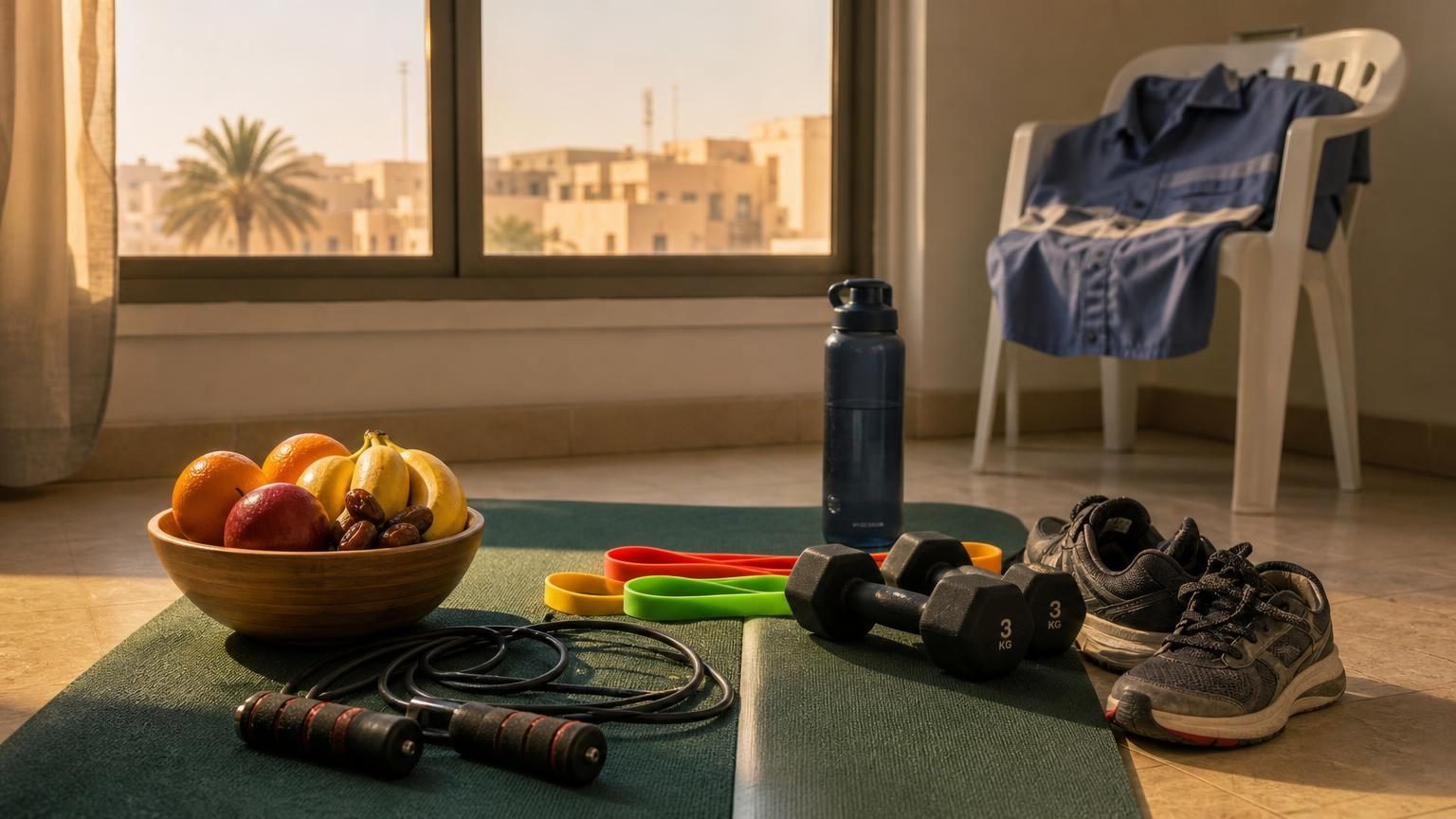
No Gym? A Home Workout Kit for SAR 100 to 200
Gym memberships in Saudi Arabia are not cheap. A year at one big gym chain cost about SAR 3,000 in a September 2026 bank card offer, roughly SAR 250 a month. For many expats that is money better sent home. A small kit from noon or Amazon.sa does most of the same job in your room.
| Item | Typical price (Amazon.sa, 13 Oct 2026) | What it is for |
|---|---|---|
| Skipping rope | SAR 9 to 29 | Cardio in a small space, 5 to 10 minutes is enough |
| Resistance loop bands, set of 5 | SAR 14 to 60 | Legs, shoulders and back, light to heavy |
| Exercise mat, 10 mm | SAR 44 to 49 | Floor exercises on a tiled floor |
| Dumbbells, pair of 3 kg | SAR 59 to 80 | Arms, shoulders and simple strength moves |
| Basic kit total | about SAR 150 to 200 | Rope, bands and mat alone come to about SAR 100 |
Prices change daily and depend on the seller, so compare a few listings and read recent reviews before you buy. Push-up bars (about SAR 22 to 60) are a nice extra, not a must.
Three 15-minute routines
| Routine | What to do | Best for |
|---|---|---|
| Brisk walk | 15 minutes at a fast pace, outside in the cool hours or up and down the corridor or stairs | Beginners, after a long day sitting |
| Cardio in your room | 3 rounds: 1 minute skipping, 1 minute marching on the spot with high knees, 1 minute jumping jacks, 2 minutes slow walking | Burning energy, heart and lungs |
| Strength | 2 to 3 rounds of 10 squats, 10 push-ups (on the knees is fine), 10 band rows, 10 dumbbell shoulder presses, 30 seconds plank | Back and joint strength for physical jobs |
Start easy. If you have a heart condition, high blood pressure, diabetes or joint pain, ask a doctor first. Stop if you feel chest pain, dizziness or shortness of breath that does not settle.
Eat Better on an Expat Budget in Saudi Arabia
Healthy food in Saudi Arabia does not have to be expensive. The World Health Organization (WHO) advises at least 400 g of fruit and vegetables a day, which is about five handfuls, and less than 5 g of salt, just under one teaspoon.
- Add one fruit or vegetable to every meal. A banana with breakfast, cucumber and tomato with lunch, an orange after dinner.
- Cook in groups. If four flatmates take turns cooking dal, chickpeas, beans, eggs or chicken with vegetables, everyone eats better for less.
- Go easy on rice, white bread and fried snacks. Fill half the plate with salad or vegetables first.
- Watch the salt. Since July 2025 the Saudi Food and Drug Authority requires restaurants to show a salt icon on dishes with more than 5 g of salt, so look for it when you order.
- Read the menu numbers. The same SFDA rules show caffeine content and how long it takes to walk or run off each item’s calories. It is a useful reality check before a late-night order.
- Dates are good, but in small amounts. They are healthy and filling, but sweet. A few a day is plenty.
Cut Soft Drinks and Energy Drinks
This is the easiest change with the biggest effect. WHO says free sugars should be under 10% of daily energy, and ideally under 5%, which is about 6 teaspoons a day. Check the label on your can: every 4 g of sugar is about one teaspoon, and many regular soft drinks carry several teaspoons in a single can.
Saudi Arabia is pushing the same way. Since 1 January 2026, ZATCA has taxed sweetened drinks by how much sugar they contain per 100 ml, so the sweetest drinks carry the highest tax. Our guide to the 4-tier excise tax on sweetened beverages explains the bands.
- Carry a water bottle and refill it through the shift.
- Swap, do not just stop: plain laban, tea or coffee with less sugar, or water with lemon.
- Limit energy drinks. SFDA menus now show the adult daily maximum of 400 mg of caffeine. Energy drinks plus several teas and coffees can pass it.
- Count the money. Add up what you spend on soft drinks and energy drinks in a month, then see what it is worth at home with our SAR to PKR converter or SAR to INR converter. For many families, that is a school bill.
Supplements: Only If You Need Them and Can Afford Them
Supplements are not a replacement for food, and nobody should cut the money sent home to buy them. If you can afford them, take them for a reason, not because a video said so.
- Vitamin D: deficiency is common in Saudi Arabia. A 2018 review of 16 Saudi studies found it in 63.5% of adults, even with all the sunshine. Ask a doctor for a blood test before you take it.
- Buy only SFDA-registered products. The SFDA advises checking that the registration number is printed on the container and avoiding unregistered products.
- Avoid “natural” pills from street sellers and social media. SFDA has found hidden medicines in products sold this way, including slimming and so-called herbal tablets.
- Report side effects to the SFDA on 19999.
Respect the Saudi Heat
Heat is a real risk for anyone working outside, and studies of migrant workers in the Gulf link hot working conditions to heart deaths and kidney damage. Shade, water and rest breaks protect your health.
Every summer the Ministry of Human Resources (HRSD) bans outdoor work in direct sun from 12 noon to 3 pm. In 2026 the ban ran from 15 June to 15 September. Employers must also provide drinking water, shade and rest areas. You can report a violation on 19911 or through the ministry app. Our Saudi Arabia weather calendar shows which months are hottest in your city.
| Heat exhaustion | Heat stroke (emergency) | |
|---|---|---|
| Signs | Heavy sweating, cool pale skin, nausea, cramps, weakness, dizziness, headache, weak pulse | Temperature 40 degrees C or higher, hot red skin, strong fast pulse, confusion, hallucinations, fainting |
| What to do | Move to a cool place, loosen clothes, cold compresses on the neck and armpits, give cold water to drink | Call 997 at once, move to a cool place, cool with cold water and compresses, do not give drinks |
| Get help if | Vomiting, symptoms are bad, or they last more than an hour | Always: it is an emergency |
Source: MOH first aid pages on heat exhaustion and heat stroke. MOH also advises drinking water through the day and cutting down on tea and coffee in the heat.
Sleep and Shift Work
Sleep is where the body repairs itself, and it is the first thing long hours steal. Sleep experts advise that most adults need 7 hours or more. MOH warns that too little sleep can lead to weight gain, type 2 diabetes, high blood pressure and mood problems.
- Keep the same sleep time where you can, even on your day off.
- Use an eye mask and earplugs in a shared room. They cost very little and help a lot.
- Put the phone away 30 minutes before sleep. The late-night video call home can happen earlier.
- Avoid energy drinks and strong tea in the last hours before sleep.
Quit Smoking With Help From MOH
Smoking costs you twice: in money that could go home, and in health. MOH says smoking kills up to half of the people who do not quit. The ministry runs quit-smoking clinics, and you can book one through the Sehhaty app or by calling 937. Asking for help works better than trying alone.
Use the Health Check-ups Your Insurance Already Covers
Most expats pay for their health insurance through their job and never use it until there is an emergency. That is a waste. The basic (essential benefits) health insurance policy that private-sector employers must provide includes preventive screening:
- Diabetes test (fasting blood sugar or HbA1c).
- Lipid profile (cholesterol).
- Diet and exercise counselling for adults with heart risk factors or a high BMI.
- Cancer screening such as a colon test, and mammogram and Pap smear for women.
- Adult vaccines, including the flu jab.
A visit to an approved primary care clinic costs at most SAR 25 in copay under the basic policy. Not sure your insurance is active? Use our health insurance check guide with your iqama number, and read healthcare for expats in Saudi Arabia to understand how clinics, hospitals and costs work.
A yearly routine: once a year, ask your insurance clinic for a blood pressure check, a sugar test and a cholesterol test. If anyone in your family back home has diabetes or heart disease, tell the doctor. It changes what they look for.
Free medical advice any time: MOH’s 937 line runs 24 hours a day and has served callers in Urdu and English, among other languages.
Look After Your Mind Too
Living away from family is hard, and many expats carry money worries, family pressure and loneliness without telling anyone. Feeling low is common, and there is help.
- Talk to someone every day, at home or here. A friend from work counts.
- Keep one day a week for something you enjoy: cricket on Friday, a walk on the corniche, cooking for friends.
- MOH’s psychological consultation line, 920033360 is answered by trained mental health professionals.
- The basic insurance policy covers diagnosis and treatment of depression, anxiety and stress.
- In an emergency, call 997 or go to the nearest emergency department.
A Simple Weekly Plan to Start This Week
| Day | Move | Food and habits |
|---|---|---|
| Sunday | 15-minute brisk walk | Fill your water bottle twice at work |
| Monday | 15-minute strength routine | One fruit with breakfast |
| Tuesday | 15-minute brisk walk | No soft drink today |
| Wednesday | 15-minute cardio in your room | Salad or vegetables with lunch |
| Thursday | 20-minute walk | Bed 30 minutes earlier |
| Friday | Rest, or a long relaxed walk | Call home, cook a healthy meal with friends |
| Saturday | 15-minute strength routine | Check your steps in Sehhaty |
After four weeks, move each session up to 20 or 30 minutes. If your shifts are long, our overtime calculator shows whether the extra hours are paid properly, and the cost of living calculator helps you plan a budget that leaves room for good food.
Common Mistakes to Avoid
- Waiting for “free time”. It never comes. Fix a time and a place.
- Starting too hard. An hour of exercise on day one leads to sore legs and giving up by day three.
- Replacing soft drinks with juice cartons. WHO counts the sugar in fruit juice as free sugar too. Water is the swap.
- Buying supplements instead of food. Fruit, vegetables, eggs and pulses come first.
- Ignoring warning signs such as chest pain, constant thirst, swollen feet or headaches because a clinic visit costs a day off. A check-up now costs far less than a hospital stay later.
- Not knowing your insurance. Check your policy and clinic network before you need them.
Frequently Asked Questions
How can expats in Saudi Arabia stay healthy with long working hours?
Expats in Saudi Arabia can stay healthy with long hours by fixing three small habits first: a 15 to 30 minute walk or home workout every day, water instead of soft drinks, and one fruit or vegetable with every meal. Add a yearly check-up through your work insurance. Small daily steps are easier to keep than a big plan.
Does health insurance in Saudi Arabia cover check-ups for expats?
Yes, the basic employee health insurance policy in Saudi Arabia covers preventive screening, including a diabetes test (fasting sugar or HbA1c), a cholesterol (lipid) test and some cancer screening. A visit to an approved primary care clinic costs at most SAR 25 in copay. Ask your insurer which clinics are on your network.
Can expats use the Sehhaty app in Saudi Arabia?
Yes, the Ministry of Health says Sehhaty serves everyone in the Kingdom, including residents with an iqama and their dependants, in Arabic and English. It counts your steps, tracks numbers such as weight and blood pressure, and offers instant medical consultations. MOH says booking needs an Absher account.
Should expats take vitamin D or other supplements in Saudi Arabia?
Take vitamin D or other supplements only after a doctor or a blood test shows you need them, and only if the product is registered with the Saudi Food and Drug Authority (SFDA). Check that the SFDA registration number is printed on the pack. Do not buy pills sold by street sellers or social media pages.
What should I do if a co-worker shows signs of heat stroke?
If a co-worker shows signs of heat stroke, such as a very high temperature, hot red skin, confusion or fainting, call the ambulance on 997 at once. Move them to a cool place and cool them with cold water and cold compresses. The Ministry of Health says not to give drinks to someone with heat stroke.
Where can expats get mental health support in Saudi Arabia?
Expats can call the Ministry of Health psychological consultation line on 920033360, where trained mental health professionals answer calls from anywhere in the Kingdom. The basic health insurance policy also covers diagnosis and treatment of depression, anxiety and stress. In an emergency, call 997 or go to the nearest emergency department.
Key Takeaways
- The most useful health tips for expats in Saudi Arabia are small habits: your family depends on your health as much as on your salary.
- Move 15 to 30 minutes a day: a brisk walk is enough to start.
- A SAR 100 to 200 home kit replaces an expensive gym for most people.
- Swap soft drinks and energy drinks for water.
- Respect the heat: water, shade, and 997 for heat stroke.
- Use the free screening in your work insurance once a year.
This guide is general health information, not medical advice. Rules and figures are from the Ministry of Health, SFDA, HRSD, ZATCA, the Council of Health Insurance, GASTAT and WHO, as read on 13 October 2026. Prices are from Amazon.sa on the same day and change often. If you have a health condition, talk to a doctor before you change your exercise or diet.