


Last updated: 4 November 2026
An Ajeer paper is an Ajeer permit: an electronic document from the Ministry of Human Resources and Social Development (MHRSD) that lets an expat work at another establishment for a set, temporary period without changing sponsor. The two companies sign an Ajeer contract on ajeer.qiwa.sa, the permit is issued for named workers, and the company pays the fee, which depends on the permit length. The worker does not apply and should never pay.
Many expats in Saudi Arabia first hear the word when a supervisor says “your Ajeer paper is ready” before a project at a client site, or when a school offers a teaching job to a wife on a family iqama. This guide explains what the Ajeer paper and the Ajeer contract are, which situations need one, what it costs and who pays, and how to check that your permit is real and still valid.
What Is Ajeer in Saudi Arabia?
Ajeer is an MHRSD programme that organises temporary work in the Saudi labour market. It runs on ajeer.qiwa.sa, inside the Qiwa system. The platform’s own FAQ is clear on two points: Ajeer does not recruit workers, and it exists to document the movement of workers between establishments. It is also linked to Nitaqat, so a company’s Saudization band decides which Ajeer services it can use.
In Saudi Arabia this rule works differently from many home countries. A work iqama ties you to the employer named on your work permit. Article 39 of the Labor Law says a worker may not work for another employer unless the official procedures are followed. Ajeer is that procedure for temporary work. For the longer legal background, read our guide to working for another employer in Saudi Arabia.
Follow Saudi Life Guide for Iqama, visa and job updates
New rules, fees and news as soon as we publish them. Join 86,000+ followers on Facebook.
Ajeer Paper vs Ajeer Contract
| Term | What it is | Who creates it |
|---|---|---|
| Ajeer contract | The agreement between the provider establishment (your employer) and the beneficiary establishment (where you will work), recorded on the Ajeer platform | One company creates it, the other approves it online |
| Ajeer permit (the “Ajeer paper”) | The permit issued under that contract for named workers, for a set period. MHRSD calls it a legal document | Issued on Ajeer after approval and, where a fee applies, after SADAD payment |
| Qiwa employment contract | Your own job contract with your sponsor. It stays in place during the Ajeer permit | Your employer, accepted by you on Qiwa |
So the contract is between companies, and the paper is what proves that you, by name, may work at the other site. Do not confuse either of them with your own job contract on Qiwa. If you have not accepted that one yet, see Qiwa login and how to accept your contract.
Who Needs an Ajeer Permit?
You need an Ajeer paper whenever you work, even for a few weeks, for an establishment that is not your sponsor. The Ajeer platform lists separate services for each case:
| Situation | Ajeer service | Typical example |
|---|---|---|
| Your company sends you to work at a client’s site | Ajeer Contracting (Taqaul) | Cleaning, maintenance, security or IT staff of a contractor working inside a hospital, mall or ministry building |
| Your company lends you to another company for a period | Ajeer Leasing | A technician lent to a sister company for a 3-month project |
| Delivery or app work for a platform through an operating company | Tashaarak | A rider of a logistics company delivering orders for a delivery app |
| Seasonal work during Hajj | Hajj Season | Saudi and expat workers contracted by Hajj service companies |
| A wife, husband or mahram on a family iqama taking a job | Ajeer Companions | A teacher at a private school or a nurse at a clinic. HRSD lists this permit as free |
| You are in a labour dispute with your employer | Labor Dispute permit | A temporary permit to work elsewhere so your income continues until the case ends |
You do not need Ajeer to work for your own sponsor at its own premises. Ajeer also does not cover working for your own customers. Freelancing, cash side jobs and home tutoring for private families are not Ajeer cases. For what is legal there, see self-employment in Saudi Arabia and part time jobs in Saudi Arabia.
How an Ajeer Contract Is Made, Step by Step
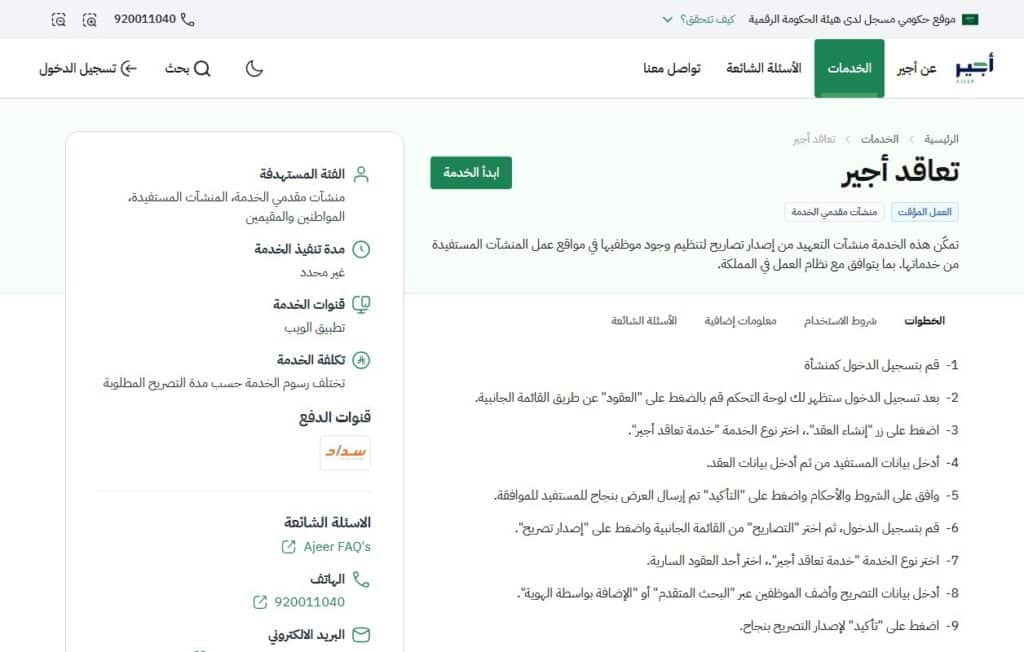
These are the steps in the MHRSD user guide for the Ajeer Contracting service. You will not do them yourself, but knowing them helps you ask HR the right questions.
- The provider establishment logs in to Ajeer with its Qiwa account and opens Contracts.
- It clicks Create Contract, chooses the service (for example Ajeer Contracting Service) and enters the beneficiary establishment’s details and the contract data.
- It agrees to the terms and confirms. The offer goes to the beneficiary for approval.
- The beneficiary logs in, opens Permits, clicks Issue Permit and selects the active contract.
- It enters the permit details and adds the workers by iqama number, then confirms. The permit is issued.
- For paid services such as Ajeer Leasing and the labor dispute permit, an invoice is issued and paid through SADAD before the permit becomes final.
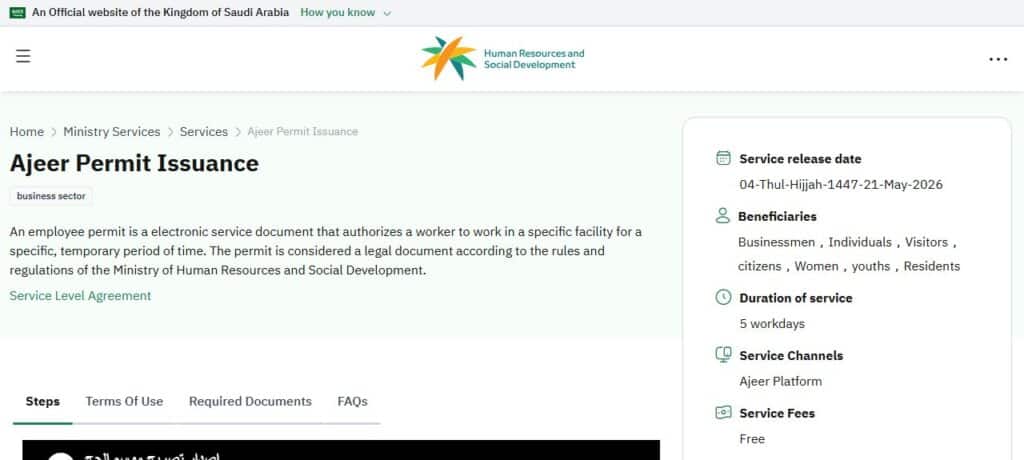
HRSD gives a service time of 5 working days for the permit issuance service. In practice the delay is usually the other company’s approval, so if your start date is close, ask both HR teams whether the contract is still waiting for approval or payment.
Ajeer Fees: How Much and Who Pays
The Ajeer service pages for contracting, leasing and labour disputes say the fee “varies by the requested permit duration” and is paid through SADAD. Ajel reported the rate in 2020 as SAR 160 for each month on the permit, and Saudi Gazette gave the same SAR 160 figure per worker in 2018. The platform does not publish a fee table today, so the exact amount is the one on the invoice inside Ajeer.
| Permit | Fee | Paid by |
|---|---|---|
| Ajeer Contracting, Ajeer Leasing, Labor Dispute | Depends on the permit length; reported as SAR 160 per month | The establishment, through SADAD |
| Ajeer Companions (dependents in listed sectors) | Free on the HRSD service page | No Ajeer fee |
| Your normal work permit and iqama | Separate yearly charges | Your employer (Labor Law Article 40) |
Article 40 of the Labor Law says the employer bears the fees for the work permit and its renewal. If a company or an agent asks you to pay for your Ajeer paper, ask for the SADAD invoice in the company’s name, or walk away. For the yearly costs that sit on top of Ajeer, see Saudi Arabia iqama fees.
How to Check Your Ajeer Permit Status
- Ask for the issued permit. Check your name, iqama number, the beneficiary establishment, your job title and the start and end dates. A screenshot of a “pending” contract is not a permit.
- Sign in to Ajeer. HRSD says the platform is opened with a Qiwa account or the National Access portal (Nafath). Individuals are one of the three user types on ajeer.qiwa.sa.
- Check your iqama and work permit first. An expired iqama or work permit is the most common reason a permit cannot be issued. Use our iqama expiry check.
- Ask Ajeer support on 920011040 or support@ajeer.com.sa if the permit is missing, has wrong details or the dates have passed.
| What you see | What it means | What to do |
|---|---|---|
| Contract created, not approved | The other establishment has not accepted the offer | Do not start work yet; ask its HR to approve |
| Approved, invoice unpaid | The SADAD invoice is waiting for payment | Ask the company to pay; the permit is not final until then |
| Permit issued, dates current | You may work at that establishment for that period | Keep a copy on your phone for site checks |
| End date passed | The permit has expired | Stop work there until a new permit or renewal is issued |
Ajeer, Qiwa Transfer or Premium Residency?
Ajeer is for temporary work while your sponsor stays the same. If the new job is permanent, a transfer of services on Qiwa is the right route. If you want to work without an employer sponsor, look at Saudi Premium Residency, which now comes with its own Qiwa work permit.
| Route | Sponsor changes? | Best for |
|---|---|---|
| Ajeer permit | No | Temporary work at another establishment, with an end date |
| Qiwa transfer of services | Yes | Moving to a new employer for good |
| Premium Residency work permit | No employer sponsor | Self-sponsored residents working in the private sector |
What Happens If You Work Without an Ajeer Paper
Inspectors check the permit when they find workers at a site that is not their sponsor’s. Working for another employer or for your own account without the official procedure can mean fines of up to SAR 50,000, up to 6 months in jail and deportation for the worker. An employer who lets its worker work for others can face a fine of up to SAR 100,000, up to 6 months in jail and a recruitment ban. Our full guide on working for another employer covers the penalties in detail.
Based on real expat experience in KSA, the safe habit is simple: no paper, no start. Ask “Is my Ajeer permit issued, and until when?” before the first day at any new site.
Ajeer Tips for Workers
- Keep your pay records. Your salary still comes from your own employer during the Ajeer period. If it is late, see what to do when your salary is delayed.
- Count your overtime. Longer shifts at a client site are still overtime under your contract. Work it out with our overtime calculator.
- Your service period continues. Ajeer time counts with your own employer, so it adds to your end of service benefit.
- Dependents: wives and husbands on a family iqama can work in permitted sectors through the free companions permit. See jobs in Saudi Arabia for females.
Frequently Asked Questions
What is an Ajeer paper in Saudi Arabia?
Ajeer paper is the everyday name for an Ajeer permit. The Ministry of Human Resources describes it as an electronic document that authorises a worker to work at a specific establishment for a specific, temporary period. It is issued on the Ajeer platform on Qiwa and is a legal document under the ministry’s rules. Without it, working at another company’s site counts as working for someone other than your employer.
What is the difference between an Ajeer contract and an Ajeer permit?
The Ajeer contract is the agreement between two establishments on the Ajeer platform: the company that employs you (the provider) and the company where you will work (the beneficiary). The permit is issued for named workers under that contract once the other side approves it. One contract can cover several workers, but each worker needs to be on the permit.
Who pays the Ajeer fee, the worker or the company?
The company. Ajeer service pages say the fee depends on the permit length and is paid by the establishment through SADAD. Saudi press has reported it as SAR 160 for each month on the permit. Article 40 of the Labor Law also puts work permit fees on the employer. If anyone asks you, the worker, to pay for your Ajeer paper, treat it as a warning sign.
How can I check my Ajeer status?
Ask the company for a copy of the issued permit and check that your name, iqama number, the other establishment and the dates are correct. You can also sign in to ajeer.qiwa.sa with your Qiwa account or the National Access portal to see what is registered to you. If something is wrong or missing, call Ajeer on 920011040 or email support@ajeer.com.sa.
Can I apply for an Ajeer permit myself?
No. Ajeer is run between establishments. Your employer creates the contract and the company that wants your services approves it, or the other way round for some services. The worker is involved only where the platform asks for approval, for example in the labor dispute permit. Ajeer does not recruit workers and is not a way to work for your own clients.
How long is an Ajeer permit valid?
The permit runs for the period set in the contract and ends when that contract ends. The fee is charged by that period, so short permits cost less. In 2020 Saudi press reported a maximum of 12 months per permit; the platform now shows the allowed length when the company creates the contract. Check the end date on your permit and ask for a renewal before it lapses.
Sources: MHRSD Ajeer Permit Issuance service page (modified 25 August 2026) and Ajeer Contracting service provider user guide (August 2026); ajeer.qiwa.sa home page, FAQ and the Ajeer Contracting, Ajeer Leasing and Labor Dispute service pages (updated 26 July 2026), read 4 November 2026; Saudi Labor Law Articles 39 and 40; Ajeer fee as reported by Saudi Gazette (July 2018) and Ajel (November 2020).