


Last updated: 21 October 2026
Part time jobs in Saudi Arabia are legal, but who can take one depends on your residency status. Saudi nationals can work part time on a written contract or by the hour through the Marn flexible work platform. Expats on a work iqama can work only for the employer named on their work permit. A second, part time job is legal only through an Ajeer temporary work permit that the other establishment applies for, or through a transfer on Qiwa. Permission from your sponsor alone does not make it legal.
Many expats in Saudi Arabia ask this question when they want extra income, or when a spouse on a family iqama wants to work a few hours a week. The answer is different for a Saudi, a worker, a dependent, a student and a Premium Residency holder. This guide explains the Labor Law rules, the legal routes for each status, what part time work pays, the penalties, and where to find openings in Riyadh and Jeddah.
Is Part Time Job Allowed in Saudi Arabia?
Yes. Part time work is recognised in Part 7 of the Saudi Labor Law (Articles 119 and 120). Article 120 leaves the detailed rules to the Minister of Human Resources, and Article 119 says that full time staff whose hours are cut for a short time do not become part time workers. Some websites quote Article 76 for part time work. That article deals with compensation when the notice period is not respected, and it says nothing about part time jobs.
The detailed rules sit in Article 27 of the Implementing Regulations. Ministerial Decision 146481 (2020) sets the core test, and later amendments that took effect with the Labor Law changes of 19 February 2025 kept it:
- The part time contract must be written and fixed term.
- Daily working hours must be less than half of the establishment’s usual daily hours, whether you work every day or only on some days.
- Part time workers keep their Labor Law rights on leave, weekly rest days, official holidays and overtime. Use the overtime calculator to check extra hours pay.
- A Saudi part timer counts in the company’s Nitaqat only when registered with GOSI as a part time worker.
The legal test is half the establishment’s daily hours, not a fixed weekly number. If an employer offers a “part time” contract with close to full time hours, ask how it is registered before you sign.
Follow Saudi Life Guide for Iqama, visa and job updates
New rules, fees and news as soon as we publish them. Join 83,500+ followers on Facebook.
Who Can Work Part Time in Saudi Arabia?
Here is who can take part time jobs in Saudi Arabia, by residency status. The sections below explain each route.
| Your status | Part time allowed? | How it works |
|---|---|---|
| Saudi national | Yes | A written part time contract with an employer, or hourly flexible work through Marn. Self employed activities through the freelance.sa document. |
| Expat on a work iqama | Only with a permit | An Ajeer temporary work permit applied for by the other establishment, or a transfer of services on Qiwa. Sponsor permission alone is not enough. |
| Dependent (family iqama) | Only with a permit | An Ajeer companion permit at an establishment in a listed sector, such as education or health. No private cash work. |
| Student visa holder | Announced, confirm first | Long-term student visa holders were told in 2024 they may work part time. Confirm with your university and get a work permit before starting. |
| Premium Residency holder | Yes, with a permit | A Qiwa work permit for Premium Residency holders, with a SAR 100 fee (reported June 2026). |
| Visitor (visit, tourist or Umrah visa) | No | A visit visa does not allow any paid work, full time or part time. |
Part Time Work for Expats on a Work Iqama
Article 38 of the Labor Law says a worker may only do the occupation written on the work permit. Article 39 says a worker may not work for another employer, an employer may not let its worker work for others, and no one may work “for his own account”, unless the official procedures are followed. The Ministry of Interior handles detection and deportation of violators.
This is why the advice “just ask your sponsor” is wrong. A message from your manager saying it is fine does not create a permit, and it will not protect you or the employer during an inspection. Our guide to working for another employer in Saudi Arabia explains how inspections and penalties work. There are two lawful routes.
Route 1: An Ajeer temporary work permit
Ajeer is the platform of the Ministry of Human Resources and Social Development (MHRSD) on Qiwa that documents the movement of workers between establishments. Ajeer does not recruit people. The establishment applies, not the worker. Its services include Taqaul (an outsourcing company’s staff working at a client site), seasonal Hajj contracting, and Tashareek (delivery and logistics apps using an operating company’s workers).
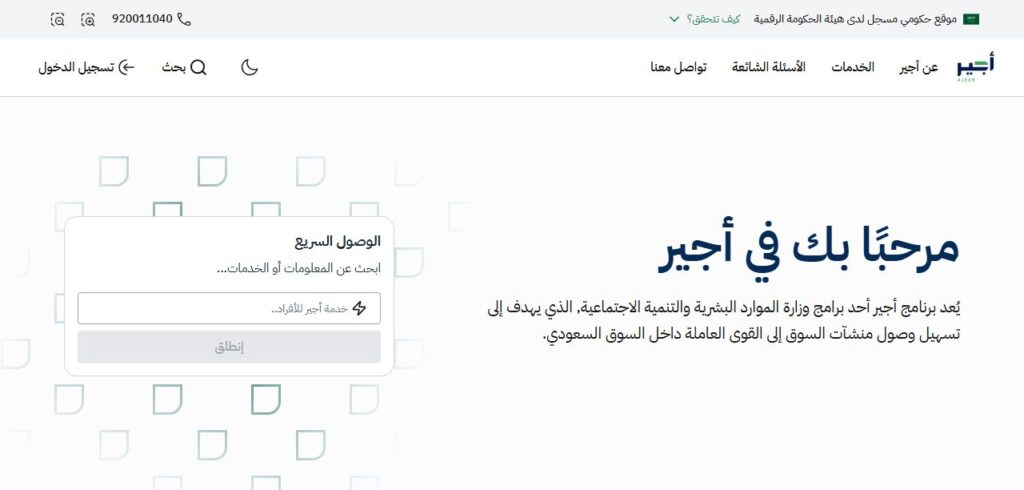
According to the ministry’s Ajeer temporary work permit service page:
- The permit covers named groups, including residents and companions of expats.
- The receiving establishment must be in the Low Green Nitaqat band or above. You can check a company’s Nitaqat colour before you agree.
- The establishment must work in one of the listed sectors, such as education and health, and hold any professional accreditation the job needs.
- The service is free and takes 5 working days.
Route 2: A transfer of services on Qiwa
If you want to move to the new job for good, the answer is a transfer of services. The new employer sends the request on Qiwa, you accept it in your individual account, and a new work permit is issued under the new employer. You can follow the request with our guide to checking your sponsor transfer status. A transfer replaces your current job; it does not let you keep two employers.
Can Dependents Work Part Time in Saudi Arabia?
Yes, but not on their own and not for cash. A wife, husband or mahram on a family iqama can work at a specific establishment through the Ajeer temporary permit for companions. The conditions on the ministry page are:
- The companion is 18 or over, and both the companion and the main iqama holder have valid iqamas.
- The employer is in the Low Green Nitaqat band or above, in a listed sector such as education or health.
- The permit is free and is issued in about 5 working days.
In October 2025, the Cabinet gave the Minister of Human Resources the power to decide which activities and professions dependents may work in, and to set dependent work permit fees at the same level as fees for private sector expat workers (reported by DLA Piper). No list of professions or start date had been published by October 2026. If fees are added, they are likely to follow the work permit fee rules.
Private tutoring from home, paid in cash, is the most common mistake. Without a permit it counts as working for your own account, even if the family that pays you is happy with it. A dependent who wants to teach should look for a school or training centre that will apply for the Ajeer companion permit. For more ideas, see our guide to jobs in Saudi Arabia for females.
Can Students Work Part Time in Saudi Arabia?
In March 2024, the head of Saudi Arabia’s education visa initiative was reported as saying that holders of long-term student visas may take part time jobs and invite family members. No official MHRSD or Study in Saudi text that sets the allowed hours or the permit process had been published by October 2026.
So the safe rule for students is simple. Before you accept any job, ask your university’s student affairs office in writing, and make sure a work permit is issued in your name. Do not rely on an hour limit you see on social media. If you are still choosing where to study, our guide to KSA scholarships for international students covers the Study in Saudi platform.
Premium Residency Holders
Saudi Premium Residency is the only self sponsored route for expats. Holders do not need a sponsor and can change jobs. Since June 2026, holders who work in the private sector also need a dedicated work permit through Qiwa, with a fee of SAR 100 (reported by EY and the Saudi press). Check Qiwa before you start a part time job on Premium Residency.
Flexible Work (Marn) and Freelance Permits: For Saudis Only
Two official programmes are often described as “part time” options, but both are open only to Saudi citizens.
Marn hourly flexible work
Flexible work means hourly work for one or more employers. According to the MHRSD Marn service page:
- It is for Saudi nationals only, registered through an establishment or a personal profile verified through Absher.
- The limits are 12 hours a day and 160 hours a month per person, across one or more establishments.
- Pay is hourly, with no paid leave, no end of service award and no overtime.
- GOSI bills the pension and occupational hazards contributions once a worker completes 8 hours with an establishment.
- The service is free. Older figures from 2020, such as 95 hours a month, no longer apply.
The freelance.sa document
The freelance work document from MHRSD lets Saudi men and women work for themselves in listed activities such as driving, delivery, crafts, food carts, accounting and tourist guiding. There is no “freelance visa” or “flexible work visa” for expats. Anyone who offers to sell you one is selling something that does not exist.
The same applies to Jadarat, the national employment platform run by the Human Resources Development Fund (HRDF). It lists jobs for Saudi nationals only.
Delivery App Jobs: Not Open to Expats as Self Employed
Driving for Jahez, HungerStation, Keeta and similar apps is often suggested as an easy part time job. For expats, it is not. Under rules from the Transport General Authority (TGA) that started in April 2024, non-Saudis are barred from self employment in app delivery. Non-Saudi riders must work through a licensed light transport company, wear its uniform, and the company must use face verification. Self employment on delivery apps is still open to Saudis.
Penalties for Working Part Time Without a Permit
The Ministry of Interior has announced that an expat who works for his own account faces a fine of up to SAR 50,000, up to 6 months in jail and deportation. An employer who lets his worker work for others faces a fine of up to SAR 100,000, up to 6 months in jail and a ban on recruitment of up to 5 years. The full breakdown is in our guide to working for another employer.
Based on real expat experience in KSA, most cases start small: a weekend job at a friend’s shop, a few tutoring hours, or delivery shifts on someone else’s account. The risk is the same as for a full time job. Part time jobs in Saudi Arabia are only safe when the paperwork matches the work.
Part Time Jobs in Riyadh and Jeddah
Part time jobs in Riyadh and part time jobs in Jeddah are searched far more than any other city. Most part time jobs in Saudi Arabia are listed in these two cities, and openings appear in the same places:
- Job boards: Sabbar has the largest number of part time listings, including roles in retail, cafes, offices and events. Many listings are open to Saudis only, so read the requirements first.
- LinkedIn and company career pages: larger retailers, restaurant groups, hotels and training centres post part time and shift roles there.
- Seasonal events: events such as Riyadh Season need extra staff in hospitality, retail and events. These roles are hired by operators and their contractors, and the same permit rules apply to expats.
For an expat, the question to ask a Riyadh or Jeddah employer is always the same: “How will you register me: Ajeer, a transfer, or not at all?” If the answer is “not at all”, the job is not legal for you, whatever the pay.
How Much Do Part Time Jobs in Saudi Arabia Pay?
There is no general statutory minimum wage in Saudi Arabia, and part time pay is set by your contract. The only fixed figures are Nitaqat counting rules for Saudis: a Saudi on SAR 4,000 a month counts as one full employee, and a Saudi on SAR 3,000 to 3,999 counts as half (Al Tamimi, September 2026). A royal order of 25 October 2026 raises the full-count figure to SAR 5,000 six months after the measure starts, then to SAR 6,000 a year after that. See our guide to the minimum salary in Saudi Arabia for details.
Listings in Sabbar’s part time section in October 2026 included an administrative assistant in Riyadh at SAR 1,500 to 6,000 a month, a branch supervisor at a tea chain at SAR 3,000 to 5,000 a month, and a sales role at SAR 6,000 to 9,000 a month. These are single listings, not averages. For typical full time pay by job and city, use our Saudi Arabia salary guide 2026.
How to Apply for a Part Time Job in Saudi Arabia Safely
- Check your status in the table above. If you are an expat, accept only an offer that comes with an Ajeer permit or a Qiwa transfer.
- Ask for a written, fixed term contract that states your daily hours, pay and days off.
- After you start, check that the job appears in your Qiwa account and, for Saudis, in your GOSI record. Your GOSI salary certificate shows the wage your employer registered.
- Never pay anyone who offers part time jobs in Saudi Arabia together with a “freelance visa”, a “flexible visa” or a “part time iqama”. These do not exist for expats.
- Prepare a short CV that states your availability, such as evening shifts or weekends. Our free CV maker builds one in a few minutes.
- Apply through Sabbar, LinkedIn and company career pages, and use the tips in 10 ways to find a job in Saudi Arabia.
Frequently Asked Questions
Is part time job allowed in Saudi Arabia for expats?
Yes, but only through a lawful route. An expat on a work iqama may work only for the employer named on the work permit. Part time work at another company is legal when that company gets an Ajeer temporary work permit for you, or when your services are transferred on Qiwa. Permission from your sponsor alone does not make it legal, and cash side jobs can lead to fines and deportation.
Can my wife on a dependent iqama work part time in Saudi Arabia?
Yes, at a specific establishment, through the Ajeer temporary work permit for companions. She must be 18 or over, both of you need valid iqamas, and the employer must be in the Low Green Nitaqat band or above and in a listed sector such as education or health. The permit is free. Private tutoring for cash without a permit is not allowed.
Can students work part time in Saudi Arabia?
A March 2024 report quoted the head of the education visa initiative saying long-term student visa holders may take part time jobs. No official text sets the hours or the permit process yet. Before you accept any job, ask your university’s student affairs office and make sure a work permit is issued for you. Do not rely on an hour limit you read online.
What is the minimum wage for part time jobs in Saudi Arabia?
There is no general statutory minimum wage in Saudi Arabia. Pay for part time work is set in your written contract. For Saudis, the Nitaqat rules matter: a Saudi earning SAR 4,000 a month counts as one full employee, and SAR 3,000 to 3,999 counts as half. A royal order of 25 October 2026 raises the full-count figure to SAR 5,000, then to SAR 6,000 a year later. Saudis on Marn are paid by the hour, with no paid leave and no end of service award.
Do part time workers need GOSI registration in Saudi Arabia?
A Saudi part timer counts in the company’s Nitaqat only when registered with GOSI as part time, so most employers register them. Under Marn flexible work, GOSI bills the pension and occupational hazards contributions once a worker completes 8 hours with an establishment. You can check what your employer registered through your GOSI account or your GOSI salary certificate.
Sources: MHRSD Labor Law (Part 7, Articles 38, 39, 119 and 120); Ministerial Decision 146481 on Implementing Regulation Article 27; MHRSD Marn and Ajeer temporary work permit service pages; ajeer.qiwa.sa; freelance.sa; HRDF Jadarat; TGA delivery rules (Gulf News, 2024); Al Tamimi Saudisation overview (September 2026); EY on the Premium Residency work permit (2026); DLA Piper on dependents’ work permits (October 2025); Sabbar listings, October 2026.