


Last updated: 1 November 2026
To check your iqama expiry date, open Absher and go to My Services, then My Iqama. Without an Absher account, use the MOL (HRSD) inquiry at hrsd.gov.sa: enter your iqama, border or passport number and date of birth, confirm the OTP, and the expiry date appears. Employers see every worker’s iqama expiry in Muqeem and Qiwa. Checking takes a minute, and missing the date can freeze your bank card, block your exit and bring a late fine.
Useful tool: Absher showing a Hijri date? Convert it instantly with our Hijri to Gregorian converter.
Don’t have Absher yet? Follow our step-by-step guide to Absher registration, including the 846 kiosks and banks where you can activate your account.
The good news: checking it takes under a minute, and you have several official routes, including ones that work even when Absher will not let you in. After years of living in the Kingdom, I have watched friends get caught out not because checking is hard, but because they checked the wrong thing or trusted a screenshot that was three weeks old. This guide fixes both problems.
We will cover the fastest way to check your iqama expiry date in 2026, the backup methods when Absher is down, and the part most guides skip: what you actually need to verify beyond the expiry date so you are never blindsided at the airport. If you are newer to the system generally, our complete iqama guide for expats covers how residency works end to end.
Quick Answer: The Fastest Way to Check Your Iqama Expiry Date
If you already use Absher, open the app, go to My Services then My Iqama (or Resident ID), and your expiry date appears instantly in both Hijri and Gregorian.
No Absher account? Use the MHRSD (formerly MOL) inquiry at hrsd.gov.sa: enter your iqama, border or passport number and your date of birth, confirm the OTP sent to your registered mobile, and your iqama expiry date appears. No Absher login is needed.
Everything below explains when to use which method, and what to do with the result.
Follow Saudi Life Guide for Iqama, visa and job updates
New rules, fees and news as soon as we publish them. Join 95,500+ followers on Facebook.
Why Your Iqama Expiry Date Matters More Than You Think
Your iqama is your legal identity in Saudi Arabia. It is tied to your salary, your SIM card, your bank account, your children’s school enrolment, and your right to remain in the Kingdom. When it lapses, those threads start snapping one by one, usually quietly, until you need one of them urgently.
Here is what an expired iqama actually disrupts:
- Fines. A lapsed iqama typically triggers a financial penalty that escalates for repeat lapses. Amounts change, so confirm the current figure on our iqama renewal fees guide before you rely on a number you read anywhere.
- Travel is locked. You cannot exit or re-enter Saudi Arabia on an expired iqama. If you are already abroad when it lapses, you may be stuck until it is renewed.
- Banking freezes. Banks routinely restrict accounts linked to an expired residence permit.
- Services stop. Mobile lines, health insurance, and government portals can all reject you.
- Your employer is exposed too. Companies face their own penalties for keeping staff on lapsed permits, which is why renewal is legally the employer’s cost.
None of this arrives with a warning letter. That is exactly why a 30-second check, done regularly, is the cheapest insurance you will ever buy.
Method 1: Check via Absher (Best for Residents)
Absher is the Ministry of Interior’s main platform and the most complete option if you have an account.
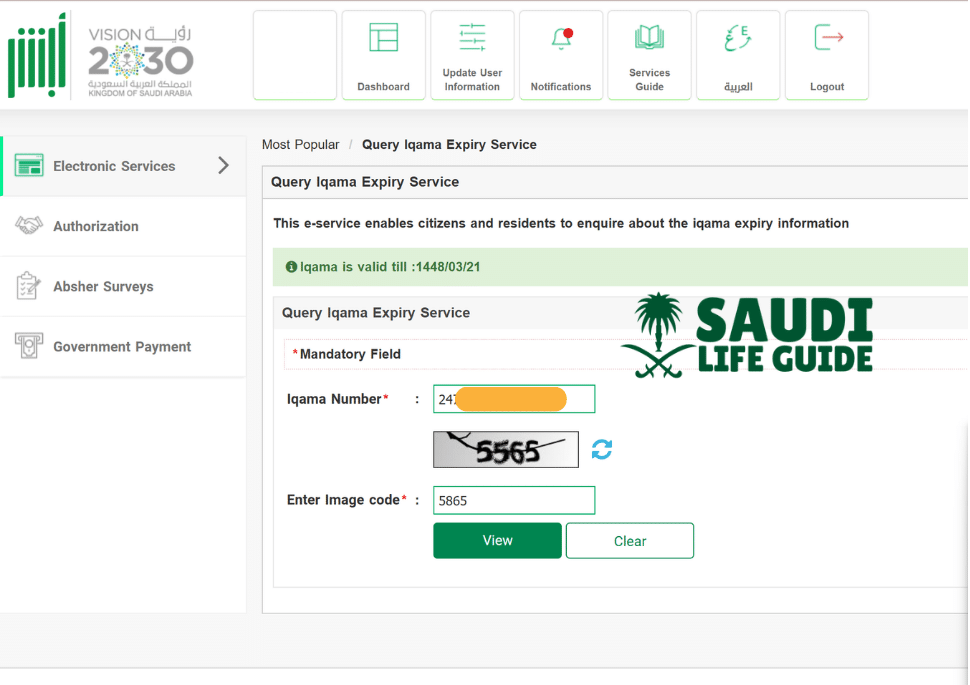
- Open the Absher app or go to absher.sa and log in.
- Enter the OTP sent to your registered mobile number.
- Go to My Services, then Iqama / Resident ID services.
- Select the iqama expiry inquiry and enter your iqama number if prompted.
- Your expiry date appears in both Hijri and Gregorian calendars.
From experience: the single most common reason people say they cannot use Absher is an unregistered or changed mobile number, not a real account problem. If your OTP never arrives, that is your fix-it list, and the methods below will cover you in the meantime.
While you are in there, other Absher digital services cover a good deal more than expiry checks.
Method 2: Iqama Expiry Check Without Login (No Absher Account)
Plenty of residents cannot get into Absher: new arrivals, anyone who changed their SIM, or people who simply never registered. The MHRSD inquiry below works without an Absher account.
How to check iqama expiry without login on MHRSD (hrsd.gov.sa):
- Open the official MHRSD website (the former MOL portal) and switch the language to English in the top corner.
- Open the iqama / work-permit inquiry and enter your iqama, border or passport number.
- Select your date of birth (Hijri or Gregorian) and type the image code.
- Enter the OTP sent to the mobile number registered to your iqama.
- Your iqama expiry date and work-permit status are shown on the next screen.
Muqeem visa validity (vv.muqeem.sa): for visas, not the iqama itself. After a one-time registration (iqama number and date of birth, then an SMS code and email activation), you can log in and check whether your exit re-entry or visit visa is valid and when it expires. It is handy before travel, but it is not a reliable way to read the iqama’s own expiry date, so use Absher or MHRSD for that. If neither works for you, your employer can read your expiry date in Muqeem (Method 3).
Safety note: only ever check on official
.sagovernment sites. Random “iqama check” websites that ask for extra personal details are best avoided, since they can show outdated results or harvest your data.
Method 3: For Employers (Muqeem & Qiwa)
If you run a company or handle HR, Muqeem gives you a company-wide view. Log in with employer credentials, open Reports then Active Residents, and read the iqama expiry column for every worker, alongside exit and re-entry and final-exit status.
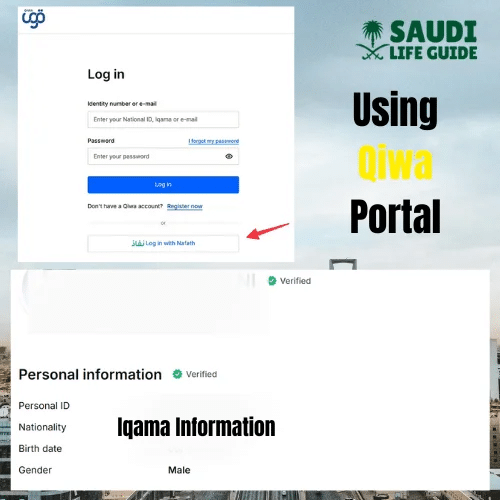
But Muqeem alone is not the full picture anymore. A clean Muqeem record can still hide a work-permit problem on Qiwa (qiwa.sa). In practice, one of the most common renewal delays for HR teams starts exactly here: the residency side looks fine in Muqeem, but the work permit on Qiwa is flagged. Check both before any deadline.
The Part Most Guides Skip: The Expiry Date Alone Isn’t Enough
Here is the mistake that catches even experienced expats. You check your iqama expiry date, see a comfortable date months away, and relax. Then you hit a wall at renewal, transfer, or the airport because a different linked record was the real problem.
In Saudi Arabia, your legal standing runs across a chain of records, and any one of them can block you:
- Iqama (residency). Is the date valid? Check on Absher or MHRSD (your employer can also see it in Muqeem).
- Work permit. Is it active on Qiwa? It can expire on a different date than your iqama.
- Exit and re-entry status. Is your travel permit valid for your actual return date? Check your exit re-entry visa validity separately, because it runs on its own date and the two rarely align.
- Your employer’s Nitaqat band. A company in the Red category cannot process your renewal at all, regardless of your own dates or whether the fee has been paid. Check your iqama color status if renewals at your company have been slow.
- Passport validity. An expiring passport can block iqama renewal entirely.
- Fines or huroob flags. An absconding (huroob) report changes everything. If you suspect one, read our huroob status check guide.
Before you travel, renew, or change jobs, check the whole chain rather than the one date. That five-minute habit is what separates a smooth renewal from a panicked one.
What Changed in 2026 (Read This Before You Rely on Old Advice)
A lot of “how to check your iqama” content still describes a Saudi Arabia that no longer exists. Two changes matter for you directly.
1. Kafala has been replaced by a contract-based system. Since 14 March 2021, under HRSD’s Labour Reform Initiative, Saudi Arabia has replaced the old employer-tied sponsorship model with a contract-based system managed digitally through Qiwa. In practice this means eligible private-sector workers can change employers and handle their own exit and re-entry without the sponsor’s approval, once contract and notice-period conditions are met. Your employer still holds and renews your iqama and work permit, and domestic workers follow separate rules, so verify your own eligibility on qiwa.sa or hrsd.gov.sa. If your job security once felt tied to whether your kafeel would release you, that calculation has changed.
2. The 5-year Resident ID card is not the same as your residency validity. Saudi Arabia now issues a physical Resident ID card valid for five years, but that card is just plastic. Your underlying residency, meaning your iqama status, still expires and must be renewed annually. Seeing 2029 printed on the card fools people every year. The card stays in your wallet; the digital permit behind it is what you are checking here. If the card itself goes missing, see what to do about a lost iqama.
Iqama Renewal: Timing, Flexibility, and Who Pays
Checking is step one; renewing on time is step two. A few current realities worth knowing:
- Renew before it expires. The Ministry of Interior expects renewal ahead of the expiry date, so do not run it to the wire.
- Flexible renewal periods exist. Depending on your contract, renewal can be issued for 3, 6, 9, or 12 months, so you are not always locked into a full year.
- Some dependents are exempt. Children under 18 are generally exempt from the renewal fee.
- Renewal is your employer’s legal cost. Under Saudi labour law, the employer bears iqama and work-permit renewal fees. If anyone asks you to pay, that is a red flag.
For the exact 2026 figures, covering single workers, dependents, and work-permit costs by Saudization category, see our regularly updated Saudi Arabia iqama fees guide. Keeping the numbers in one place is deliberate, because labour fees shift and you want the current figure rather than a stale screenshot.
Troubleshooting: When the Check Doesn’t Work
“Data not found” or number rejected. Re-check the iqama number and date of birth, and try switching between Hijri and Gregorian. Brand-new iqamas can take 24 to 72 hours to appear, so wait and retry, then contact your employer if it persists.
The expiry date looks wrong. A pending renewal may not have synced yet, or your employer made a change. Cross-check against a second platform, Absher against MHRSD, and confirm with HR.
Access denied or captcha keeps failing. Refresh the captcha, remove any spaces when typing numbers, and try during off-peak hours, early morning or late evening KSA time, when portals are less loaded.
Real Expat Tips That Actually Save You
- Check monthly, and always before travel, renewal, a bank update, or a job change. These are the exact moments a hidden lapse surfaces.
- Never trust an old screenshot. Records change, and a two-week-old image has cost people re-entry.
- Diarise 90 days out. Set a reminder three months before expiry to start gathering documents, and confirm your passport has enough validity to support renewal.
- Match your profession to your contract. With the new skill-based work-permit framework, a mismatch between your registered profession (mehna) and your actual role is an active enforcement risk, and worth checking while you are in there.
If your renewal is not moving
Frequently Asked Questions
Can I check my iqama expiry date without Absher?
Yes. Use the MHRSD (formerly MOL) inquiry at hrsd.gov.sa: enter your iqama number and date of birth, then the OTP sent to your registered mobile. No Absher account is needed. The Muqeem portal at vv.muqeem.sa checks visa validity, not the iqama expiry itself.
Is my iqama expiry date the same as my work-permit expiry?
Not necessarily. Your iqama (residency) and your work permit can carry different validity dates. Check the work permit separately on Qiwa, especially before a renewal or job transfer.
Does the 5-year Resident ID card mean my residency lasts 5 years?
No. The physical card is valid for five years, but your residency status still expires and must be renewed annually. Always check the underlying status rather than the card date.
Can I still change jobs or travel without my sponsor’s permission in 2026?
Following the abolition of the kafala system, eligible private-sector workers can change employers and manage exit and re-entry without sponsor consent, once contract and notice-period conditions are met. Rules are phased and some categories differ, so confirm your eligibility on Qiwa or HRSD.
What happens if my iqama expires while I’m outside Saudi Arabia?
You generally cannot re-enter until it’s renewed. If you’re travelling near your expiry date, verify both your iqama and your re-entry validity before you leave.
2413467487
Iqama
Iqama check ✅